AEO vs SEO
AEO vs SEO vs GEO: What’s the Difference?
AEO, SEO and GEO get sold as three separate jobs. They aren't. This guide compares them side by side: what each one optimizes for, where they really differ, what Google and Microsoft say about them, and how to decide where your time and budget go.

Key takeaways6 points
- SEO earns a ranking so people click your page. AEO and GEO earn a place inside an AI-written answer, as a brand mention or a cited source.
- AEO and GEO are two names for nearly the same work. GEO comes from a 2023 research paper; AEO is the older, wider term that also covers featured snippets and voice answers.
- Google's own 2026 guide says optimizing for generative AI search is still SEO, and lists llms.txt, content chunking and special schema as things you don't need.
- Ranking and citation are different outcomes: in Ahrefs' 2025 study of 15,000 prompts, only about 12% of AI-cited URLs ranked in Google's top 10 for the same prompt.
- Off-site reputation weighs more in AI answers: brand web mentions correlated with AI Overview visibility at 0.664, versus 0.218 for backlinks (Ahrefs, 75,000 brands).
- Measure them differently: rankings and clicks for SEO; mentions, citations and AI share of voice for AEO and GEO, plus Google's and Bing's new AI reports.
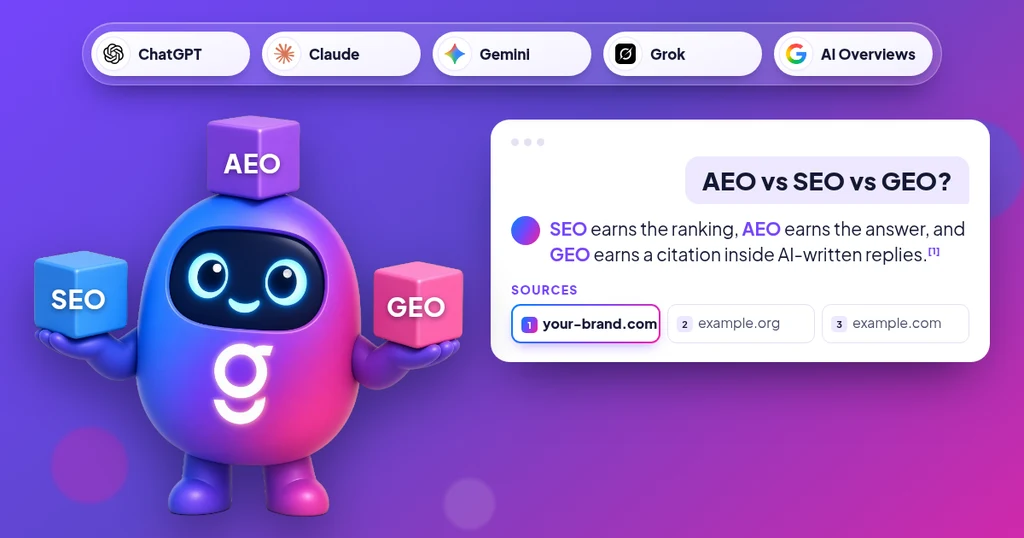
AEO vs SEO comes down to where you win: SEO earns a ranking in a list of search results so people click your page, while AEO (answer engine optimization) earns a place inside the answer an AI tool writes, as a brand mention or a cited source. GEO (generative engine optimization) is a newer name for almost the same work as AEO, focused on generative tools such as ChatGPT, Gemini and Perplexity.
Spend a week on LinkedIn and you’ll see these three acronyms sold as rival disciplines. One post says SEO is dead and GEO is the future. The next says GEO is a buzzword.
The reality is more useful. The three overlap heavily. Google now says that optimizing for its AI features is still SEO, while Microsoft calls its new reporting tool a step toward GEO. Both are true at once, and once you see why, deciding what to do gets much easier.
This article is the side-by-side comparison: the goal, the unit that wins, the signals, the content, the technical setup, the metrics and the money. Then it gives you a simple way to decide where your effort goes.
 How we put this guide together
This guide is written by Jade Teekhasaenee, who leads SEO and AEO at Grixhub, where our team technically audits websites for brands in Thailand and around the world. It draws on official documentation from Google, Microsoft, OpenAI and Perplexity, on named studies from Ahrefs, Seer Interactive, SparkToro, Pew Research Center and academic researchers, and on what our team sees when we check brands’ visibility in ChatGPT, Gemini and Google AI Mode. Every statistic was checked against its source on 4 November 2026, and each one carries its date, because these numbers move fast.
What is the difference between SEO, AEO and GEO?
SEO optimizes pages to rank in search results and earn clicks. AEO optimizes content and reputation to be named or cited inside AI answers, including featured snippets and voice. GEO is the research-born term for the same goal inside generative AI answers.
SEO (search engine optimization) is the work of making your pages rank in search engine results, mainly Google and Bing, so people click through to your site. Success is a position in a list and a visit.
AEO (answer engine optimization) is the work of making your content and your brand easy for answer engines to find, trust and quote, so the answer itself names you or links to you. The term is older than ChatGPT. It started with featured snippets and voice assistants, and now covers Google AI Overviews, AI Mode, ChatGPT search, Gemini, Perplexity and Microsoft Copilot.
GEO (generative engine optimization) is the work of increasing how visible your content is inside AI-generated answers. The term was coined by researchers in a 2023 paper and is mostly used for generative tools: ChatGPT, Gemini, Perplexity, Claude and Copilot.
Here’s how they line up at a glance.
| SEO | AEO | GEO | |
|---|---|---|---|
| Main goal | Rank a page and earn the click | Be the answer, or a named part of it | Be cited or used inside a generated answer |
| Where it shows | Google and Bing results pages | AI Overviews, AI Mode, ChatGPT, Gemini, Perplexity, Copilot, featured snippets, voice | ChatGPT, Gemini, Perplexity, Claude, Copilot, AI Mode |
| What wins | A whole page | A passage, a fact or a brand | A passage, a fact or a brand |
| Where the term came from | Industry, 1990s | Industry, featured snippet and voice era | Academic paper, 2023 (KDD 2024) |
| Main metrics | Rankings, clicks, organic traffic | Mention rate, citation rate, AI share of voice | Same as AEO, plus visibility scores in research |
Notice that the AEO and GEO columns are almost identical. The bigger gap is between SEO and the other two, and even that gap is narrower than it looks.
If you need a refresher on how answer engines pick their sources in the first place, start with our complete guide to answer engine optimization, then come back here for the comparison.
SEO vs AEO vs GEO at a glance
SEO
- Goal: rank a page and earn the click
- Shows in: Google and Bing results
- Wins with: a whole page
- Measured by: rankings, clicks, traffic
AEO
- Goal: be the answer or part of it
- Shows in: AI Overviews, AI Mode, ChatGPT, Gemini, Perplexity, Copilot, snippets, voice
- Wins with: a passage, a fact or a brand
- Measured by: mentions, citations, AI share of voice
GEO
- Goal: be the answer or part of it
- Shows in: ChatGPT, Gemini, Perplexity, Claude, Copilot, AI Mode
- Wins with: a passage, a fact or a brand
- Term from: 2023 research paper
AEO and GEO: nearly the same work
AEO vs SEO: what actually changes?
The goal changes from a click to a mention or citation, the unit that wins shrinks from a page to a passage, the queries get longer and more conversational, and off-site reputation counts for more. The foundations stay the same.
The cleanest way to see the difference between SEO and AEO is to follow one search through both systems. Take a hypothetical Bangkok accounting firm that helps foreign-owned companies with Thai tax filings. It’s our example throughout this article; nothing about it is real.
In classic SEO, a prospect types “accounting firm Bangkok foreign company” into Google. The firm’s job is to rank high on the results page, with a title good enough to earn the click. If it ranks fifth, it still has a chance. People scroll.
In AEO, the same prospect asks ChatGPT or Google AI Mode: “I’m opening a Thai company with a foreign director. Which Bangkok accounting firms handle monthly VAT and can report in English?” There’s no list to scroll. The tool runs several searches, reads a handful of pages, and writes a short answer naming two or three firms with a few sources.
A lot of people now search this way. OpenAI said in February 2026 that ChatGPT had around 900 million weekly users (eWEEK), and at Google I/O in May 2026 Google said AI Mode had passed 1 billion monthly users (Neowin).
So what changed? Four things.
1. The goal moved from the click to the answer
In SEO, a ranking is only valuable if it turns into a visit. In AEO, being named in the answer has value on its own, because the prospect may remember the name and search for it later.
2. The unit that wins got smaller
Search engines rank pages. Answer engines pull passages. Google’s documentation describes AI Overviews and AI Mode issuing “multiple related searches across subtopics and data sources” to build a response (Google Search Central). Each of those sub-searches looks for the passage that best answers one piece of the question. Your page competes paragraph by paragraph.
3. The query got longer
The SEO query had five words. The AEO question had more than twenty, plus context about the buyer. Questions like that don’t map neatly to one keyword.
4. Other people’s words count for more
An AI answer that recommends a firm is vouching for it, so models lean on what other sites say: reviews, directories, forum threads, lists and press. We’ll put numbers on this below.
What didn’t change matters as much. Google says a page must be indexed and eligible to show a snippet to appear in AI Overviews or AI Mode, with no additional requirements (Google Search Central). That’s SEO.
One question, two systems
SEO
accounting firm Bangkok foreign company
- 110 links
- 2Click result 5
- 3Website
Win = ranking + click
AEO
I’m opening a Thai company with a foreign director. Which Bangkok accounting firms handle monthly VAT and can report in English?
Firm A, Firm B, Firm C
[1][2][3]
Win = named in the answer + cited source
Firm names are invented examples.
GEO vs SEO: how is generative engine optimization different?
GEO targets visibility inside AI-generated answers rather than rankings in a list. Research shows content changes like adding statistics, quotations and cited sources raise that visibility, while keyword stuffing, a classic SEO habit, made things worse.
GEO vs SEO is really a question about what kind of engine you’re optimizing for. SEO optimizes for a ranking engine that sorts pages. GEO optimizes for a generative engine that reads pages and writes something new.
The term comes from a November 2023 paper, “GEO: Generative Engine Optimization”, by Pranjal Aggarwal of IIT Delhi and colleagues from Princeton and elsewhere, later presented at KDD 2024 (Aggarwal et al.).
What the GEO study found
The researchers built a benchmark called GEO-bench with 10,000 queries, rewrote source content in different ways, and measured how much of each source showed up in the generated answer. Usefully for this comparison, they tested SEO-style and GEO-style changes side by side.
Three methods stood out: citing sources, adding quotations and adding statistics. The best methods improved visibility over the baseline by 41% on their main word-count metric and 28% on a subjective impression score, which the abstract rounds to “up to 40%”.
Keyword stuffing, the oldest trick in the SEO book, scored below the baseline (17.7 vs 19.3). On a live Perplexity test it did 10% worse than doing nothing, while adding quotations improved visibility by 22%.
That finding matters most. Lower-ranked sources gained the most from GEO methods. Generative engines don’t simply reward whoever ranks first; they reward the most quotable, well-supported material.
The honest caveats
The study ran on the researchers’ own benchmark plus a smaller Perplexity test, not on live ChatGPT or AI Overviews as they work today. Treat the exact percentages as directional.
Where GEO and SEO meet
None of this means GEO replaces SEO. Engines must retrieve your page before quoting it, and Google says its AI features use its core Search ranking systems to retrieve pages from its index (Google Search Central). GEO is what you do to content once SEO has made it findable. For the term’s full background, see our GEO explainer.
What the GEO study tested (KDD 2024)
Best methods (cite sources, add quotations, add statistics): up to 40% more visibility. Keyword stuffing: worse than doing nothing.
Source: Aggarwal et al., GEO-bench, 10,000 queries, KDD 2024. Benchmark results; treat as directional.
Rank vs gain from citing sources
AEO vs GEO: are they the same thing?
In practice, yes. Both describe being used as a source in AI answers, and the daily work is nearly identical. AEO is the older, wider term that also covers featured snippets and voice; GEO comes from 2023 research and focuses on generative tools.
AEO vs GEO is the comparison people argue about most, and it matters least. The work is almost the same. The difference is mostly history and emphasis.
AEO grew up in the featured snippet and voice era, when one page was read out as “the answer”. Today most practitioners use it as an umbrella that also covers AI Overviews and chatbots.
GEO was born in the generative era. It assumes a model reads several sources and writes a new answer, so the goal is to be one of the sources it credits.
Some draw a sharper line: AEO aims to be the extracted answer, GEO aims to be one of several cited sources. That’s fair as history. But any AEO or GEO checklist has the same tasks: crawler access, answer-first passages, clear facts, matching structured data, third-party mentions and prompt tracking.
Who uses which word
Google’s 2026 guide names both terms. It says AEO and GEO are “terms you may see used to describe work specifically focused on improving visibility in AI search experiences”, and then says that from Google Search’s perspective, optimizing for generative AI search is optimizing for the search experience, “and thus still SEO” (Google Search Central).
Microsoft took the opposite naming approach. When it launched AI Performance reporting in Bing Webmaster Tools on 10 February 2026, it called the release “an early step toward Generative Engine Optimization (GEO) tooling” (Bing Webmaster Blog).
You’ll also see LLM SEO, LLMO and AI SEO. They describe the same goal from slightly different angles. Our guide to LLM SEO covers the content side under that name.
 Pro tip
Pick one term and use it consistently inside your company. We use AEO at Grixhub because it covers every surface where an answer replaces a list, including featured snippets and AI Overviews. What matters is that everyone on the team means the same set of tasks when they say it.
One family of terms
- AEO (umbrella)featured snippets · voice answers · AI Overviews · AI Mode · chatbots
- Inside AEOGEO (generative answers, term from 2023 research) · LLM SEO / LLMO · AI SEO
- SEO foundationscrawl · index · helpful content · E-E-A-T
What does Google say about AEO and GEO?
Google's 2026 guide says optimizing for its generative AI features is still SEO. It says you don't need llms.txt or other AI text files, content chunking, special schema or writing just for AI, and warns that inauthentic brand mentions don't help.
Google answered the AEO vs SEO question directly in May 2026, when it published a guide called “Optimizing your website for generative AI features on Google Search”. The page was last updated on 10 July 2026 (Google Search Central). If you only read one official document on this topic, read that one.
Its core message: from Google Search’s point of view, optimizing for generative AI search “is optimizing for the search experience, and thus still SEO”.
What Google says you can skip
The guide is unusually blunt about popular AEO and GEO tactics. Here is what it says, in its own words where possible.
AI text files. “You don’t need to create new machine readable files, AI text files, markup, or Markdown to appear in Google Search.” That covers llms.txt. Google may crawl such a file, but reports on the guide note that Google says this doesn’t mean it is treated in a special way.
Chunking. “There’s no requirement to break your content into tiny pieces for AI to better understand it.” Long, well-organized pages are fine.
Writing for AI. “You don’t need to write in a specific way just for generative AI search.”
Special schema. “Structured data isn’t required for generative AI search, and there’s no special schema.org markup you need to add.” Google still suggests using structured data as part of normal SEO.
Manufactured mentions. Google acknowledges that its AI features “can show what’s being said about products and services across the web”, but warns that “seeking inauthentic ‘mentions’ across the web isn’t as helpful as it might seem”, because its core systems focus on quality and its spam systems block the rest.
What Google says does matter
The positive advice is classic people-first SEO: content visitors find helpful, content that isn’t a commodity (such as a first-hand review), and pages Google can access and index, because indexing and serving aren’t guaranteed.
The guide also warns that “No third-party tool has access to our internal ranking or AI systems.” Use such tools if they help, but check their advice against Google’s guidance. We agree, and built our own tracker to record what AI answers say, not some secret score.
“Still SEO” is Google’s position for Google’s AI features. ChatGPT, Perplexity and Copilot use different crawlers and indexes, and the guide doesn’t speak for them. That’s why the technical and measurement sections below cover each platform separately.
So is AEO fake? No. Read the guide as “AEO done properly is good SEO with a sharper focus”. It confirms the foundations, but being named inside an answer is still a different outcome from ranking in a list. For our take on SEO’s future, read is SEO dead?
Google’s 2026 AI guide: skip vs focus
Optimizing for generative AI search is still SEO
You don’t need
- llms.txt or other AI text files
- Breaking content into tiny chunks
- Writing a special way for AI
- Special schema.org markup
- Inauthentic brand mentions
What matters
- Pages Google can crawl and index
- Eligible to show a snippet
- Helpful, people-first content
- Non-commodity content (first-hand experience)
- Structured data as normal SEO
Source: Google Search Central, Optimizing your website for generative AI features on Google Search (updated 10 Jul 2026)
Watch: Ahrefs on AEO, GEO and SEO
Ahrefs · AEO Course: What is AEO? · watch on YouTube
Where do SEO, AEO and GEO overlap?
Most of the work is shared: crawlable and indexable pages, fast and usable sites, helpful content with real expertise, structured data that matches the page, and a brand other sites describe consistently. AEO and GEO add sharper writing and wider reputation work on top.
The overlap between SEO, AEO and GEO is large enough that we usually describe it as one stack with layers, not three separate disciplines.
Access and indexing. Every engine needs to fetch and index your page, whether through Googlebot, Bing, OAI-SearchBot or PerplexityBot. If your server, CDN or robots.txt blocks them, nothing else matters.
Helpful content. Google’s ranking systems and its AI features both reward content made for people, with real experience behind it. The GEO research points the same way.
Page experience. Google’s May 2025 tips for AI search included “Provide a great page experience” next to “Ensure we can access your content” (Search Engine Land). It reads like an SEO checklist because it is one.
Structured data that matches the page. Schema doesn’t win AI answers by itself, and Google says no special markup is needed. But markup that accurately describes your business, products and authors helps every machine reader. We cover what’s worth adding in our schema markup guide for AEO.
E-E-A-T. Experience, expertise, authoritativeness and trust are how Google describes quality, and what makes a model comfortable repeating a claim.
So where’s the gap? It sits in three places: how passages are written, how much off-site reputation counts, and how results are measured. Those are what the next sections cover.
One stack, three names
- Wider for AEO and GEOReviews, directories, forums, lists, press
- Sharper for AEO and GEOAnswer-first passages · Specific facts and numbers · Cited sources
- Shared foundation (SEO, AEO, GEO)Crawler access · Indexing · Page experience · Helpful content · E-E-A-T · Matching schema
Measurement differs: rankings and clicks vs mentions, citations, share of voice
Why doesn't a top ranking guarantee an AI citation?
Because AI answers run many sub-searches and pick passages, not pages. In Ahrefs' 2025 study of 15,000 prompts, only about 12% of URLs cited by AI assistants ranked in Google's top 10 for the same prompt, and the figure was about 8% for ChatGPT.
This is the single most important difference between SEO and AEO, and it’s backed by solid data.
In August 2025, Ahrefs ran 15,000 long-tail prompts through ChatGPT, Gemini, Copilot and Perplexity. For each prompt, it checked whether the URLs the assistant cited also ranked in Google’s or Bing’s top 10 for that same prompt (Ahrefs).
Across platforms, only about 12% of cited URLs ranked in Google’s top 10. For ChatGPT’s in-text citations it was 8.0%; Perplexity, which runs its own index, was highest at 28.6%. For every assistant except Perplexity, more than 80% of citations came from pages that didn’t rank at all for the target query.
Why the overlap is so low
Query fan-out. The AI doesn’t search for your prompt. It searches for several smaller questions derived from it. The page that ranks for the full prompt may not be the best answer for any one of those sub-questions.
Passage selection. The engine pulls the best paragraph for each sub-question, wherever it lives. A well-written section on a page that ranks 30th can beat a vague section on the page that ranks first.
Different indexes. ChatGPT, Perplexity and Copilot don’t use Google’s index. Perplexity has its own crawler; Copilot is built on Bing; ChatGPT uses OpenAI’s own search crawler. Rankings on one engine don’t transfer automatically.
The data has limits: ChatGPT’s results were a snapshot from early July 2025, AI Mode wasn’t covered, and Ahrefs sells AI visibility tools. But the gap is too wide to be noise.
What this means for our example firm
Say the accounting firm ranks third on Google for “accounting firm for foreign companies in Thailand”. When someone asks ChatGPT the longer version, the answer might cite a government page for the VAT rules, a forum thread for first-hand experience and a competitor’s FAQ for the documents needed. The firm’s page answers none of those sub-questions directly, so it isn’t cited.
The fix isn’t to abandon the ranking. It’s to make sure the page also contains the passages the sub-questions need. Our guide to how AI search engines work goes deeper into retrieval and fan-out if you want the mechanics.
How often AI-cited pages also rank in Google’s top 10
For every assistant except Perplexity, over 80% of citations came from pages that don’t rank for the target query.
Source: Ahrefs, 15,000 long-tail prompts, August 2025. ChatGPT data from early July 2025.
How do the ranking signals differ: backlinks vs brand mentions?
Backlinks remain a core SEO signal, but brand mentions across the web line up more closely with AI visibility. In Ahrefs' study of 75,000 brands, branded web mentions correlated with AI Overview visibility at 0.664, against 0.218 for the number of backlinks.
In SEO, links have been the main off-site signal for more than twenty years. In AEO, the picture shifts toward something broader: how often, and how consistently, the web talks about your brand.
The best data on this comes from Ahrefs. In May 2025, it studied 75,000 brands and measured how strongly different factors correlated with how often each brand was mentioned in Google AI Overviews (Ahrefs).
| Factor | Correlation with AI Overview brand mentions |
|---|---|
| Branded web mentions | 0.664 |
| Branded anchors | 0.527 |
| Branded search volume | 0.392 |
| Domain Rating | 0.326 |
| Referring domains | 0.295 |
| Number of backlinks | 0.218 |
The pattern is clear. Brand mentions, whether or not they carry a link, lined up with AI visibility about three times as strongly as raw backlink counts. Links that use your brand name as the anchor text came second.
Read this carefully
This is correlation, not causation. Well-known brands get more mentions and more AI visibility for the same reason: people talk about them. The study also covered only Google AI Overviews and excluded small domains and the roughly 26% of brands with zero AI Overview mentions.
And remember Google’s warning that inauthentic mentions don’t help. The lesson isn’t to spam forums. It’s that real reputation work now shows up directly in search.
How this changes the off-site plan
For classic SEO, our example firm would chase links. For AEO, it also asks which pages AI tools read when someone asks about its category: usually comparison articles, directories, member lists, review platforms and forum threads. Being described accurately there, with or without a link, is the job.
That’s the difference in one line: SEO counts votes, AEO also listens to what people say. Our guide on earning AI mentions and citations covers how to find and win those pages.
What lines up with AI Overview visibility (75,000 brands)
Mentions line up about 3x more strongly than backlink counts
Source: Ahrefs, May 2025. Spearman correlation, not causation. Google AI Overviews only.
How does content differ for SEO, AEO and GEO?
SEO content is built to rank a whole page for a keyword. AEO and GEO content is built so each section can be lifted out and quoted: a direct answer first, specific facts, cited sources and clear authorship. Good content today does both.
The difference between SEO and AEO content is less about topics and more about how each section is written.
Classic SEO content is planned around a keyword and judged as a whole page. A page could bury its best answer in the fifth paragraph and still rank.
AEO and GEO content is judged one passage at a time. A section only helps if it answers a question on its own. That changes the writing in five ways.
The answer moves to the top. Each section opens with one or two sentences that answer its heading directly. The detail follows. This is the single habit that makes the biggest difference, and it’s the format you’re reading right now.
Headings become questions. “Our services” becomes “Which tax filings do you handle for foreign-owned companies?”, matching how people ask AI tools.
Adjectives give way to facts. “Fast, reliable service” can’t be quoted. “We file your monthly VAT return and send an English summary within two working days” can. Numbers, dates, prices or price ranges, locations and eligibility rules are what answers are made of.
Claims get sources. The GEO study found that citing sources, adding quotations and adding statistics were the most effective changes it tested. If you state a rule or a number, link to where it comes from.
Authorship is visible. A named author with real experience and an honest update date show who stands behind the claim.
What doesn’t change
Google’s 2026 guide is a useful brake here: you don’t need to write a special way for AI or chop content into tiny pieces. Answer-first writing isn’t an AI trick. It’s how good reference writing has always worked.
The practical rule: write for a busy person first, then check that each section still makes sense if quoted alone. Our guide to answer-first writing has the full method.
Looking for the best accounting firm in Bangkok? Our experienced team offers a full range of professional accounting services tailored to your business needs. Contact us today to learn more about how we can help your company grow.
VAT-registered companies in Thailand file a VAT return (PP 30) every month. We prepare and submit it for you, send an English summary, and need your sales and purchase invoices by the 5th of each month.
The first version has nothing an AI tool could repeat. The second answers a real question and makes sense on its own. Before you publish, the free AEO Content Checker scores a page for this kind of structure in your browser.
Page-level vs passage-level writing
Written for SEO only
Whole page
Nothing to quote
Written for SEO and AEO
One highlighted paragraph
- 1Direct answer first
- 2Specific fact (PP 30, monthly)
- 3Clear who it’s for
- 4Makes sense on its own
Answer firstQuestion headingsFacts over adjectivesCite sourcesNamed author
How do the technical requirements differ for SEO and AEO?
SEO mostly cares about Googlebot and Bingbot. AEO adds the crawlers each AI tool uses for answers, such as OAI-SearchBot for ChatGPT and PerplexityBot for Perplexity, and separates them from training crawlers such as GPTBot, which you can block independently.
On the technical side, the difference between SEO and AEO is mainly about which bots you let in.
Classic SEO had two crawlers that mattered: Googlebot and Bingbot. AEO adds several more. Some fetch pages for AI answers; others collect content to train models. You can treat them differently.
| Platform | What it uses to find pages for answers | Separate training control | Worth knowing |
|---|---|---|---|
| Google AI Overviews and AI Mode | Googlebot and Google’s normal index | Google-Extended token for its other AI systems | Page must be indexed and snippet-eligible; no extra requirements |
| ChatGPT search | OAI-SearchBot | GPTBot | Each setting is independent; robots.txt changes take about 24 hours |
| Perplexity | PerplexityBot | PerplexityBot isn’t used to train models | Perplexity-User fetches pages for a user and generally ignores robots.txt |
| Microsoft Copilot | Bing’s index | Managed through Bing | Copilot Search was built inside Bing |
The details come straight from each company. OpenAI says OAI-SearchBot is used to show websites in ChatGPT search results, GPTBot collects content that may be used to train its models, and “each setting is independent of the others” (OpenAI). So you can block training and still appear in ChatGPT search.
Perplexity says PerplexityBot surfaces and links websites in its search results and isn’t used to crawl content for AI foundation models; its user-triggered fetcher, Perplexity-User, generally ignores robots.txt (Perplexity).
Microsoft says Copilot Search began inside Bing and shows clickable citations inline (Microsoft), so Bing Webmaster Tools matters more for AEO than many SEO teams assume.
Google is the simplest case: its AI features use the Search index, and snippet controls such as nosnippet and max-snippet limit what it shows (Google Search Central).
One AEO blocker we always check for in technical audits isn’t in robots.txt at all. It’s a CDN or firewall bot-protection setting that challenges or blocks AI crawlers by default. Your robots.txt can say “allow” while the server quietly says no. Always test with the real user agents.
Our free AI Crawler Checker tests whether your robots.txt lets the main AI crawlers in. If you’re unsure whether to add an llms.txt file on top, read our llms.txt explainer; it’s optional, and Google says it doesn’t need one.
Which bots matter for SEO vs AEO
Sources: Google, OpenAI, Perplexity, Microsoft documentation
How do you measure SEO vs AEO vs GEO?
Measure SEO with rankings, clicks and organic traffic. Measure AEO and GEO with mention rate, citation rate and AI share of voice from repeated prompt tests, plus Google's Generative AI performance report in Search Console and Bing's AI Performance report.
Measurement is where SEO and AEO differ the most in day-to-day work, because the outcome you’re tracking is different.
SEO has mature metrics: rankings, Search Console clicks, organic conversions. AEO and GEO outcomes are messier, because AI answers change between runs, accounts and countries. So instead of a single position, you measure rates over many runs.
| Metric | SEO | AEO and GEO | Where to get it |
|---|---|---|---|
| Visibility | Ranking position | Mention rate and citation rate | Rank tracker; repeated prompt tests |
| Competitive share | Share of top-10 rankings | AI share of voice | Rank tracker; prompt tests across competitors |
| Platform impressions | Search Console Performance report | Search Console Generative AI performance report | Google Search Console |
| Platform citations | Not applicable | Total citations, cited pages, grounding queries | Bing Webmaster Tools AI Performance |
| Traffic | Organic sessions | AI referral sessions from chatgpt.com, perplexity.ai and others | GA4 |
The new platform reports
Bing went first. On 10 February 2026, Microsoft launched AI Performance in Bing Webmaster Tools as a public preview. It shows when your site is cited in Microsoft Copilot, AI-generated summaries in Bing and select partner integrations, with total citations, average cited pages per day, the grounding queries used to retrieve your content, and citations per URL (Bing Webmaster Blog). It doesn’t show clicks.
Google followed. On 3 June 2026, Google announced Search Generative AI performance reports in Search Console (Google Search Central Blog). They show impressions in AI Overviews and AI Mode, plus a separate Discover report, by page, country, device and date. At launch there were no clicks, and access started with a subset of sites (PPC Land) before widening later in the year (Search Engine Watch).
Neither report tells you whether your brand was recommended, how it was described, or which competitors were named instead. For that, you still need prompt tracking.
Prompt tracking, done properly
Build a list of 20 to 50 questions your buyers really ask, in their languages. Run them through ChatGPT, Gemini, Google AI Mode and Perplexity on a schedule, record mentions, citations and competitors, and judge the trend over months, never one screenshot.
A spreadsheet works, but it’s tedious. We built GrixTrack to automate it: it tracks Google rankings by country, city and language next to mentions and citations in ChatGPT, Gemini and Google AI Mode, and runs each prompt three times to smooth out randomness. The free plan covers 10 keywords and 5 prompts.
For the full method, see how to measure AI visibility, and for the metric definitions, what AI visibility and AI share of voice mean.
How to measure SEO vs AEO vs GEO
In practice, I don’t really care what optimizing for AI Search is called: SEO, AI Search Optimization, AEO, GEO, or whatever the new acronym ends up being.
— Aleyda Solis (@aleyda) May 17, 2026
What happens to traffic: clicks vs citations?
Clicks from search results are falling where AI answers appear. Studies from 2025 and 2026 found fewer clicks on regular results when an AI summary shows, with organic click drops of roughly 40% to 60% in the largest recent studies. Being cited in the answer softens the loss but doesn't erase it.
The reason this comparison matters commercially is simple: the click, which SEO was built around, is getting scarcer on exactly the queries where AI answers appear.
Zero-click searches are rising. SparkToro’s analysis of Similarweb data found that 68.01% of US Google searches ended without a click from January to April 2026, up from 60.45% in 2024. AI Overviews appeared on more than 20% of searches (Search Engine Land).
People click less when an AI summary shows. Pew Research Center tracked 900 US adults across 68,879 Google searches in March 2025. With an AI summary, users clicked a regular result on 8% of visits, against 15% without one, and clicked a link inside the summary on just 1% (Pew Research Center).
A controlled experiment agrees. Saharsh Agarwal (Indian School of Business) and Ananya Sen (Carnegie Mellon) ran a randomized field experiment with 1,065 desktop Chrome users in early 2026. AI Overviews cut outbound organic clicks by 39.8% in the June 2026 revision of the paper, a preprint on SSRN that isn’t yet peer-reviewed (PPC Land).
Top results lose the most. Ahrefs compared 300,000 keywords between December 2023 and December 2025 and found that an AI Overview correlated with a 58% lower clickthrough rate for the top-ranking page, up from 34.5% in its April 2025 study (Ahrefs). The data is desktop-only and correlational.
Where AEO changes the math
Here’s where AEO changes the math. Seer Interactive studied 3,119 informational queries across 42 organizations from June 2024 to September 2025. Organic CTR on queries with an AI Overview fell 61%, from 1.76% to 0.61%. But brands cited inside the AI Overview earned 35% more organic clicks and 91% more paid clicks than brands that weren’t (Seer Interactive).
Seer stresses that this is correlation: stronger brands may be both more cited and more clicked. Still, the shift is clear. SEO alone competes for a shrinking pool of clicks; SEO plus AEO also competes for attention inside the answer.
We cover the full picture of falling clicks in our guide to zero-click search, and more numbers in our AI search statistics roundup.
Clicks vs citations: what the studies show
US Google searches ending without a click
Source: SparkToro, “In 2026, Less than One Third of Google Searches Still Send a Click”. Panels differ by year: Jumpshot (2016, 2019), Datos (2024), Similarweb (Jan–Apr 2026), so read it as a trend.
Are AI clicks worth more than organic clicks?
If AI answers send fewer clicks, are those clicks worth more? Probably, with big caveats. In May 2025, Google’s John Mueller said that when people click to a website from results pages with AI Overviews, “these clicks are higher quality, where users are more likely to spend more time on the site” (Search Engine Land). Google hasn’t published the underlying data.
Semrush made the most cited estimate. In July 2025, it said the average AI search visitor, tracked to non-Google sources such as ChatGPT, is 4.4 times as valuable as the average traditional organic visitor, based on conversion rate. It also projected that AI search visitors could overtake traditional search visitors by early 2028 (Semrush).
Treat both as a hint, not a plan. The 4.4x figure rests on conversion rate alone, the dataset isn’t published, the 2028 date is an extrapolation, and Semrush sells AI visibility tools. The logic is sound, though: someone who asked a detailed question, read a summary and then clicked is further along than someone scanning ten blue links.
Don’t judge AEO by AI referral sessions alone. Track what those visitors do (enquiries, calls, LINE messages) and watch branded search in Search Console, because many people who see your name in an AI answer search for you directly later.
Which should your business prioritize: SEO, AEO or GEO?
For almost every business, SEO comes first because it feeds the other two. Add AEO once your key pages are indexed and ranking, prioritizing it earlier if your buyers ask long, research-heavy questions. Treat GEO as part of AEO rather than a separate project.
The honest answer to “which one should we do?” is that it’s the wrong question. The useful question is: in what order, and with how much weight?
SEO first, almost always
If your site has crawl problems, thin pages or indexing gaps, fix that first. Every AI platform depends on search retrieval: Google’s AI features use its core ranking systems, Copilot runs on Bing, and ChatGPT and Perplexity crawl the web for search. Skipping SEO to “do GEO” is like painting a house that has no walls.
AEO next, and earlier for some businesses
Once your important pages are indexed and reasonably visible, AEO is where the next gains are. Some businesses should move it up the list.
Research-heavy purchases. If buyers compare options for weeks, as with B2B services, education, healthcare, travel and finance, they’re likely asking AI tools detailed questions. Our accounting firm sits squarely here.
Categories with few clicks left. If AI Overviews already show on your key informational queries, competitors are building their place in the answer now.
GEO as part of AEO
Don’t run GEO as a separate project with its own team and reports. The tasks are the same as AEO for generative tools, so treat GEO as that slice of your AEO plan.
| Your situation | Where to put most of the effort first |
|---|---|
| New site, few pages indexed | SEO foundations: technical health, indexing, core service pages |
| Ranking well, but AI answers name competitors | AEO: answer-first rewrites, third-party mentions, prompt tracking |
| Local business, mostly map and phone leads | Local SEO and Google Business Profile, then AEO for local questions |
| Long B2B or high-value buying cycle | SEO and AEO in parallel from the start |
| Strong reputation, weak website | SEO fixes first, then AEO to connect the reputation to your pages |
If you’d rather have someone look at your situation directly, our AEO service and SEO service are run by the same team for exactly this reason: the work only makes sense together.
SEO, AEO or GEO: where should you start?
Are your key pages crawlable and indexed?
NoFix SEO foundations firstYesNext question
Do your buyers ask long, research-heavy questions, or do AI Overviews show on your key queries?
NoNext questionYesRun SEO and AEO in parallel
Are competitors named in AI answers instead of you?
NoKeep SEO as the core, check AI answers monthlyYesAdd AEO: answer-first rewrites, mentions, prompt tracking
How do you run SEO, AEO and GEO as one workflow?
Use one process: fix access for every relevant crawler, research both keywords and real buyer questions, write pages that rank and answer, build links and genuine mentions, and report rankings and AI visibility side by side every month.
The cleanest way to avoid the AEO vs SEO turf war is to never split the work. We run one five-step workflow: access, research, content, authority and measurement, with AEO additions at each step. Here’s what it looks like for our accounting firm.
Access. The firm’s site runs behind a CDN with bot protection switched on. Googlebot is allowed, but the default rules challenge unfamiliar crawlers. The fix takes an afternoon: allow the AI search crawlers it wants, keep a separate decision on training crawlers, and test with real user agents.
Research. The keyword list already has “accounting firm Bangkok”. The question list adds “Do I need a Thai accountant if my company has no revenue yet?”, drawn from the sales inbox, forum threads and ChatGPT’s suggested follow-ups.
Content. The core services page keeps its keyword focus but gains a short FAQ built from that question list. A new page explains monthly filing deadlines with a clear table. Each section passes the “would this make sense if quoted alone?” test.
Authority. The firm keeps its existing link work, and adds a review of the pages AI tools cite for its questions: a couple of business directories, a chamber of commerce member list, a well-known expat forum. It updates its listings and fixes an outdated description.
Measurement. One monthly report shows rankings and organic clicks, the Search Console Generative AI performance report, Bing’s AI Performance citations, and a prompt-tracking table showing how often the firm is named and cited compared with three competitors.
That’s it: one team, one plan, one report. The step-by-step version of this process, platform by platform, is in our guide on optimizing for AI search, and our AEO checklist is handy before you publish.
What are the biggest myths in the AEO vs SEO debate?
The biggest myths are that SEO is dead, that AEO needs special files or schema, that content must be chopped into tiny chunks, that brand mentions can be manufactured, and that AEO results show up within a week.
Because AEO and GEO are new and commercially hot, a lot of advice about them is oversold. These are the myths we hear most.
Myth 1: SEO is dead, GEO replaced it. AI tools retrieve pages through search systems. Clicks are falling on some queries, but the foundation AI answers stand on is SEO.
Myth 2: You need llms.txt to show up in AI. Google says you don’t need AI text files or special markup for its AI features. An llms.txt file is cheap and harmless, but it isn’t a ranking switch.
Myth 3: AI needs special schema. Google says no special schema.org markup is needed. Accurate structured data is still good SEO practice, but it doesn’t buy citations on its own.
Myth 4: Chop every page into tiny chunks. Google says there’s no such requirement. Clear structure works: a direct answer under each heading and sections that stand on their own.
Myth 5: Mentions can be manufactured. The correlation between brand mentions and AI visibility is real, but Google warns that seeking inauthentic mentions isn’t as helpful as it might seem, and its spam systems are designed to catch it. Buying forum posts is a short road to a bad reputation.
Myth 6: AEO results show up in a week. Some technical fixes show up fast, but rewritten pages must be recrawled and reputation takes months. Google itself warns about tools that promise ranking success.
We’re not neutral observers here: Grixhub sells AEO and SEO services. That’s exactly why we lean on official documentation and named studies throughout this guide, and why we tell clients what Google says they can skip.
How does AEO vs SEO play out in Thailand and other bilingual markets?
In bilingual markets like Thailand, people search and ask AI tools in more than one language, so SEO and AEO both need content in each language buyers use. Local platforms such as Google Business Profile, LINE and Pantip shape what AI answers say about a business.
Most AEO advice assumes an English-only market. If your buyers search in two languages, as in Thailand, there are a few extra wrinkles.
Two languages means two sets of questions. A Thai founder and a foreign director may ask about the same service in different words, languages and platforms. SEO handles this with separate Thai and English pages and hreflang; AEO adds that the Thai questions people ask AI tools often differ in substance, not just translation.
Translated-sounding pages are weak sources. A page translated word for word from English often misses how Thai buyers phrase the question, which hurts it in both rankings and answers.
Local platforms carry the reputation. In Thailand, much of the talk about businesses happens on Pantip, in Facebook groups and in LINE chats, alongside Google reviews. Pantip threads are public pages AI tools can read; LINE chats are private, so they shape word of mouth but not AI answers.
Google Business Profile matters twice. For local searches, a complete Google Business Profile helps in Maps and local results, and it gives Google’s AI features clear facts about a business: hours, location, services and reviews. For our accounting firm, that’s an easy shared win for SEO and AEO.
The same applies in any market where buyers use more than one language, from Singapore to Canada: run prompt tracking in each language and expect different answers. Our guide to doing SEO in Thailand covers the bilingual SEO side.
SEO vs AEO vs GEO: what should you do next?
Audit your SEO foundations, check the AI crawlers can reach you, rewrite your top pages answer-first, find the third-party pages AI answers cite in your category, and start tracking rankings and AI visibility side by side.
If you’ve read this far, you know the three terms describe one connected job. Here’s how to turn that into action this month.
Week 1: Check the foundations. Confirm your key pages are indexed in Google and Bing, fix any crawl errors, and test whether OAI-SearchBot and PerplexityBot can reach your site through your CDN.
Week 2: Build your baseline. Write 20 to 50 buyer questions in your customers’ languages, run them through ChatGPT, Gemini, AI Mode and Perplexity, and record who gets named and cited.
Weeks 3 to 4: Rewrite your most important pages. Pick 5 to 10 pages that matter most for revenue. Open each section with a direct answer, replace adjectives with facts, cite your sources and show who wrote it.
Month 2 onward: Earn mentions and measure. Work through the third-party pages AI answers cite in your category. Re-run your prompt list every month and report it next to your SEO numbers.
None of this requires choosing between SEO, AEO and GEO. It just means doing SEO with the answer in mind. For a second pair of eyes, book a free AEO audit and we’ll show you where you stand in rankings and AI answers.
Frequently asked questions

Is AEO better than SEO?
Neither is better, because they do different jobs on the same foundation. SEO wins rankings and clicks from search results. AEO wins mentions and citations inside AI answers. A page that fails at SEO is rarely cited by AI, so most businesses need both, with SEO done first.
Does AEO replace SEO?
No. AEO is built on top of SEO. Google says its AI features use its normal index and core ranking systems, and ChatGPT, Perplexity and Copilot all search the web before they answer. If search engines can’t crawl and index your pages, AI tools usually can’t use them either.
Is GEO the same as AEO?
Almost. GEO (generative engine optimization) is a term from a 2023 research paper about being cited in AI-generated answers. AEO (answer engine optimization) is an older, wider term that also covers featured snippets and voice answers. Google treats both as SEO, and the day-to-day work is nearly identical.
What is the difference between SEO and AEO in one sentence?
SEO gets your page ranked in a list of results so people click it, while AEO gets your brand named or your page cited inside the answer an AI tool writes.
Do I need separate teams for SEO, AEO and GEO?
Usually not. The technical, content and reputation work overlaps so much that splitting it across teams tends to create duplicated effort and mixed messages. One team with SEO skills, answer-first writing habits and a prompt-tracking routine can cover all three.
Can you do AEO without SEO?
Only partly. You can earn mentions on review sites, forums and lists without strong SEO on your own site, and those can get your brand named in AI answers. But to get your own pages cited, they need to be crawlable, indexable and genuinely useful, which is SEO work.
How do you measure GEO results compared with SEO results?
SEO uses rankings, clicks and organic traffic. GEO and AEO use mention rate, citation rate and AI share of voice from repeated prompt tests, plus Google’s Generative AI performance report in Search Console and Bing’s AI Performance report for Copilot citations.
Which should a small business start with?
Start with SEO basics, because they feed everything else: crawl access, indexing, a complete Google Business Profile and clear service pages with real details. Then rewrite your key pages answer-first and check a short list of buyer questions in ChatGPT, Gemini and Google AI Mode every month.
Sources and further reading
- Google Search Central: Optimizing your website for generative AI features on Google Search (published May 2026, updated 10 Jul 2026)
- Google Search Central: AI features and your website (updated 10 Dec 2025)
- Google Search Central Blog: Introducing Search Generative AI performance reports in Search Console (June 2026)
- PPC Land: Google gives Search Console its own generative AI visibility reports (3 Jun 2026)
- Search Engine Watch: Google's Generative AI report in Search Console rolling out globally (2026)
- Bing Webmaster Blog: Introducing AI Performance in Bing Webmaster Tools, public preview (10 Feb 2026)
- Microsoft: Bringing the best of AI search to Copilot
- OpenAI: Overview of OpenAI crawlers
- Perplexity: Perplexity crawlers
- Aggarwal et al.: GEO: Generative Engine Optimization (KDD 2024)
- Ahrefs: Only 12% of AI-cited URLs rank in Google's top 10 for the original prompt (11 Aug 2025)
- Ahrefs: An analysis of AI Overview brand visibility factors, 75K brands studied (26 May 2025)
- Ahrefs: Update: AI Overviews reduce clicks by 58% (4 Feb 2026)
- Seer Interactive: AIO impact on Google CTR, September 2025 update (4 Nov 2025)
- Search Engine Land: Google zero-click searches reach 68% in early 2026 (SparkToro / Similarweb data)
- Pew Research Center: Google users are less likely to click on links when an AI summary appears (22 Jul 2025)
- PPC Land: Researchers find Google AI Overviews cut publisher clicks 39.8% (Agarwal and Sen, SSRN, 2026)
- Semrush: AI search and SEO traffic study (21 Jul 2025)
- Search Engine Land: Google shares 8 ways to be successful with AI search experiences (May 2025)
- eWEEK: ChatGPT nears 1 billion weekly users (27 Feb 2026)
- Neowin: Google products with more than 1 billion users, including AI Mode (Google I/O, May 2026)
Keep reading

Written by Jade Teekhasaenee
Founder & Managing Director, Grixhub
Jade leads SEO and AEO strategy at Grixhub in Bangkok. He has technically audited websites for brands in Thailand and around the world, and he built GrixTrack to measure how often brands are mentioned and cited by ChatGPT, Gemini and Google AI Mode.
Want to see where you stand in SEO and AI answers?
We will check your rankings and run your most important buyer questions through ChatGPT, Gemini and Google AI Mode, then show you where SEO is holding you back, where AI answers leave you out, and what to fix first.

Grixhub is a digital growth and technology company in Bangkok, Thailand: SEO, AEO, digital marketing, paid media management, websites, apps and AI automation.
 Registered company
Services
Digital marketing
SEO
AEO
Website development
App development
AI & automation
Paid Media Management
Google Ads
ChatGPT Ads
Facebook Ads
Instagram Ads
TikTok Ads
Contact
Email: jade@grixhub.com
Phone: +66 62 480 9604
LINE: Grixhub
Bangkok, Thailand
Company
About · Blog
Free AEO Audit call
Terms · GrixTrack Terms · Refund Policy · Privacy Policy · Cookie Policy · Image Licence
Follow us