Content and structure guide
How to Write Answer-First Content for AI Search
Answer-first content puts the direct answer in the first sentence under every heading, then adds the proof. This guide shows what it is, why AI search quotes it, and the step-by-step process, templates and rewrites we use to structure pages for AI.
Key takeaways6 points
- Answer-first content opens every page and every section with a direct, specific answer to the question in its heading, then adds the explanation, evidence and caveats underneath.
- AI search tools quote passages, and those passages come disproportionately from the top: 44.2% of verified ChatGPT citations came from the first 30% of a page (Kevin Indig, 18,012 citations, 2026).
- Surfer found 38% of AI Overview citations came from a page's first 100 words in June 2026, up from about 20% a year earlier, and pages that answered the query early were cited about 45% of the time versus 23%.
- Google says you don't need to chop pages into tiny chunks or write a special version for AI. Answer-first works because it serves readers first and machines second.
- Write each answer as a self-contained passage: name the subject instead of saying 'it', give the number, the condition and the source, and keep it to one or two sentences.
- Back answers with things a model can't get elsewhere: your own data, prices, timelines, named experts and first-hand experience. In the KDD 2024 GEO study, statistics, quotations and cited sources raised visibility while keyword stuffing lowered it.
To write answer-first content, you put the direct, specific answer to the reader’s question in the first one or two sentences of the page and of every section, then add the explanation, evidence and caveats underneath. It is the oldest rule of good web writing, and it has become the most practical way to structure content for AI search.
Here’s why it matters now. When someone asks ChatGPT, Google AI Mode or Perplexity a question, the tool doesn’t send them to your page and wait. It reads a handful of pages, picks out the passages that answer the question, and writes its own reply with a few links underneath.
If your answer sits in paragraph six, after a warm welcome and a history of your company, the passage that gets quoted is probably someone else’s. Not because your answer was worse, but because theirs was easier to find and easier to lift out.
The fix isn’t a trick, and it isn’t writing for robots. It’s writing the way busy readers have always wanted: say the thing, then prove it. In this guide you’ll learn what answer-first content is, what the research says about where AI tools quote from, a seven-step writing process, templates for each page type and full before-and-after rewrites.
 How we put this guide together
This guide is written by Jade Teekhasaenee, who leads SEO and AEO at Grixhub, where our team technically audits websites for brands in Thailand and around the world. It draws on the official documentation from Google, Microsoft, OpenAI and Perplexity, on named studies from Kevin Indig, Surfer, CXL, the researchers behind the GEO paper and Nielsen Norman Group, and on what our team sees when we run customer questions through ChatGPT, Gemini, Google AI Mode and Perplexity. Every statistic was checked against its original source on 6 November 2026, and we will update this guide when the platforms change how they work.
What is answer-first content?
Answer-first content gives the direct answer to a question in the first one or two sentences of a page or section, then adds context and proof. It is the inverted pyramid from journalism, applied to every heading on the page.
Answer-first content is writing that leads with the conclusion. The first sentence under a heading answers the question that heading asks, in plain and specific words, and everything after it supports, qualifies or expands that answer.
Most web pages are written the other way around. They warm up, give background, explain why the topic matters, and only then get to the point. That order feels natural to the writer, who is building an argument. It feels slow to the reader, who just wants to know.
A writing structure in which every page and every section opens with a direct, self-contained answer to the question in its heading, followed by the detail, evidence and exceptions. Also called “bottom line up front” (BLUF) or the inverted pyramid.
Let’s make it concrete with the example we’ll use throughout this guide: Soi 38 Cooking School, a hypothetical Thai cooking school in Bangkok that runs half-day classes for tourists. Its prices, times and menus in this article are invented for illustration.
A traveler asks ChatGPT: “How long is a Thai cooking class in Bangkok, and is it OK for vegetarians?” ChatGPT searches, reads a few pages, and writes an answer with links. Now look at two ways the school could open its class page.
Context-first. “Thai food is loved all over the world for its balance of sweet, sour, salty and spicy flavors. At Soi 38, we believe cooking is about more than recipes. Our passionate team has welcomed guests from many countries…” The class length and the vegetarian question are answered somewhere below, if you keep scrolling.
Answer-first. “Our Bangkok cooking class lasts 4 hours, from 9:00 to 13:00, including a 45-minute market tour, and every dish can be made vegetarian or vegan on request.” Then the menu, the market tour, what’s included and how to book.
The second version answers both halves of the traveler’s question in one sentence a machine can quote as is. Nothing else about the page has to change. That’s the whole idea, and it scales from a single FAQ answer to a 7,000-word guide like this one.
If you’re new to the wider discipline this belongs to, our guide to answer engine optimization explains how answer engines choose their sources. This article zooms in on the writing itself.
Context-first vs answer-first
Context-first
How long is a Thai cooking class in Bangkok, and is it OK for vegetarians?
Answer-first
How long is a Thai cooking class in Bangkok, and is it OK for vegetarians?
Our Bangkok cooking class lasts 4 hours, 9:00 to 13:00, including a 45-minute market tour, and every dish can be made vegetarian or vegan on request.
Soi 38 Cooking School and its details are a hypothetical example.
Why does answer-first content matter for AI search?
Because AI tools quote passages, and they quote from the top of pages far more than from the bottom. Three 2026 studies found 38% to 55% of citations come from the opening part of a page.
Answer-first content matters for AI search because answer engines quote short passages, and the evidence keeps showing those passages come disproportionately from the top of the page and the start of each section.
Three independent analyses published in 2026 point the same way, each with a different method and a different AI product.
Kevin Indig, ChatGPT. Indig analyzed 1.2 million ChatGPT answers and matched 18,012 verified citations back to the sentences they came from. He found 44.2% of citations came from the first 30% of a page’s content, 31.1% from the middle and 24.7% from the final third, with a sharp drop near the footer (Search Engine Land). Inside paragraphs, 24.5% of citations came from first sentences.
CXL, Google AI Overviews. In a smaller hand-checked sample of 100 AI Overview citations, CXL’s Tarek Reslan found 55% came from the first 30% of the source page, and the top 20% of pages alone supplied 48 of the 100 citations (CXL, March 2026). He called the top-of-page concentration “not subtle.”
Surfer, AI Overviews and more. Surfer looked at about 100,000 citation placements across roughly 10,000 AI Overview responses scraped on 2 June 2026. 38% of all citations were pulled from the first 100 words of a page, up from about 20% in its 2025 study (Surfer, September 2026).
Where on the page Google AI Overview citations come from
First 30% of the page: 55 of 100 citations
Source: CXL, 100 AI Overview citations, March 2026. The last two buckets cover wider slices of the page (20 points each).
Surfer also measured something closer to cause and effect, though still correlational. Across more than 650,000 AI-generated answers, pages that confirmed and answered the query early were cited about 45% of the time, against 23% for pages that didn’t. In its factor model, “early query confirmation” carried a weight of 28.6% for Google AI Mode (Surfer).
How much “confirm the query early” weighs, by platform
Source: Surfer, 650,000+ AI-generated answers, September 2026. Surfer’s own factor model; correlational.
Be careful with these numbers. All three studies are correlational: they show where AI tools quote from, not why. Surfer says so plainly, calling its explanation “a reasonable model, not a proven causal chain.” CXL’s sample is small. Indig’s covers ChatGPT only. And part of the pattern is simply that many well-written pages already put their best material first.
How do AI search engines read and quote your page?
They retrieve pages from a search index, run several related searches (query fan-out), pick the passages that best answer each part of the question, and write an answer with links. You are competing passage by passage, not page by page.
AI search engines read your page by retrieving it from a search index, pulling out the passages that best match the question and its sub-questions, and then writing an answer grounded in those passages, with links to the pages they came from.
Google describes its version in its May 2026 guide to generative AI search. AI Overviews and AI Mode use retrieval-augmented generation, or grounding, which relies on “our core Search ranking systems to retrieve relevant, up-to-date web pages from our Search index.” The systems then “review the specific information from those retrieved pages” to write the response (Google Search Central).
The second technique Google names is query fan-out: “a set of concurrent, related queries generated by the model.” Google’s example is a question about a lawn full of weeds that fans out into searches like “best herbicides for lawns” and “remove weeds without chemicals.” Each of those sub-searches retrieves its own pages and its own passages.
How an AI answer is built from passages
- 1Questiona long, specific prompt
What you controlpages for the questions people ask
- 2Fan-outseveral related searches
What you controlone clear section per sub-question
- 3Retrievepages from the search index
What you controlcrawlable, indexed pages
- 4Pick passagesthe spans that answer best
What you controlanswer-first, self-contained passages
- 5Write and citeanswer plus links
What you controlspecific, checkable facts
Source: Google Search Central, generative AI guide, May 2026 (RAG and query fan-out).
Other answer engines follow the same broad pattern. Perplexity says it “searches the internet” and that “each answer includes numbered citations linking to the original sources” (Perplexity Help Center). OpenAI says “any public website can appear in ChatGPT search” as long as its OAI-SearchBot crawler isn’t blocked, but doesn’t publish how it picks sources (OpenAI Help Center).
The key word in all of this is passage. Search engines have scored parts of pages for years. In February 2021, Google switched on passage ranking for US English queries, saying it would affect 7% of queries across all languages once fully rolled out, because it could now judge “the relevancy of specific passages, not just the overall page” (Search Engine Land). AI answers take that further: the passage isn’t only ranked, it’s lifted out and repeated.
Position matters inside the model too. In the “Lost in the Middle” study, Nelson Liu and colleagues found performance “can degrade significantly when changing the position of relevant information,” and is often highest when it sits at the start or end of the input (Liu et al., TACL 2023). That tested long prompts, not web pages, so treat it as a plausible mechanism, not proof.
Put together, the practical takeaway is simple. You are not competing for one slot with your whole page. You’re competing with every other page’s best passage, sub-question by sub-question. A section that opens with a clean answer gives the system an easy, accurate span to take. A section that warms up for three paragraphs gives it nothing. For the full technical picture, read our explainer on how AI search engines work.
Is answer-first writing just the inverted pyramid?
Mostly, yes. Answer-first applies journalism's inverted pyramid to every heading on the page. Usability research has backed it for decades: Nielsen found 79% of test users scanned new pages and only 16% read word by word.
Answer-first writing is the inverted pyramid applied at every level of a page: the page opens with its main answer, each section opens with its own answer, and each paragraph opens with its most important sentence.
Nielsen Norman Group defines the inverted pyramid as a structure where “the most important information (or what might even be considered the conclusion) is presented first,” and calls it well suited to the web because readers skim and can “stop reading at any point on the page” yet still leave with the point (Nielsen Norman Group, 2018). Its advice: “The first sentence of every paragraph should be the most important.”
The reader research behind that advice is old and consistent. In 1997, Jakob Nielsen found that “79 percent of our test users always scanned any new page they came across; only 16 percent read word-by-word.” A version of a page that was concise, scannable and objective at once scored “124% better usability” in the same research (Nielsen Norman Group).
Twenty years later, NN/g’s eyetracking work on the F-shaped pattern found readers fixate heavily on the top and the left of the page. Kara Pernice’s recommendations read almost like an AEO checklist: “Include the most important points in the first two paragraphs,” and “Start headings and subheadings with the words carrying most information” (Nielsen Norman Group, 2017).
The inverted pyramid at three levels
- Pagethe intro’s first sentence answers the H1
- Sectionthe first 1 to 2 sentences answer the H2
- Paragraphthe first sentence carries the point
- Detailevidence, examples, caveats
Sources: NN/g inverted pyramid (2018); NN/g, How users read on the web (1997).
So what’s new? Two things.
The unit is smaller. A newspaper story has one pyramid. A web page written for AI search has a pyramid under every heading, because each section may be retrieved and quoted on its own, without the rest of the page around it.
The reader can’t ask you what you meant. A human who skims your opening can scroll back. A system that lifts one passage takes it as written. If that passage says “it usually takes about four hours” without saying what “it” is, the quote is useless. That’s why answer-first for AI adds a second rule, self-containment, which we cover in step 6.
Does Google say you should write for AI?
No. Google says you don't need to chunk content or rewrite it just for AI, and that optimizing for its AI features is still SEO. Answer-first fits that guidance because its purpose is to help readers find the answer fast.
No. Google’s official position is that you should not write a special version of your content for AI, and that breaking pages into tiny chunks isn’t required for its AI features.
In its May 2026 guide, Google lists “chunking” content as something you can ignore: “There’s no requirement to break your content into tiny pieces for AI to better understand it. Google systems are able to understand the nuance of multiple topics on a page and show the relevant piece to users.” It also says “you don’t need to write in a specific way just for generative AI search” (Google Search Central).
Danny Sullivan said the same on Google’s Search Off the Record podcast in January 2026. He warned against advice to “turn your content into bite-sized chunks, because LLMs like things that are really bite size,” adding: “So we don’t want you to do that.” And: “We don’t want people to have to be crafting anything for Search specifically” (Search Engine Roundtable, 9 Jan 2026; Search Engine Land).
Google Search Central · YouTube
Google Search Central · SEO, AIO, GEO, your site, and third-party support to optimize for LLMs · watch on YouTube
Not everyone agrees on the details. Mike King of iPullRank argued a week later that retrieval systems still work on passages, so structuring content so each passage performs well is a valid optimization that also serves people. In a small test with his own tool, splitting one mixed paragraph into two focused ones raised the similarity score of one passage by 19.24%, and adding a heading raised another by 17.54% (iPullRank, Jan 2026). It’s a single-paragraph demonstration, not a controlled study, but the logic is sound.
Google is warning against fragmenting content: turning a useful page into disconnected bullet points, or publishing one thin page per variation of a question. Answer-first does the opposite. It keeps full sections and full sentences. It changes the order inside them, so the answer comes before the context. Google’s own guide asks for content organized “by paragraphs and sections, along with headings that provide a clear structure to navigate content.” That’s exactly what an answer-first page is.
Chunking for AI vs answer-first writing
What Google says to skip
- Breaking pages into tiny pieces
- A second version written for LLMs
- A page for every fan-out query
- Special AI files or markup
What answer-first does
- Keeps full sections and sentences
- One page, written for people
- Puts the answer before the context
- Uses descriptive headings and sections
Source: Google Search Central, generative AI guide, May 2026.
The honest test is the one Google offers: “Is this content that my visitors would find satisfying?” If an answer-first rewrite makes the page faster and clearer for a human, do it. If a change only makes sense for a machine and makes the page worse for people, don’t.
Google also says that creating separate content for every fan-out query “primarily to manipulate rankings or generative AI responses” violates its scaled content abuse policy. Answer more questions on the pages you have before you create new ones.
Curious about AI in Search and your website? We just launched two new documentation pages and a blog post with some general tips on what to think about with regards to these new Search experiences. Check out the blog post at https://t.co/fYaVOfICmL
Google Search Central (@googlesearchc)
How do you write answer-first content, step by step?
Use seven steps: find the exact question, write a one or two sentence answer, add proof underneath, use descriptive headings, pick the right format for each part, make every passage self-contained, and add experience only you have.
You write answer-first content in seven steps: pin down the exact question, write the answer sentence, add the evidence beneath it, structure the page with descriptive headings, choose the right format for each part, make every passage self-contained, and add the first-hand proof only you can give.
The steps work the same whether you’re writing a new page or rewriting an old one. With a rewrite, you’ll find the answer usually already exists somewhere on the page. Your job is mostly to move it up, sharpen it and cut what stood in front of it.
Write the answers as a list before you write the page. For our cooking school, the class page list might read: the class lasts four hours; it starts at 9:00; it includes a market tour; it suits vegetarians; it costs a fixed price per person; it’s taught in English; up to a set number of guests per class. Seven facts. Each will become the opening line of a section or an FAQ answer.
Step 1: How do you find the exact question a section must answer?
Collect the questions customers actually ask, in their own words, from your inbox, chats, sales calls, Google's People Also Ask and AI tools' follow-up questions. Then give each important question one clear home on one page.
You find the exact question by collecting what real customers ask, in their words, and then assigning each question to one section of one page.
The phrase “in their words” matters. AI search prompts are longer and more conversational than classic keywords. Google notes that in its AI experiences people are “asking longer and more specific questions,” including follow-ups. A heading that matches the way someone actually asks makes it obvious, to readers and machines, which question the section answers.
Your own inbox and chats. The best questions are already in your email, contact forms, LINE Official Account chats and sales call notes. They come with the exact wording, the worries behind them and the details people care about. For Soi 38 Cooking School, they’d include “Can I join if I’m vegan?”, “Do you pick up from hotels?” and “Is it too spicy for kids?”
AI tools themselves. Ask ChatGPT, Perplexity and Google AI Mode your customers’ main questions and look at which sub-topics they cover and which follow-up questions they suggest. Those follow-ups are a window into query fan-out.
Then sort. Each important question gets one home: a section on an existing page, a row in an FAQ, or, if the intent is truly different, its own page. Don’t answer the same question on five pages in five slightly different ways. That splits your signals and confuses anyone, human or machine, trying to find your definitive answer.
For a deeper method, including how to build a prompt list you can track over time, see our guide to prompt research for AI search.
Step 2: How do you write the answer sentence?
Restate the subject, answer the question directly, and add the one specific detail that makes it true, such as a number, a condition or a name. Keep it to one or two sentences that make sense on their own.
You write the answer sentence by naming the subject, answering the question directly, and adding the one specific detail that makes the answer true and useful, all in one or two sentences that make sense without anything around them.
Microsoft gives the clearest official guidance on this. In its October 2025 advice on inclusion in AI search answers, Bing’s Krishna Madhavan recommends “self-contained phrasing: sentences that make sense even when pulled out of context,” and notes that “direct questions with clear answers mirror the way people search” (Microsoft).
Kevin Indig’s data points the same way. Passages ChatGPT cited were nearly twice as likely to use clear, definitive language, such as “X is…” definitions (Search Engine Land). Hedged openings like “There are many factors to consider” give a model nothing to repeat.
A simple formula
Most good answer sentences follow the same shape: subject + direct answer + the specific that makes it true. Sometimes a condition follows: “for most people,” “in Bangkok,” “unless you have a referral.”
Anatomy of an answer sentence
How long is a Thai cooking class in Bangkok?
The Soi 38 cooking class lasts 4 hours, from 9:00 to 13:00, including a 45-minute market tour.
Hypothetical example. Use your own real figures.
The answer type depends on the question type. Here’s how we match them.
| Question type | What the first sentence must contain | Example opening |
|---|---|---|
| What is X? | A one-line definition with the category and what makes it different | “A Thai cooking class is a hands-on lesson where you cook three to five dishes yourself, usually after a market tour.” |
| How much does X cost? | A price or range, the currency, and what moves it | “Our class costs [your price] per person, including ingredients, recipes and lunch.” |
| How long does X take? | A duration and the condition it depends on | “The class lasts 4 hours, from 9:00 to 13:00.” |
| Can I / is it OK to X? | Yes or no, then the condition | “Yes, every dish can be made vegetarian or vegan if you tell us when you book.” |
Answer the question asked, not the one you wish they’d asked. If someone asks how much something costs, the first sentence has a price in it. “Contact us for a quote” is not an answer. If prices genuinely vary, give the range and say what moves it.
Never invent precision. A made-up number looks specific but is easy to contradict. If you don’t know, say what you do know: “Most guests finish all five dishes within the class time.” Our hypothetical school would only publish “4 hours” if that’s really how long the class runs.
Read your answer sentence aloud as if a voice assistant were saying it to a stranger. If it would confuse them, or if it needs the heading to make sense, rewrite it.
Step 3: How do you add proof and detail under the answer?
Follow the answer with evidence: numbers, named sources, quotes, examples and exceptions. In the KDD 2024 GEO study, adding statistics, quotations and cited sources raised visibility in AI answers, while keyword stuffing lowered it.
Under the answer, you add the proof: the numbers, sources, quotes, examples and exceptions that show the answer is true and tell the reader what to do with it.
This is where answer-first content earns trust. The opening sentence gets you quoted. The support beneath it is what makes a careful system, and a careful reader, believe the quote.
The best controlled evidence on which kinds of support help comes from the GEO paper by Pranjal Aggarwal and colleagues, presented at KDD 2024. The team built a benchmark of 10,000 queries and tested nine ways of editing a source page, measuring how much of each page showed up in AI-generated answers. The abstract reports that the best methods “can boost visibility by up to 40%” (Aggarwal et al.).
Which edits made pages more visible in AI answers? (GEO study)
Keyword stuffing scored below doing nothing
Source: Aggarwal et al., GEO, KDD 2024, GEO-bench test set, position-adjusted word count. The researchers’ own setup, not live ChatGPT or Google.
Adding quotations, statistics and citations to sources all beat the baseline of 19.3 by a wide margin. Keyword stuffing scored 17.7, worse than leaving the page alone. The paper also found the best method varied by topic: citing sources worked best for factual and legal questions, quotations for people and history, statistics for law, government and opinion. So the lesson isn’t “add a quote to everything.” It’s “back your answers with the kind of evidence your topic calls for.”
What good support looks like
A number with its context. Not “most guests,” but how many, out of what, and over what period, if you track it.
A named source. When you state someone else’s fact, link to it and name it in the sentence, as this guide does. When you state your own, say how you know: “in our 2026 classes” or “based on our booking records.”
An example. A short, concrete case turns a general answer into something the reader can picture.
The exception. Every honest answer has limits. “Every dish can be made vegetarian, except the fish sauce in the dipping sauce, which we swap for a soy-based version.” Exceptions are where expertise shows.
Don’t add statistics for the sake of it. A vague or unsourced number is worse than none, and models can cross-check claims against other pages. Only publish figures you can stand behind.
Step 4: How do you structure content for AI with headings?
Give each page one main topic and an H1 that names it, then use descriptive H2s that ask the questions readers ask, each followed by its answer. In Kevin Indig's ChatGPT study, 78.4% of question-related citations came from headings.
You structure content for AI with one clear topic per page, an H1 that names it, and descriptive H2 and H3 headings that each state the question their section answers, so every section can be found and understood on its own.
Headings are how both readers and parsers cut a page into pieces. Microsoft puts it this way: headings “act like chapter titles that define clear content slices” for AI, and vague labels like “Learn More” work poorly (Microsoft). Google’s helpful-content questions ask whether “the main heading or page title provide[s] a descriptive, helpful summary of the content” (Google Search Central).
The ChatGPT data backs question-style headings in particular. In Indig’s study, cited content was twice as likely to include a question mark, and 78.4% of citations tied to questions came from headings (Search Engine Land).
Vague headings vs descriptive headings
Start headings with the words that carry the meaning (NN/g).
Hypothetical cooking school example.
A page outline that works
H1. Names the page’s single main topic, in the words people search. “Thai Cooking Class in Bangkok (Half-Day, Vegetarian Friendly)” says far more than “Experience the Magic of Thai Cuisine.”
Intro. The first sentence answers the main question the H1 implies. The next few lines say who the page is for and what it covers.
H2s. One question per H2, in roughly the order a reader would ask them: what it is, what’s included, how long, how much, who it suits, how to book. Each opens with its answer.
FAQ. The leftover questions that don’t need a full section, each with a direct one or two sentence answer. Our guide to optimizing FAQs for AI covers how to write and mark these up.
Keep one main topic per page. A page that tries to be the class page, the blog, the about page and the gift voucher page at once has no single question it clearly answers. Google says its systems can handle “multiple topics on a page,” which is true, but a focused page is still easier to understand, link to and cite. Over time, a set of focused pages that cover a subject thoroughly is also how you build topical authority.
Headings must be real HTML headings (H2, H3), not bold paragraphs styled to look big. Parsers and screen readers use the markup, not the font size.
Step 5: When should you use lists, tables and definitions?
Use numbered lists for real steps, tables for comparisons, definition boxes for key terms and short paragraphs for explanations. Don't turn everything into bullets: a page of fragments gives a model no complete sentence to quote.
Use a numbered list when the content is a sequence, a table when you’re comparing options across the same attributes, a definition when you introduce a term, and short paragraphs for everything that needs explaining.
Microsoft notes that “bulleted lists, numbered steps, and comparison tables break complex details into clean, reusable segments,” and that they suit how-to content and feature comparisons especially well. It also warns against the opposite problem: “long walls of text” that “blur ideas together and make it harder for AI to separate content into usable chunks” (Microsoft).
The trap is overcorrecting. Some pages written “for AI” are now nothing but bullet points. That fails readers, who lose the reasoning that connects the points, and it doesn’t help machines either, because a bullet like “Fresh ingredients” isn’t a quotable answer to anything.
Numbered lists. Use them for steps a reader follows in order: how to book, how to prepare, how to cook a dish. Introduce the list with a full sentence that answers the question, such as “Booking takes three steps,” so the answer survives even if the list is cut off.
Tables. Use them when you compare two or more options on the same attributes: morning vs evening class, three package levels, two menus. Give the table a header row and write the verdict in a sentence above it. A table without a verdict makes the reader do the work.
Don’t hide answers. Microsoft advises: “Don’t hide important answers in tabs or expandable menus,” and “Avoid putting key information only in images.” If your price or timetable lives only in a PNG or a collapsed accordion, put it in visible HTML text too.
Step 6: How do you make every passage self-contained?
Write each answer so it makes sense if it is the only thing someone reads: name the subject instead of using 'it' or 'this', repeat the key condition, and avoid references like 'as mentioned above'.
You make a passage self-contained by writing it so that it still makes complete sense when it’s the only part of the page someone sees: the subject is named, the conditions are stated, and nothing depends on a sentence above it.
This is the rule that separates answer-first writing for AI from answer-first writing for print. A newspaper reader always has the headline. A passage lifted into an AI answer may not have its heading, its page title or the paragraph before it. It has to carry its own context.
Here are the most common breaks and how to fix them.
Dangling pronouns. “It takes about four hours” is meaningless out of context. “The Soi 38 cooking class takes four hours” is not. Name the subject in the first sentence of every section, even if the heading already names it.
Backward references. “As mentioned above” and “see the previous section” point to text that won’t be there. Restate the fact in a short clause instead.
Split answers. If the duration is in one paragraph and the start time is three paragraphs later, no single passage answers “how long and when.” Put facts that answer the same question in the same passage.
Does this passage stand alone?
Depends on context
As mentioned above, it takes around four hours and we can adapt it for most diets. Prices start from 1,500.
Stands alone
The Soi 38 Thai cooking class in Bangkok takes 4 hours and every dish can be made vegetarian or vegan. It costs 1,500 baht per person, including ingredients and lunch.
Hypothetical example; the price is invented for illustration.
Self-containment also helps the brand side of AI visibility. Answer engines can cite a page without naming the business behind it. When your passages name your brand, your service and your location, any quote of that passage carries your name with it. For how mentions and citations differ, see our guide on how to get cited by AI.
Consistent names matter too. Use the same name for your business, your products and your people across your site, your Google Business Profile and other listings. Systems connect facts to entities, and an entity with three spellings is three weak entities instead of one strong one. Our explainer on entity SEO goes deeper.
The “cover test”: hide everything on the page except one section’s first two sentences. If those two sentences alone answer the heading’s question truthfully and specifically, the passage is self-contained.
Step 7: How do you add experience and proof AI can't copy?
Add what only you know: first-hand experience, your own data, real prices and timelines, named experts and honest limits. Google says unique, non-commodity content will likely influence your presence in AI search more than anything else.
You add proof AI can’t copy by putting what only you know into the answer: first-hand experience, your own numbers, real prices and timelines, named people with real credentials, and honest statements of who your product isn’t for.
This is the step most “answer-first” advice skips, and it’s the one Google stresses most. Its May 2026 guide says that creating content people find “unique, compelling, and useful will likely influence your website’s presence in generative AI search in the long run more than any of the other suggestions in this guide” (Google Search Central).
Google draws a sharp line between commodity and non-commodity content. Its example of commodity content is “7 Tips for First-Time Homebuyers,” which “is often based on common knowledge.” Its example of non-commodity content is a first-hand piece titled “Why We Waived the Inspection & Saved Money: A Look Inside the Sewer Line.” It advises: “Don’t just recycle what others on the internet have already said, or could easily be produced by a generative AI model.”
That matters doubly for answer-first content. A short, generic answer is exactly what a model can already write without you. If your opening sentence says “Thai cooking classes usually last a few hours,” the AI doesn’t need your page to say that. If it says “Our class runs 4 hours because the market tour takes 45 minutes and each of our five dishes needs about 30 minutes of hands-on cooking,” you’ve given it something it can only get from you.
Experience. Say what you’ve seen, done or tested, and when. “In our classes, guests who have never cooked Thai food finish the green curry without help” is experience. “Our classes are suitable for beginners” is a claim.
Who wrote it. Google’s helpful-content guidance asks: “Is it self-evident to your visitors who authored your content?” and “Do pages carry a byline, where one might be expected?” (Google Search Central). Put a real name and role on articles, and link to an author page that shows why that person knows the subject.
All of this is E-E-A-T in practice: experience, expertise, authoritativeness and trust. Our guide on what E-E-A-T is and how to improve it covers the signals in detail.
What does an answer-first rewrite look like?
A rewrite moves the answer to the first sentence, names the subject, adds the specifics and proof, and cuts the warm-up. The facts usually already exist on the page; the order and the precision change.
An answer-first rewrite takes the same facts, moves the answer to the first sentence, names the subject, sharpens the specifics and cuts the warm-up that stood in front of them.
Here’s a full rewrite of the opening of our hypothetical cooking school’s class page, then the same treatment for a blog post section. Notice how little new information is added. Most of the work is ordering and precision.
Before and after: rewriting a class page answer-first
Before
Experience the Magic of Thai Cuisine
Thai food is loved around the world for its harmony of flavors. At Soi 38, we believe cooking is about more than recipes: it’s about culture, community and fun.
Our passionate team has welcomed guests from all over the world. Join us for an unforgettable morning!
Learn more about our classes below.
After
Thai Cooking Class in Bangkok (Half-Day, Vegetarian Friendly)
The Soi 38 Thai cooking class is a 4-hour, hands-on morning class in Bangkok where you cook 5 dishes yourself after a 45-minute market tour. It runs daily from 9:00 to 13:00, is taught in English, and every dish can be made vegetarian or vegan.
The class costs [price] per person, including ingredients, recipes and lunch. Up to [number] guests per class.
- Answer in sentence 1
- Named subject
- Numbers with units
- Reader’s own words
- Warm-up cut
Hypothetical cooking school; fill brackets with real figures.
The H1 went from a slogan to a description that matches how people search: what, where, how long and who it suits.
The first sentence now defines the product and answers the two most common questions, length and format. A model could quote it whole. The next two sentences answer schedule, language, diets and price, so six questions are settled before the reader scrolls.
“Passionate team” and “unforgettable” are gone from the opening. They aren’t wrong, but they don’t answer anything. The team can be introduced lower down with names and experience, which is proof rather than adjectives.
The same method on a blog section
Blog posts drift even more than service pages, because writers like to build up to their point. Here’s a section from a hypothetical blog post on the same site, answering “Is Thai food too spicy for kids?”
Spice is a big part of Thai culture, and many visitors wonder about it. Every family is different, and every child has different tastes, so it’s hard to give one answer. In our experience, it really depends. Let’s look at some of the factors you might want to consider before booking a class with little ones.
Thai food doesn’t have to be spicy for kids, because in the Soi 38 class every guest seasons their own plate. Children cook the same five dishes as adults, we prepare a no-chili curry paste for anyone who asks, and our pad Thai is cooked without chili, with chili flakes served on the side.
The “before” never answers. It promises to consider factors. The “after” gives a verdict in the first clause, explains why, adds first-hand details only this school can give, and names a safe dish. A parent gets their answer in eight seconds. An AI tool gets a passage it can quote that also names the business.
What answer-first templates work for each page type?
Each page type has a natural first sentence: a service page states what you do, for whom and where; a blog post answers its title question; a product page states what it is and its key spec; an FAQ answers yes, no or the number first.
Each page type has a natural first sentence, and getting that sentence right is most of the work. Here are the templates we use when we rewrite pages, with the question each opening must answer.
Answer-first opening templates by page type
Grixhub’s working templates. Replace brackets with real, checkable facts.
Service pages. The opening states what you do, for whom, where, and the one thing that sets you apart. Then cover how it works, what’s included, price or price range, timelines, who it’s not for, proof (credentials, reviews, examples), and how to start. Many service pages open with a mission statement. Move it down or cut it.
Blog posts and guides. The title is usually a question, so the first sentence answers it, as this guide does. Then each H2 is a sub-question with its own answer. Long guides should still let a reader stop after the first paragraph and leave with the right answer.
Pricing pages. Give the number. If you can’t publish exact prices, publish a range, a starting price or the factors that determine it. “Contact us” with no numbers gives an AI tool nothing to quote when someone asks “how much does X cost?”
FAQ answers. Start with yes, no or the number, then the condition. Each answer should stand alone, because FAQ answers are among the most quotable passages on a site.
If you publish in both Thai and English, write the answer-first opening natively in each language rather than translating one from the other. Thai searchers often phrase the same question differently, and the answer sentence should match how they ask.
How do schema, llms.txt and technical setup fit with answer-first content?
They support it but can't replace it. AI tools quote your visible text, so the answer must be in crawlable HTML. Schema that matches the visible content helps machines understand the page; Google says no special schema or AI files are needed for its AI features.
Schema, llms.txt and technical setup support answer-first content, but none of them can replace it, because AI tools quote your visible text, not your markup.
Start with access. Google says a page must be “indexed and eligible to be shown in Google Search with a snippet” to appear as a supporting link in AI Overviews or AI Mode (Google Search Central). OpenAI says to avoid blocking OAI-SearchBot if you want to appear in ChatGPT search summaries and snippets. The best answer sentence in the world does nothing if the crawler can’t reach it, or if it’s rendered by JavaScript that fails.
Next, snippet controls. Google’s nosnippet, data-nosnippet and max-snippet settings apply to AI features too: “More restrictive permissions will limit how your content is featured in our AI experiences” (Google Search Central Blog). A sitewide max-snippet setting left over from an old project can quietly cap how much of an answer is shown, so check yours.
Featured snippets are worth a note here because they were the first answer-first test. Google’s documentation is blunt about whether you can mark up a page to win one: “You can’t.” Google’s systems decide whether a page “would make a good featured snippet” (Google Search Central). The same is true for AI answers. There’s no tag that makes a passage quotable. Only the writing does that.
Schema. Google says structured data “isn’t required for generative AI search, and there’s no special schema.org markup you need to add,” but it’s still worth using as part of your SEO (Google Search Central). The rule that matters: markup must describe content that’s visible on the page. Our guide to schema markup for AEO shows which types help and how to generate them.
llms.txt. Google says it ignores llms.txt and similar files: creating one “will neither harm nor help your site’s visibility or rankings in Google Search.” Other services may use them. It’s optional and cheap, but it is not a substitute for answer-first pages. We explain the trade-offs in what llms.txt is and whether you need it.
The bigger picture. Answer-first writing is one part of optimizing content for language models. Our guide to LLM SEO covers the rest, including how models handle brands and entities.
What answer-first mistakes should you avoid?
The big ones are vague openings, answers split across paragraphs, keyword stuffing, invented numbers, turning pages into bullet fragments, hiding answers in tabs or images, and publishing near-duplicate pages for every question variation.
The most common answer-first mistakes are openings that don’t actually answer, answers split across the page, keyword stuffing, invented precision, over-fragmented pages, hidden answers, and thin duplicate pages for every variant of a question.
Here’s how to spot and fix each one on your own pages.
The fake answer. The section opens with a sentence shaped like an answer that says nothing: “Choosing the right class depends on many factors.” It looks answer-first and isn’t. Fix: the first sentence must contain the verdict, number or yes/no.
The split answer. Duration in one paragraph, start time in another, price in a sidebar. Each passage is incomplete. Fix: group the facts that answer one question into one passage.
Keyword stuffing. Repeating the exact phrase in every sentence to “match the query.” In the GEO study it scored 17.7, below the 19.3 baseline for doing nothing (Aggarwal et al.). Google also notes its AI systems “understand synonyms and general meanings.” Fix: use the reader’s words once, naturally, then write normally.
Invented precision. Making up a statistic so the answer sounds specific. It’s easy to contradict and it erodes trust. Fix: only publish numbers you can source or measure, and say how you got them.
The bullet blizzard. Rewriting a whole page as fragments “for AI.” Fix: keep explanations as sentences. Google explicitly says you don’t need to break content into tiny pieces.
Hidden answers. Key facts only in accordions, tabs, images or PDFs. Fix: put the answer in visible HTML text near the top. Collapsible FAQs below it are fine.
One page per variation. Separate thin pages for “cooking class Bangkok price,” “cooking class Bangkok cost” and “how much is a cooking class in Bangkok.” Google warns that doing this to manipulate AI responses violates its scaled content abuse policy. Fix: one strong page, with the variants answered inside it.
How do you check, measure and roll out answer-first content?
Check each page with the cover test and a content checker, then track a fixed set of prompts in ChatGPT, Gemini, Google AI Mode and Perplexity. Start with the five to ten pages that answer your most valuable questions.
You check answer-first content before publishing with a simple editorial test and a content checker, then measure it after publishing by tracking whether AI tools cite the page for the questions it answers.
Before you publish
Run every page through three quick checks.
The cover test. Hide everything except the H1 and the intro’s first two sentences. Do they answer the page’s main question? Repeat for every H2.
The stranger test. Read each section’s first sentence alone. Would a stranger know what “it” is, which place, which price and which condition?
The visibility test. Make sure every key answer is in visible HTML text, not only in an image, tab or script.
Our free AEO Content Checker automates part of this. Paste your page as text or HTML and it scores answer-readiness out of 100 across ten checks, including question-style headings, a direct 20 to 90 word answer under each question, names and numbers, definitions and author cues, and highlights the heading that most needs a direct answer. It runs in your browser, and like any heuristic it can’t predict citations, but it catches the structural problems fast.
After you publish
Prompt tracking. Before the rewrite, write down 10 to 20 questions the page should answer, in customers’ words. Run them in ChatGPT, Gemini, Google AI Mode and Perplexity and note whether your page is cited and your brand is named. Repeat after the page has been recrawled. AI answers vary from run to run, so a single check proves little. Our GrixTrack tracker runs each prompt three times per platform for exactly this reason.
Search Console. Google’s May 2026 guide points to the Generative AI performance report in Search Console to see how your content performs in its AI features (Google Search Central). Compare the rewritten pages with the period before.
AI referral traffic. OpenAI says ChatGPT automatically adds utm_source=chatgpt.com to referral links (OpenAI Help Center). Watch those sessions, and the leads they bring, in your analytics.
Set expectations honestly. A rewrite only counts once the page has been recrawled, and citations depend on many things beyond your page, including your reputation on other sites and what competitors publish. Answer-first writing raises your odds; it doesn’t guarantee a citation. Give it weeks, compare against a baseline, and judge trends, not single answers. For the broader rollout across a site, our step-by-step guide to AI search optimization shows where content fits next to crawling, indexing and reputation work.
Where to start
Start with the five to ten pages that answer your most valuable customer questions: usually the main service or product pages, pricing, locations and the blog posts that already get traffic.
Do it in this order: collect 10 to 20 real questions per key page and record who AI tools cite today; rewrite each H1 and opening two sentences; turn vague H2s into question headings with self-contained answers and move facts out of images and tabs; then add the proof only you have. For our hypothetical cooking school, that’s five pages and about a month of work, with no new content required. Re-run the same prompts once the pages are recrawled, then move on to the next set. If you want the shorter version as a checklist that also covers crawling, schema and reputation, our AEO best practices checklist has it in 14 steps.
Frequently asked questions

What is answer-first content?
Answer-first content is writing that gives the direct answer to the reader’s question in the first one or two sentences of a page or section, then adds context, evidence and detail. It borrows the inverted pyramid from journalism and suits AI search because answer engines lift short, self-contained passages to quote.
How long should an answer-first opening be?
Keep the opening answer to one or two sentences, usually under about 50 words. It should be long enough to be true and specific on its own, with the number, condition or name the question needs, and short enough to be quoted without editing.
Does answer-first content still work for Google rankings?
Yes. Google’s guidance says the same helpful-content and SEO best practices apply to AI Overviews, AI Mode and classic results. A clear answer near the top also helps readers who scan, which is how most people read web pages.
Should I break my content into small chunks for AI?
No, not for its own sake. Google says there is no requirement to chunk content for its AI features. What helps is clear sections with descriptive headings, each opening with a direct answer, which is good writing for people anyway.
How do I structure content for AI search?
Use one main topic per page, a descriptive H1, question-style H2s that match how people ask, a one or two sentence answer under each heading, short paragraphs for explanation, numbered lists for steps, tables for comparisons, and key facts in plain HTML text rather than images or hidden tabs.
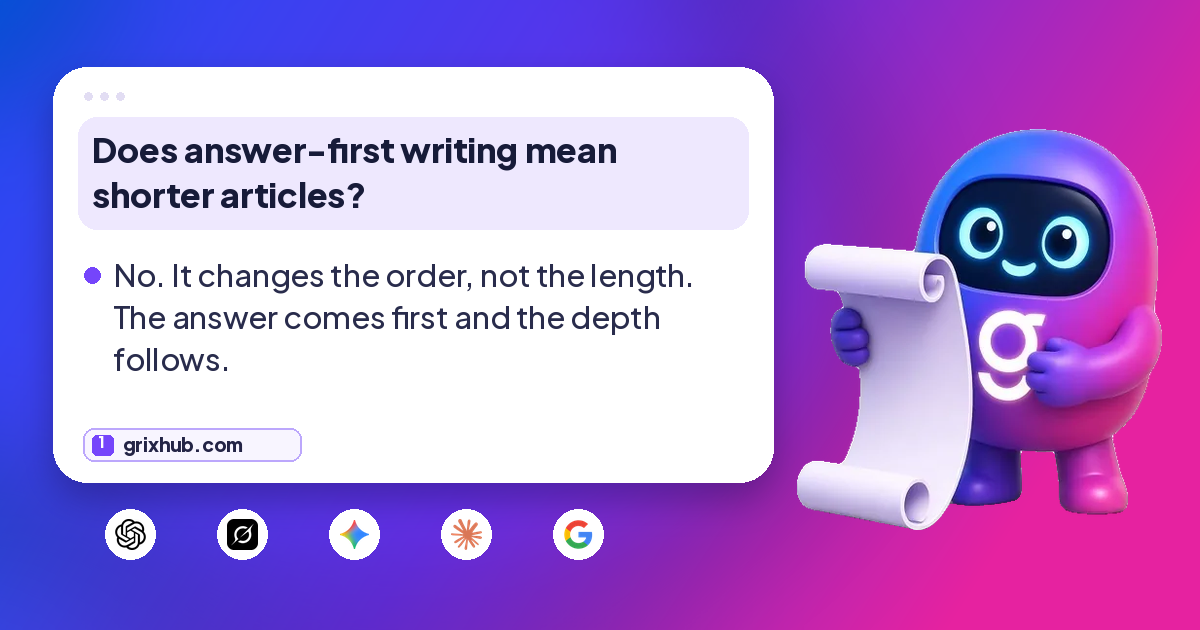
Does answer-first writing mean shorter articles?
No. It changes the order, not the length. The answer comes first and the depth follows. Long guides can be fully answer-first if every section opens with its own direct answer.
Do I need schema markup for answer-first content to be cited?
No. Google says no special schema is needed for its AI features, and AI tools read your visible text. Schema that matches your visible content is still worth adding because it helps machines understand the page and makes it eligible for rich results.
How do I know if my answer-first rewrite worked?
Track a fixed set of questions in ChatGPT, Gemini, Google AI Mode and Perplexity before and after the rewrite, running each prompt several times, and watch whether your page gets cited. Pair that with the generative AI report in Google Search Console and AI referral sessions in analytics.
Sources and further reading
- Google Search Central: Optimizing your website for generative AI features on Google Search (May 2026)
- Google Search Central Blog: A new resource for optimizing for generative AI in Google Search (John Mueller, 15 May 2026)
- Google Search Central: AI features and your website (updated 10 Dec 2025)
- Google Search Central: Creating helpful, reliable, people-first content
- Google Search Central: Featured snippets and your website (updated 10 Dec 2025)
- Google Search Central Blog: Top ways to ensure your content performs well in Google's AI experiences on Search (21 May 2025)
- Microsoft (Krishna Madhavan, Bing): Optimizing your content for inclusion in AI search answers (8 Oct 2025)
- OpenAI Help Center: Publishers and developers FAQ
- Perplexity Help Center: How does Perplexity work?
- Search Engine Land: Kevin Indig's study of 1.2 million ChatGPT answers and 18,012 verified citations (2026)
- Surfer: Why almost 40% of AI citations come from your first 100 words (18 Sep 2026)
- CXL (Tarek Reslan): Where Google AI Overviews pull their answers from: what 100 citations reveal (6 Mar 2026)
- Aggarwal et al.: GEO: Generative Engine Optimization (KDD 2024)
- Liu et al.: Lost in the Middle: How Language Models Use Long Contexts (TACL, 2023)
- Search Engine Land: Google passage ranking now live in US English search results (Feb 2021)
- Search Engine Roundtable: Google: Don't turn your content into bite-sized chunks (9 Jan 2026)
- Search Engine Land: Google doesn't want you to create bite-sized chunks of your content (Jan 2026)
- iPullRank (Mike King): A refutation of misinformation about chunking (15 Jan 2026)
- Nielsen Norman Group (Amy Schade): Inverted pyramid: writing for comprehension (Feb 2018)
- Nielsen Norman Group (Kara Pernice): F-shaped pattern of reading on the web (Nov 2017)
- Nielsen Norman Group (Jakob Nielsen): How users read on the web (Sep 1997)
- Google Search Central on YouTube: SEO, AIO, GEO, your site, and third-party support to optimize for LLMs (Search Off the Record, Jan 2026)
Keep reading

Written by Jade Teekhasaenee
Founder & Managing Director, Grixhub
Jade leads SEO and AEO strategy at Grixhub in Bangkok. He has technically audited websites for brands in Thailand and around the world, and he built GrixTrack to measure how often brands are mentioned and cited by ChatGPT, Gemini and Google AI Mode.
Want your key pages rewritten answer-first?
We will check your most important pages against the questions your customers ask ChatGPT, Gemini and Google AI Mode, show you which passages get cited and which get skipped, and rewrite them so the answer comes first.

Grixhub is a digital growth and technology company in Bangkok, Thailand: SEO, AEO, digital marketing, paid media management, websites, apps and AI automation.
Services
Digital marketing
SEO
AEO
Website development
App development
AI & automation
Paid Media Management
Google Ads
ChatGPT Ads
Facebook Ads
Instagram Ads
TikTok Ads
Contact
Email: jade@grixhub.com
Phone: +66 62 480 9604
LINE: Grixhub
Bangkok, Thailand
Company
About · Blog
Free AEO Audit call
Terms · GrixTrack Terms · Refund Policy · Privacy Policy · Cookie Policy · Image Licence
Follow us