SEO guide
How to Do SEO in Thailand: A Practical Guide
Thailand searches on Google, mostly on phones and mostly in Thai, and Google's AI Mode now answers in Thai too. This guide covers the Thai language, bilingual sites, hreflang, domains, local SEO, PDPA and AI search, with every number linked to its source.

Key takeaways6 points
- Google handled 99.33% of searches in Thailand in October 2026 (StatCounter), so SEO in Thailand means Google SEO, done mostly for phones.
- Most people in Thailand search in Thai. Thailand ranked 116th of 123 countries in the EF English Proficiency Index 2025, so English-only sites miss most of the market.
- Thai has no spaces between words and some characters have two encodings, so research real Thai queries instead of translating an English keyword list.
- For bilingual sites, keep one language per page, give each language its own URL, link them with two-way hreflang tags, and never auto-redirect by IP or browser language.
- A .co.th domain is a strong local signal but not a requirement. Subfolders such as /th/ on one domain work well and are easier to maintain.
- AI Mode has supported Thai since October 2025 and ChatGPT had 69.96% of AI chatbot traffic in Thailand in September 2026, so track AI answers in Thai and English too.

To do SEO in Thailand, you optimize for Google in the language your buyers actually use, which for most of the country is Thai, on a site that loads fast on a phone and is trusted by the Thai websites and platforms people already read. Google handled 99.33% of searches in Thailand in October 2026 (StatCounter), so the rules of the game are Google’s rules. What changes is everything around them.
Thai is written without spaces between words. Many people mix Thai and English in the same search, or type an English brand name in Thai script. A big share of buying decisions start in LINE chats, Pantip threads and Wongnai reviews rather than on a company website. And since October 2025, Google’s AI Mode answers questions in Thai.
That’s why a site that ranks well in Singapore or Sydney can be close to invisible in Bangkok or Chiang Mai. The English pages are fine. They just aren’t what most Thai searchers type, read or trust.
This guide walks through what actually works: how people in Thailand search, how the Thai language affects keywords and URLs, how to run a bilingual site without confusing Google, whether you need a .co.th domain, how local SEO and PDPA fit in, and how AI search is changing results. We’ll use one made-up business throughout so the advice stays concrete.
 How we put this guide together
This guide is written by Jade Teekhasaenee, who leads SEO and AEO at Grixhub in Bangkok, where our team technically audits websites for brands in Thailand and around the world. It draws on Google’s Search Central documentation, Thailand’s domain registry rules, named studies such as DataReportal’s Digital 2027 report, the EF English Proficiency Index and the e-Conomy SEA 2025 report, and what our team sees when we check bilingual sites in Google and in ChatGPT, Gemini and Google AI Mode. Every statistic was checked against its source on 12 November 2026. Nothing in the PDPA section is legal advice.
What makes SEO in Thailand different?
Google dominates and most traffic is mobile, but most people search in Thai, the Thai script has no spaces between words, platforms like LINE and Pantip shape decisions, and Thailand's PDPA governs tracking.
The basics of SEO don’t change at the border. Google still needs to crawl your pages, understand them and trust them. What changes in Thailand is the context those basics sit in, and that context decides whether your work pays off.
Start with the numbers. DataReportal’s newest report counts 67.6 million internet users in Thailand, or 94.6% of the population, and 99.0 million mobile connections, which is 138% of the population (DataReportal, Digital 2027: Thailand, published 4 November 2026). Almost everyone is online, and most of them are online on a phone. StatCounter put mobile at 78.38% of web traffic in Thailand in September 2026, against 18.31% for desktop (StatCounter).
Thailand’s search market in four numbers
Sources: StatCounter search share, StatCounter platform share, DataReportal. StatCounter measures page views, so shares move month to month.
Then there’s language. Most people in Thailand search in Thai, and Thai behaves differently from English in ways that affect keyword research, titles and even URLs. We cover that in detail below, because it’s where most foreign brands go wrong.
Third, Thai buyers check other places before they trust you. LINE is close to universal, Pantip is one of the most visited websites in the country, and food, travel and beauty decisions often run through Wongnai, Facebook groups and TikTok. Search rewards brands that show up consistently across all of those.
Finally, the way Google shows results is changing. AI Overviews and AI Mode now work in Thai, and ChatGPT is widely used. If you want the bigger picture of how answer engines choose sources, start with our guide to answer engine optimization, and for tracking it, see how to measure AI visibility and AI citations.
To keep things concrete, we’ll follow one made-up business through this guide: Lanna Bean Co., a hypothetical coffee roaster in Chiang Mai. It runs two cafes, sells beans online to buyers across Thailand, and wants English-speaking visitors and expats to find it too. Its problems are the ones we see most often: an English-first website, Thai pages that read like translations, and no idea whether AI tools mention it at all.
Which search engines and devices do people in Thailand use?
Google, by a very wide margin: 99.33% of searches in October 2026, with Bing at 0.53%. About four in five page views come from phones, so mobile performance and mobile layout come first.
Google is effectively the only search engine that matters for organic traffic in Thailand. In October 2026, StatCounter measured Google at 99.33% of search engine traffic, with Bing at 0.53% and every other engine below 0.1% (StatCounter).
Search engine market share in Thailand, October 2026
Source: StatCounter, all platforms, October 2026. Shares are based on page views and move month to month.
That simplifies your priorities. You don’t need a separate plan for a local search engine, the way you would in South Korea, China or Russia. Your Thai SEO work is Google SEO, and Google’s own documentation is the rulebook.
It doesn’t mean Bing is worthless, though. Microsoft Copilot’s search answers are built on Bing, so it’s still worth verifying your site in Bing Webmaster Tools and making sure Bingbot isn’t blocked. It takes an hour and protects a channel that may grow.
Mobile comes first, and it isn’t close
The device split matters just as much. StatCounter measured 78.38% of web traffic in Thailand coming from mobile phones in September 2026, 18.31% from desktops and 3.31% from tablets (StatCounter). Telenor Asia’s Digital Lives Decoded research found Thais spend nearly five hours a day online on mobile (The Reporter Asia, January 2025).
Google indexes the mobile version of your pages, so if your Thai text, prices or menus only appear on desktop, Google may never see them. Check your pages on a mid-range Android phone, not only on the latest iPhone, and test on mobile data rather than office Wi-Fi.
Thailand’s networks are fast: DataReportal reports a median mobile download speed of 134.45 Mbps (DataReportal, citing Ookla). Fast networks hide a lot of sins in casual testing, but they don’t fix heavy JavaScript, oversized images or layout shifts on cheaper phones. We cover speed and hosting in a later section.
For Lanna Bean Co., this means the first audit question isn’t “what keywords?” but “what does a Thai visitor see on a phone?” When we looked at its hypothetical site, the English homepage looked great on a laptop. On a phone, the Thai menu was an image, the shop page took several seconds to become usable, and the LINE button was hidden below the footer.
Do people in Thailand search in Thai, English or both?
Mostly Thai, with a lot of mixing. People type Thai words, English brand and product names, and English words spelled in Thai script, sometimes in the same query, so you need to research all three forms.
Most people in Thailand search in Thai. That sounds obvious, but many foreign brands still launch in English and assume people will adapt. They mostly don’t.
The clearest data point is English proficiency. Thailand ranked 116th of 123 countries in the EF English Proficiency Index 2025 with a score of 402, which EF classes as very low proficiency. The index is based on test results from 2.2 million people (The Thaiger, December 2025). People who took a voluntary English test are, if anything, more confident in English than average, so the real picture for everyday searching is likely more Thai, not less.
But Thai search queries aren’t purely Thai either. In practice you’ll see four patterns, often for the same need:
Pure Thai. A query written fully in Thai, such as a question about where to buy coffee beans in Chiang Mai. This is usually the biggest group for consumer topics.
English brand or product names inside Thai. Thai words wrapped around an English name, like an iPhone model, a skincare brand or “SEO” itself. People rarely translate brand names.
English words written in Thai script. Many borrowed words are spelled out phonetically in Thai, so “drip coffee” or “cold brew” may be typed in Thai letters. Spelling often varies, because there’s no single official transliteration for most loanwords.
Pure English. Common for expats, tourists, B2B buyers, tech topics and international brands. Smaller in volume for most consumer niches, but often high in value.
One need, four ways people in Thailand search for it
Research all four forms before you decide which page targets which query.
Illustration with a made-up coffee roaster. Query forms reflect Google’s advice to use your audience’s language and transliterated words where relevant (Google Search Central).
Google’s own guidance points the same way. Its URL guidelines tell site owners to use words in the audience’s language and, where it applies, transliterated words (Google Search Central). The same logic applies to titles, headings and body copy.
The takeaway for Lanna Bean Co. is simple. Its Thai pages should be written for Thai queries, including the loanword spellings real customers use, while its English pages should target the smaller, more specific English searches from visitors and expats. Translating one keyword list into the other language misses most of both.
How does the Thai language affect SEO?
Thai is written without spaces between words, so search engines must segment text into words themselves, and some characters, such as the vowel in ทำ, can be encoded two ways. Write natural Thai, keep spelling consistent and don't insert spaces to help Google.
Thai is written without spaces between words. Spaces mark the end of phrases or sentences instead. The W3C’s Thai script notes put it plainly: in Thai, spaces separate phrases, rather than words (W3C Internationalization).
That means any search engine has to split a run of Thai characters into words before it can match a query to a page. Researchers call this word segmentation, and it’s still an active research problem. A 2024 paper in the Journal of Computer and Creative Technology compared six segmentation techniques on LST20, a Thai corpus of 3,745 news documents, and described Thai as a language whose word boundaries lack clarity (Damrongkamoltip et al., 2024).
The process of splitting text written without spaces, such as Thai, into individual words so software can index, match or translate it. Different tools can split the same Thai sentence in different ways.
Google hasn’t published how it segments Thai. So be wary of anyone who claims to know the exact rules. What you can control is writing that is easy to segment the way a native reader would read it.
Don’t add spaces to “help” Google. Some sites insert spaces between Thai words in titles or headings, hoping to make keywords clearer. It makes the text look unnatural to Thai readers and there’s no evidence Google needs it. Write normal Thai.
Keep spelling consistent. Loanwords often have several Thai spellings. Pick the form your customers use most (check Search Console and Google’s autocomplete) and use it consistently on a page, while mentioning a common alternative naturally where it fits.
Watch out for hidden character differences. Some Thai characters have two valid encodings. The vowel in the common word ทำ (“do” or “make”) can be stored as one character, or as two characters that look identical on screen. We tested this in Python: applying Unicode NFKC normalization to ทำ changes its code points from U+0E17 U+0E33 to U+0E17 U+0E4D U+0E32. Text copied from PDFs, design tools or some CMS plugins can end up in the decomposed form, so a page can look right but not match the way people type. If a Thai page underperforms for a phrase it clearly contains, check the raw characters.
Thai text details that affect SEO
Avoid
- Spaces inserted between Thai words
- Text pasted from PDFs or design files without checking
- Thai text inside images only
Do
- Natural Thai, spaced as a native writer would
- One spelling per loanword, used consistently
- Real HTML text Google can read
NFKC turns ทำ (U+0E17 U+0E33) into U+0E17 U+0E4D U+0E32: same look, different code points
Sources: W3C Thai script resources; Damrongkamoltip et al., 2024; normalization tested by Grixhub in Python on 12 Nov 2026.
Thai URLs: readable, but long when shared
You can use Thai words in URLs. Google’s URL guidelines give a Japanese-script URL as an example of using the audience’s language, and say non-ASCII characters should be percent-encoded in links (Google Search Central). The catch is length. Each Thai character takes three bytes in UTF-8, so the two-character word ทำ becomes %E0%B8%97%E0%B8%B3 when it’s encoded. A Thai slug that looks short in the address bar can turn into a very long string when it’s pasted into LINE or email. Either choice works; pick one, stay consistent and use 301 redirects if you ever change it.
How do you do keyword research for Thailand?
Start from the questions real customers ask, in Thai and English, then check Thai autocomplete, Search Console queries filtered to Thailand, Pantip threads and competitor pages. Group queries by intent, not by language.
Good keyword research for Thailand starts with customers, not with a tool. Tools are useful, but their Thai data is thinner and more rounded than their English data, and they can’t tell you which spelling of a loanword your buyers actually use.
Here’s the process we follow when we plan Thai and English keywords for a site.
Keyword research for Thailand in five steps
- 1Collect real questionsLINE chats, calls, emails, shop staff, reviews
- 2Expand in Thai and EnglishGoogle autocomplete, People also ask, loanword spellings
- 3Check what already worksSearch Console, filtered to Thailand
- 4Read the forums and competitorsPantip threads, Facebook groups, top-ranking Thai pages
- 5Group by intent, then map to pagesone page per intent, per language
Grixhub’s working process. Volumes from keyword tools are estimates, especially for Thai.
Step 1: Collect real questions. In Thailand, a lot of pre-sales conversation happens in LINE Official Account chats and Facebook Messenger. Export or skim a few months of those messages. You’ll find the exact Thai wording people use, the loanword spellings and the worries they have before buying. Shop and cafe staff are just as useful: ask them what customers ask every day.
Step 2: Expand in both languages. Type your seed terms into Google on a phone with Thai as the interface language and note autocomplete suggestions and the People also ask questions. Do the same in English. Try the loanword in both scripts, because the suggestions often differ.
Step 3: Check what already works. In Google Search Console, open the Performance report and filter by country to Thailand. Sort queries by impressions. Thai queries where you get impressions but few clicks are your quickest wins, because Google already sees you as relevant.
Step 4: Read the forums and the competition. Pantip threads show how people describe problems in their own words, and which brands they recommend to each other. Then look at the Thai pages that rank in the top five for your main terms. Note their format, length, headings and what they answer that you don’t.
Step 5: Group by intent, then map to pages. A Thai query and an English query often share the same intent, such as “best coffee beans for a moka pot”. They should map to the same topic, but to two different pages: one in Thai and one in English. Don’t try to rank one mixed-language page for both.
Write each target query the way a person would say it out loud, not as a keyword string. AI Mode questions are long: Google says people ask it questions nearly three times longer than traditional searches (Google Thailand). Full Thai questions are what your FAQ and headings should answer.
For Lanna Bean Co., this process turned up something a tool never would. Customers in its hypothetical LINE chats kept asking whether beans would arrive fresh after a two-day delivery to Bangkok in the hot season. That became a Thai FAQ section on the shop page, and a short English page for expats asking the same question about shipping.
What are bilingual SEO best practices for Thailand?
Give each language its own URL, keep one language per page, translate the whole page rather than just the menus, link the versions with hreflang, and let users switch language instead of redirecting them automatically.
Most businesses that target Thailand end up with at least two languages: Thai for the local market and English for visitors, expats or international buyers. Done well, a bilingual site doubles your reach. Done badly, it confuses both users and Google.
These are the bilingual SEO best practices for Thailand that matter most, all based on Google’s own guidance.
One language per page. Google says to use a single language for the content and navigation of each page and to avoid side-by-side translations (Google Search Central). A page that stacks a Thai paragraph on top of its English version serves neither audience well.
Each language gets its own URL. Use a structure such as example.com/th/ and example.com/en/, or a subdomain, so each version can be crawled, indexed and linked separately. Google also recommends separate locale URLs over pages that change content based on who is visiting (Google Search Central).
Translate the whole page. Google warns that translating only the boilerplate, such as menus and footers, while the main content stays in one language can create pages that look like duplicates with different navigation (Google Search Central). If you can’t translate a page properly yet, don’t publish a half version.
Never auto-redirect by language or location. Google advises against automatically redirecting users from one language version to another, and against using IP analysis to adapt content (Google Search Central). An English-speaking expat in Bangkok with a Thai phone, or a Thai traveler in Tokyo, should see the page they asked for. Add a clear language switcher instead.
Use the language in the visible content. Google determines a page’s language from its visible content. It doesn’t use code-level information such as the lang attribute or the URL to detect language (Google Search Central). Set the lang attribute anyway for accessibility, but don’t expect it to fix a page that’s mostly in the wrong language.
Bilingual site setup: what confuses Google vs what works
Confusing
- Thai and English mixed on one page
- Same URL shows Thai or English by IP
- Only the menu is translated
Works
- /th/ and /en/ versions, one language each
- Language switcher, no forced redirect
- Full translation plus two-way hreflang
Source: Google Search Central, Managing multi-regional and multilingual sites, updated 10 Dec 2025.
Google’s Martin Splitt summed up the same advice in a short Search Central video: pick a site structure that fits, make sure every language version links to every other one with hreflang, and don’t forcefully redirect users to a version you assume they want (Search Engine Journal).
Google Search Central · YouTube
Google Search Central · 3 Tips for International Websites · watch on YouTube
Lanna Bean Co.’s hypothetical site broke three of these rules at once. Its homepage showed English to desktop visitors and Thai to visitors on Thai phones, the shop pages had Thai menus around English product descriptions, and there was no way to switch. The fix was a /th/ and /en/ structure, Thai as the default for the shop, and a switcher in the header on every page.
How should you set up hreflang for Thai and English pages?
Add hreflang annotations that list every language version of a page, including itself: th for Thai pages, en or en-TH for English pages, plus an optional x-default. Every link must be returned by the other page, or Google ignores it.
Hreflang tells Google which pages are language or regional versions of each other, so it can show the Thai version to Thai searchers and the English version to English searchers. It’s one of the most useful tags for bilingual sites in Thailand and one of the easiest to get wrong.
An annotation, added in the HTML head, an HTTP header or an XML sitemap, that tells search engines which URLs are alternate language or regional versions of the same page.
Google supports three ways to add hreflang: link tags in the HTML head, HTTP headers and XML sitemaps. It treats them as equivalent, and using more than one gives no extra benefit (Google Search Central). Most WordPress sites use the head tags their multilingual plugin generates. Large shops often use the sitemap method.
Which codes to use for Thailand
The language part of a hreflang value uses ISO 639-1 codes and the optional region part uses ISO 3166-1 Alpha 2 codes (Google Search Central). For a Thai and English site, that usually means:
Hreflang values for a Thai and English website
Every version lists itself and every other version, or Google ignores the set.
Source: Google Search Central, localized versions, updated 21 Sep 2026. Example URLs are made up.
You don’t usually need th-TH. Thai is spoken almost entirely in Thailand, so the plain th code does the job. Use en-TH only if your English pages are genuinely written for people in Thailand, for example with baht prices and Thai delivery terms, and you also have a different English version for other markets. If you have just one English version, en is simpler and fine.
The rules that break most setups
Return links are mandatory. Google says each language version must list itself as well as all other language versions, and if two pages don’t link to each other, the tags are ignored (Google Search Central). In our audits, one-way hreflang is one of the problems we run into most often on bilingual sites: the Thai page points to the English page, but the English page doesn’t point back.
A region alone is invalid. Google is explicit that you can’t specify the country code by itself, so hreflang=”TH” does nothing. Reserved codes such as UK and EU have no effect either.
Use x-default for pickers. The x-default value is the fallback for users whose language settings don’t match any version. Google recommends it for language selector pages and pages that redirect automatically.
Hreflang is a hint, not a guarantee. Google’s John Mueller has pointed out that hreflang doesn’t guarantee indexing and that not every variation is necessarily indexed. When two versions are essentially the same, such as two English versions with identical content, Google often picks one as canonical, and reporting shows the canonical URL (Search Engine Roundtable, May 2025). That’s another reason not to create en-TH and en versions unless they really differ.
Hreflang tags must sit in a valid HTML head. A script or tag that breaks the head section early can make everything after it, including hreflang, invisible to Google. View the raw HTML of a Thai page, not the rendered page, and confirm the tags are there.
Do you need a .co.th domain to rank in Thailand?
No. A .co.th or .th domain is a strong country signal, but sites on .com with a /th/ subfolder and hreflang rank in Thailand too. Choose based on your business: one country only, or Thailand plus other markets.
No, you don’t need a .co.th domain to rank in Thailand. Many sites that rank well for Thai searches use .com. But a Thai country-code domain is a real signal, and for some businesses it’s the right choice.
Google lists four ways to structure an international site: a country-code domain (ccTLD) such as example.co.th, a subdomain such as th.example.com, a subdirectory such as example.com/th/, and URL parameters, which it doesn’t recommend (Google Search Central). It describes a ccTLD as a clear geotargeting signal, but notes that it’s more expensive, can have strict eligibility rules and can target only one country.
Four ways to structure a site for Thailand
Sources: Google Search Central; T.H.NIC registration guidelines.
Who can register a .co.th?
Thailand’s domain registry, T.H.NIC, limits .co.th to juristic persons, commercial enterprises, business owners and trademark owners. Foreign businesses or trademark owners can qualify if they appoint a Thai representative. Accepted proof includes company registration documents, a commercial registration, a business license or a trademark registration certificate, and the domain must match the organization’s name or registered trademark (T.H.NIC). By contrast, .in.th is open to individuals with ID, and .or.th and .ac.th are for organizations and schools.
So a .co.th domain can’t simply be bought for any keyword you like. That’s partly why it carries trust with Thai users: it suggests a registered business.
So which should you choose?
If you only serve Thailand and you have a registered Thai company or trademark, a .co.th is a natural fit. It’s clear to users and to Google.
If you serve Thailand and other countries, one domain with subfolders is usually easier. Every link you earn helps all language versions, you only manage one site, and hreflang does the language targeting. Google’s John Mueller made a similar point in December 2025, telling a company that had bought ccTLDs for each country that he questioned whether it really needed to split its site across them, since separate domains make things harder for site owners and for search engines (Search Engine Roundtable).
Lanna Bean Co. is a hypothetical Thai company that mostly sells inside Thailand, so it could use a .co.th. But it already had years of links pointing at its .com, so the cheaper path was to keep the .com, put Thai on /th/ and register the matching .co.th only to redirect it and protect the name.
Does hosting location matter for SEO in Thailand?
Not directly. Google treats server location as a weak signal and Googlebot mostly crawls from US IP addresses, so speed matters far more than where the server sits. Use a CDN with nodes near Thailand and meet Core Web Vitals on mobile.
Server location matters much less than most people think. Google lists server location as one of several signals it can use to understand a site’s audience, but it says the signal isn’t definitive, because CDNs and hosting choices blur it (Google Search Central). The other signals it lists include a ccTLD, hreflang, local addresses and phone numbers, the language and currency on the page, local links and Business Profile data.
There’s also a practical detail. Google says the default IP addresses of Googlebot appear to be based in the USA, although it also crawls from addresses outside the US (Google Search Central). So if your server shows different content to visitors from Thailand, Google may never see your Thai content. That’s another reason to give each version its own URL.
What matters instead: speed for Thai users
Where hosting does matter is speed. A server in Europe or the US adds delay for every request from Bangkok, and that delay shows up in your Core Web Vitals. Google’s “good” thresholds are a Largest Contentful Paint within 2.5 seconds, an Interaction to Next Paint of 200 milliseconds or less and a Cumulative Layout Shift of 0.1 or less, measured at the 75th percentile of page loads and split by mobile and desktop (web.dev).
Because most Thai traffic is mobile, your mobile numbers are the ones that count. A content delivery network (CDN) with points of presence in or near Thailand is usually the easiest win. It caches images, scripts and often whole pages close to your visitors, wherever the origin server is.
Thai web fonts. Fonts that cover both Thai and Latin characters contain more glyphs than Latin-only fonts, so they are usually heavier files. Load only the weights you use, preload the main one and use font-display: swap so text appears quickly. A page that waits for a heavy Thai font before showing any text feels slow even on 5G.
Images and menus. Many Thai restaurant, cafe and clinic sites post menus and price lists as large images. They’re slow, Google can’t read the prices well, and AI tools can’t quote them. Put the text in HTML and use compressed WebP images for the visuals. Our free WebP converter does this in your browser.
Some security plugins and CDNs have a “block AI bots” or aggressive bot-protection setting. It can stop the crawlers behind ChatGPT search and Perplexity as well as training bots. Our free AI Crawler Checker tests the main crawlers against your site.
Lanna Bean Co.’s hypothetical site was hosted cheaply in Europe. Moving it behind a CDN with an Asia edge, converting its menu images to HTML text and trimming its Thai font to two weights did more for its mobile experience than any change of server would have.
Thai SEO tips: how do you write content that ranks and doesn't read as translated?
Write in Thai first with native writers, study how top Thai pages cover the topic, answer the real question in the first lines, use the loanword spellings people search, and show who is behind the content.
The single biggest Thai SEO tip is this: write Thai content in Thai, for Thai readers, instead of translating English pages. Translated Thai is easy to spot. It uses stiff, formal phrasing, the wrong loanword spellings and examples that don’t fit local life. Thai readers notice, and they leave.
Google’s ranking systems are built to reward helpful, people-first content, and Google says there are no extra requirements for AI Overviews or AI Mode beyond normal SEO best practice (Google Search Central). For Thai content, “helpful” starts with sounding like a person who actually lives the topic.
Study the top Thai pages first. Before writing, read the five Thai pages that rank best for your main query. Look at their tone (formal or casual), the words they use for key concepts, how long they are, and what questions they answer. You’re not copying them. You’re learning the vocabulary and expectations of the reader.
Answer the question in the first lines. Thai readers scan on phones just like everyone else. Put a direct answer in the first sentence under each heading, then explain. This also makes a passage easier for AI answers to quote, which we cover in our AEO guide.
Use the words people search. If customers type a loanword in Thai script, use that spelling in your heading and text, and mention the English term once where it helps. Industry terms are often clearer in English, so don’t force awkward Thai translations of technical words.
Be specific about Thailand. Prices in baht, delivery times to Bangkok and the provinces, opening hours, LINE IDs, BTS or MRT stations, and seasonal details such as the hot season or the rainy season. These details are what make content useful, and they’re exactly what translated pages leave out.
Show who wrote it. Name the author, show their real experience and add a visible date. This matters for any topic where people spend money or take risks, and it builds the kind of trust that helps a brand become a recognized entity. We explain how in what entity SEO is.
Thai titles and meta descriptions
Google doesn’t publish a character limit for titles or descriptions; what you see is cut by pixel width on the device. Thai complicates character counts, because vowels and tone marks sit above or below consonants and take no extra width, so a Thai title can have more characters than an English one and still fit. Preview Thai titles on a phone-sized screen rather than trusting a character count. Our SERP snippet preview tool helps, and keep the main Thai keyword near the start.
A stiff Thai paragraph translated word for word from English, describing “premium quality coffee beans with passion”, no price, no roast date, and an English loanword spelled differently from how buyers type it.
A natural Thai paragraph that opens with the roast schedule and delivery time to Bangkok, gives the baht price per 250 g bag, uses the loanword spelling customers use in LINE chats, and names the head roaster.
Lanna Bean Co.’s hypothetical Thai pages improved most when its Thai head roaster briefed a Thai writer directly instead of sending English copy to a translator.
How do you do local SEO in Thailand with Google Business Profile?
Claim and verify your Google Business Profile, fill in every field in Thai and English where useful, keep hours and contact details accurate, add real photos, and earn and reply to genuine reviews. Google ranks local results by relevance, distance and prominence.
If you have a physical location in Thailand, your Google Business Profile is often worth more than your homepage. It’s what appears in Google Maps and the local pack when someone searches for a cafe, clinic or shop nearby.
Google says local results are based mainly on three things: relevance (how well a profile matches the search), distance (how far the business is from the searcher) and prominence (how well-known the business is). It also says there’s no way to request or pay for a better local ranking (Google Business Profile Help).
You can’t change distance, but you can work on the other two.
Verify and complete the profile. Google says businesses with complete and accurate information are more likely to show up in local results. Fill in categories, services, products, attributes, opening hours, special holiday hours, phone, website and a description.
Handle names and addresses carefully. In Thailand, many businesses have a Thai name and an English name, and addresses can be written in Thai or romanized. Use your real business name as it appears on signage, don’t stuff keywords into it, and keep the same name, address and phone number everywhere online, including your website footer, Facebook page, LINE Official Account and Wongnai listing.
Keep hours accurate. Thai public holidays and long weekends change opening hours often. Update special hours before Songkran and New Year, not after customers complain.
Earn and reply to reviews. Google says replying to reviews shows you value customers’ feedback. Reply in the language the review was written in. Never pay for reviews or offer discounts in exchange for them, because that breaks Google’s policies and can get reviews removed.
Add real photos. Photos of your storefront, your team and your products help people recognize you when they arrive. They also make your profile more complete.
Local SEO is now also local AI visibility. When someone asks Google AI Mode or ChatGPT for a good cafe or clinic nearby, the answer leans heavily on business profiles, reviews and local listings. Our guide to AEO for local businesses covers how to get named in those answers.
For Lanna Bean Co., the hypothetical quick wins were obvious: both cafes had unverified duplicate profiles, one listed old hours, and the English name on Google didn’t match the Thai name on Wongnai. Merging duplicates, fixing hours and aligning names took an afternoon.
What role do LINE, Pantip, Wongnai and social platforms play in Thai SEO?
They shape what people trust before they search and what Google and AI tools see about you. LINE is used by over 80% of online adults, Pantip is one of Thailand's most visited sites, and Wongnai is a key review platform for food and lifestyle.
Search doesn’t happen in a vacuum. In Thailand, people often hear about a brand in a LINE group, check it on Facebook or TikTok, read what Pantip users say, then search for it on Google. Each of those steps affects your SEO, either by creating branded searches or by putting your name on pages that Google and AI tools read.
The reach of these platforms is enormous. In GWI’s survey of online adults aged 16 and over in Q2 2026, 87.1% said they had used Facebook in the past month, 82.5% LINE, 82.0% TikTok and 81.2% YouTube (DataReportal, Digital 2027: Thailand).
Platforms used in the past month by online adults in Thailand, Q2 2026
Source: GWI via DataReportal, Digital 2027: Thailand, published 4 Nov 2026. Self-reported use among internet users aged 16+.
LINE. LINE isn’t a search engine, and LINE chats aren’t indexed by Google. But it’s where many Thai customers ask questions and buy. A visible LINE Official Account link on your site turns organic visitors into conversations, and the questions in those chats are your best keyword research. DataReportal counts 56.3 million monthly active LINE users in Thailand.
Pantip. Pantip is Thailand’s best-known discussion forum, and its threads rank for a huge range of Thai questions. Ahrefs estimated Pantip at about 16.5 million monthly organic visits in October 2026, the seventh-largest site in Thailand by organic traffic (Ahrefs). Reading Pantip shows you how people describe problems. Taking part honestly, as a named and disclosed brand or expert, can earn mentions. Spamming it does the opposite.
Wongnai. For restaurants, cafes, spas and many lifestyle businesses, Wongnai is a key review and discovery platform, and its listings often rank alongside Google Maps results. Ahrefs put it at about 6.2 million monthly organic visits in the same period. Keep your Wongnai listing complete and consistent with your Google Business Profile.
Estimated monthly organic search visits to selected sites in Thailand, October 2026
Facebook, YouTube and Google itself rank above all of these
Source: Ahrefs, top websites in Thailand, October 2026. Estimates of organic search traffic, not total visits; adult sites in the list are left out.
Facebook, TikTok and Lemon8. Short videos and posts drive discovery, especially for food, beauty and travel. They rarely send much direct organic search traffic, but they create the branded searches and mentions that support rankings.
How do you build links and mentions in Thailand?
Earn them from Thai sources your customers already read: local news and portal sites, industry associations, partners, suppliers, events and genuine community participation. Avoid paid link packages, which are common and risky.
Links and mentions still matter for rankings in Thailand, and for AI answers too, because AI tools lean on what other sites say about you. The best links come from Thai websites that your customers actually read, and they’re earned, not bought.
Thai news and portal sites. As the Ahrefs data above shows, Thai portals and news sites have very large organic audiences. Coverage there comes from having something worth reporting: original data, a local angle, a useful comment on an industry change or a real event. A Thai-language press release with a clear story and real numbers gets further than an English one.
Partners and suppliers. Distributors, suppliers, venues, schools and clients you work with often have websites that list partners. These links are local, relevant and easy to ask for.
Associations and chambers. Thai trade associations, foreign chambers of commerce in Bangkok and local business groups often have member directories that are trusted and relevant.
Events and sponsorships. Local events, workshops and community activities often get written up by organizers, venues and local media. A coffee cupping workshop at Lanna Bean Co. is a better link-building idea than any link package.
Forums and communities, honestly. Answering questions on Pantip or in Facebook groups, as a disclosed brand or named expert, can earn mentions and branded searches. It works only when the answer is genuinely useful.
Cheap “backlink packages” that promise hundreds of links for a small fee are easy to find. Links bought to manipulate rankings break Google’s spam policies. At best they’re ignored; at worst they lead to a manual action. Spend that budget on content or PR that earns links instead.
Mentions matter even without a link. AI tools build their picture of a brand from what other websites say, and Google uses signals of prominence for local results. Our guide to building topical authority covers how links and content work together. If you want help with the work, see our SEO service.
How are AI Overviews, AI Mode and ChatGPT changing SEO in Thailand?
AI Overviews and AI Mode both work in Thai, and ChatGPT had about 70% of AI chatbot traffic in Thailand in September 2026. Pages still need normal SEO to be cited, but you also need clear, quotable Thai and English answers and a way to track AI mentions.
AI answers are now part of search in Thailand, in Thai. Google’s help page lists both Thailand and the Thai language among the places where AI Overviews are available (Google Search Help), and Google announced on 8 October 2025 that AI Mode, its full conversational search experience, now supports Thai (Google Thailand blog).
That launch was part of a wider expansion. Google said on 7 October 2025 that AI Mode was launching in more than 35 new languages and over 40 new countries and territories, bringing it to over 200 countries and territories in total (Google). Thai was in the list of new languages (Search Engine Roundtable). Google’s Rajan Patel announced the rollout on X the same day:
— Rajan Patel (@rajanpatel) October 7, 2025
Outside Google, ChatGPT dominates. StatCounter measured ChatGPT at 69.96% of AI chatbot page views in Thailand in September 2026, followed by Google Gemini at 24.5% and Perplexity at 3.39% (StatCounter). Ahrefs’ October 2026 list of Thailand’s top sites by organic traffic also includes both chatgpt.com and openai.com in the top 12 (Ahrefs).
AI chatbot market share in Thailand, September 2026
Source: StatCounter, September 2026. Based on page views of AI chatbot sites, not on number of users.
Thai consumers are using AI, but cautiously. The e-Conomy SEA 2025 report by Google, Temasek and Bain found that 45% of Thai respondents interact with AI tools and features every day and 35% have conversations with or ask questions of AI chatbots, while trust in AI stood at 47%, below the ASEAN average of 50% (e-Conomy SEA 2025, Thailand). Those figures come from a Google and Milieu survey of 7,200 consumers across ten ASEAN countries in September 2025.
What changes for your SEO
Normal SEO is still the entry ticket. Google says a page must be indexed and eligible to show with a snippet to appear as a supporting link in AI Overviews or AI Mode, and that there are no additional technical requirements or special files (Google Search Central). Everything earlier in this guide still applies.
Answers get longer and more specific. AI Mode questions are nearly three times longer than traditional searches, according to Google. Thai pages that answer full questions clearly, with real numbers, are more likely to be pulled into those answers.
Language changes the answer. In our checks, the same question asked in Thai and in English can produce different answers citing different sources, because each language draws on a different pool of pages. A brand cited in English may be missing in Thai. Test both.
Fewer clicks, more influence. When an AI answer satisfies a question, fewer people click through. The numbers behind this trend are in our AI search statistics roundup, and our guide to optimizing for Google AI Mode covers the platform in depth. If you’re wondering whether any of this makes SEO pointless, we tackle that question here. Short version: it doesn’t.
What does Thailand's PDPA mean for SEO tracking and analytics?
Thailand's Personal Data Protection Act has applied in full since 1 June 2022. There is no separate cookie law, so non-essential cookies such as analytics and advertising cookies generally need explicit consent first. Plan for some data loss in your reports.
Thailand’s Personal Data Protection Act B.E. 2562 (2019), known as the PDPA, affects how you track visitors from organic search. It was fully enforced from 1 June 2022 (LawPlus), and the regulator has been issuing real fines.
This section is general information to help you plan SEO measurement, not legal advice. Check your own setup with a lawyer qualified in Thai data protection law.
Cookies fall under the PDPA. Thailand has no specific cookie law, so cookies are covered by the PDPA. According to Chandler Mori Hamada’s 2025 Chambers guide, strictly necessary cookies don’t need consent, but explicit consent is required before performance, functional, targeting and advertising cookies are used (Chambers Practice Guides). In practice, that usually includes analytics tags such as Google Analytics.
Enforcement is real. By August 2025, Thailand’s Personal Data Protection Committee had imposed fines totaling about THB 21.5 million, and the largest single fine was THB 7 million, against a company whose data breach led to a call-center scam (Tilleke and Gibbins). Those cases weren’t about cookies, but they show the regulator is active.
What this means for measuring SEO
Use a proper consent banner in Thai and English. Visitors should be able to accept or reject non-essential cookies as easily as each other, in the language of the page they’re reading.
Expect gaps in analytics. When some visitors decline analytics cookies, GA4 sees fewer sessions than actually happened. Don’t panic when organic sessions in GA4 look lower than clicks in Search Console. They measure different things, and consent widens the gap.
Use Search Console as your baseline. Search Console data comes from Google’s side, not from cookies on your site, so it isn’t affected by your consent banner. For SEO trends in Thailand, it’s the most consistent source you have.
For Lanna Bean Co., the hypothetical change was simple: a bilingual consent banner, GA4 set to respect consent, and a monthly report that leads with Search Console clicks and impressions for Thailand rather than GA4 sessions.
How do you measure SEO results in Thailand?
Track Search Console clicks and impressions filtered to Thailand, rankings by city and language, conversions such as LINE chats and orders, and how often AI answers mention or cite you in Thai and English.
Measuring SEO in Thailand means measuring in two languages and, increasingly, in two kinds of search: classic results and AI answers. A single “rank for keyword X” number tells you very little.
Search Console, filtered to Thailand. In the Performance report, filter by country to Thailand and compare Thai and English queries separately. Google says traffic from AI features such as AI Overviews and AI Mode is included in the Performance report under the Web search type (Google Search Central), so it’s in your numbers even if it isn’t broken out.
Rankings by city and language. Results in Bangkok can differ from results in Chiang Mai or Phuket, and Thai-interface results can differ from English-interface results. Track your main keywords in the locations and languages that matter to you. Our tool GrixTrack tracks Google rankings by country, city and language, and has a free plan with 10 keywords, 5 prompts, 1 project and 2 competitors.
Conversions that fit Thailand. A lot of Thai buying happens in LINE. Track clicks on your LINE Official Account button, phone taps, map direction requests and orders as conversions, not just form submissions.
AI mentions and citations. Pick 20 to 50 real questions in Thai and English, run them in ChatGPT, Gemini and Google AI Mode, and record whether your brand is named and your pages are cited. Answers vary from run to run, which is why GrixTrack runs each prompt 3 times. Our hub guide on measuring AI visibility explains the full method.
Report Thai and English separately. A site can grow strongly in English and stall in Thai, and a blended number hides it. For most consumer businesses, the Thai line is the one that pays the bills.
For Lanna Bean Co., the hypothetical monthly report fits on one page: Search Console clicks for Thailand split by Thai and English queries, rankings for 30 core keywords in Chiang Mai and Bangkok, LINE clicks and online orders from organic, and a short table of how often it’s named in AI answers in each language.
How do you rank a website in Thailand, step by step?
Fix crawling, mobile speed and language structure first, then build Thai and English pages around real customer questions, complete your Google Business Profile, earn local mentions and links, and track rankings and AI answers monthly. Plan in quarters, not weeks.
To rank a website in Thailand, work in this order: make the site readable and fast, make each language version clear, build pages that answer real questions in Thai and English, strengthen local signals, then earn mentions over time. Each stage builds on the last.
Google doesn’t publish a timeline for SEO results, and it says plainly that no one can guarantee a #1 ranking on Google (Google Search Central). Be suspicious of anyone in Thailand who promises first-page rankings by a date. What you can plan is the order of work and typical ranges for each stage.
A plan to rank a website in Thailand
- Weeks
- 1Weeks 1 to 2: Technical and mobile auditindexing, speed, Thai fonts, bot blocking
- 2Weeks 2 to 4: Language structure/th/ and /en/ URLs, two-way hreflang, no auto-redirect
- 3Weeks 2 to 4: Google Business Profile and listingsverified, complete, consistent with Wongnai and LINE
- Months
- 4Months 1 to 3: Rewrite or write key Thai pagesnative writers, real questions, answer first
- 5Months 2 to 6+: Mentions and linksThai PR, partners, associations, events
- 6Monthly: Measure and adjustSearch Console, rankings by city, AI answers in Thai and English
Grixhub’s working plan. Ranges are typical, not guarantees: Google says no one can guarantee a #1 ranking.
Weeks 1 to 2: technical and mobile audit. Confirm your key pages are indexed in Google Search Console, that nothing blocks Googlebot or the AI search crawlers, that pages are fast on a mid-range phone and that the main Thai text is real HTML. Technical fixes are usually the fastest to show up, because Google only needs to recrawl.
Weeks 2 to 4: language structure. Put each language on its own URLs, add two-way hreflang, remove any automatic language redirects, and add a language switcher. If you’re changing URLs, map 301 redirects carefully so you don’t lose existing rankings.
Weeks 2 to 4: local profiles. Verify and complete your Google Business Profile, clean up duplicates, and align your name, address and phone number across Wongnai, Facebook and your LINE Official Account.
Months 1 to 3: Thai content. Rewrite your most important Thai pages with native writers, starting with the pages closest to revenue: services, products, pricing and locations. Then add supporting articles around the questions you found in keyword research.
Months 2 to 6 and beyond: mentions and links. This takes longest and matters most for competitive terms. Thai PR, partnerships, associations and community activity build the reputation that both Google and AI tools look for.
Every month: measure and adjust. Look at Search Console for Thailand, rankings by city and language, conversions and AI answers. Double down on what moves and fix what doesn’t.
If you’d rather not do it alone, our SEO service can help.
What mistakes should you avoid when doing SEO in Thailand?
The most common are launching in English only, machine-translating Thai pages, auto-redirecting by IP or language, one-way hreflang, menus and prices inside images, inconsistent business names, bought links, and ignoring PDPA consent.
Most SEO problems we see on sites that target Thailand come from a short list of avoidable mistakes. If you fix these, you’re ahead of a large share of competitors.
Launching in English only. With Thailand ranked 116th of 123 in the EF English Proficiency Index 2025, an English-only site speaks to a small slice of the market. Unless your audience is truly expats, tourists or international buyers, Thai has to come first.
Machine-translated Thai. Translated text uses the wrong words, the wrong tone and the wrong spellings. It rarely ranks for the queries Thai people actually type, and it doesn’t convince the ones who do land on it.
Automatic redirects. Redirecting visitors by IP address or browser language is against Google’s advice, and it can stop Googlebot, which mostly crawls from US IP addresses, from ever seeing your Thai pages.
Broken hreflang. One-way links, region-only codes such as TH, and tags that point to redirected or noindexed URLs. Any of these can make Google ignore the whole set.
Bought link packages. Cheap links from unrelated sites break Google’s spam policies and waste budget that could earn real coverage.
Ignoring consent. Firing analytics and advertising tags before consent creates PDPA risk, and it makes your data look more complete than it legally should be.
Not checking AI answers. Many brands still have no idea what ChatGPT or Google AI Mode says about them in Thai. Run your top questions once a month in both languages and write down what you see.
None of these fixes needs a big budget. Start with the mistakes that cost the most, usually language and structure, and work down the list.
Frequently asked questions

Is SEO in Thailand different from SEO in other countries?
The fundamentals are the same, but the language, the platforms and the local rules change how you apply them. Google has over 99% of searches, most traffic is mobile, most people search in Thai, and platforms such as LINE, Pantip and Wongnai shape what people read before they buy. Thailand’s PDPA also affects how you track visitors.
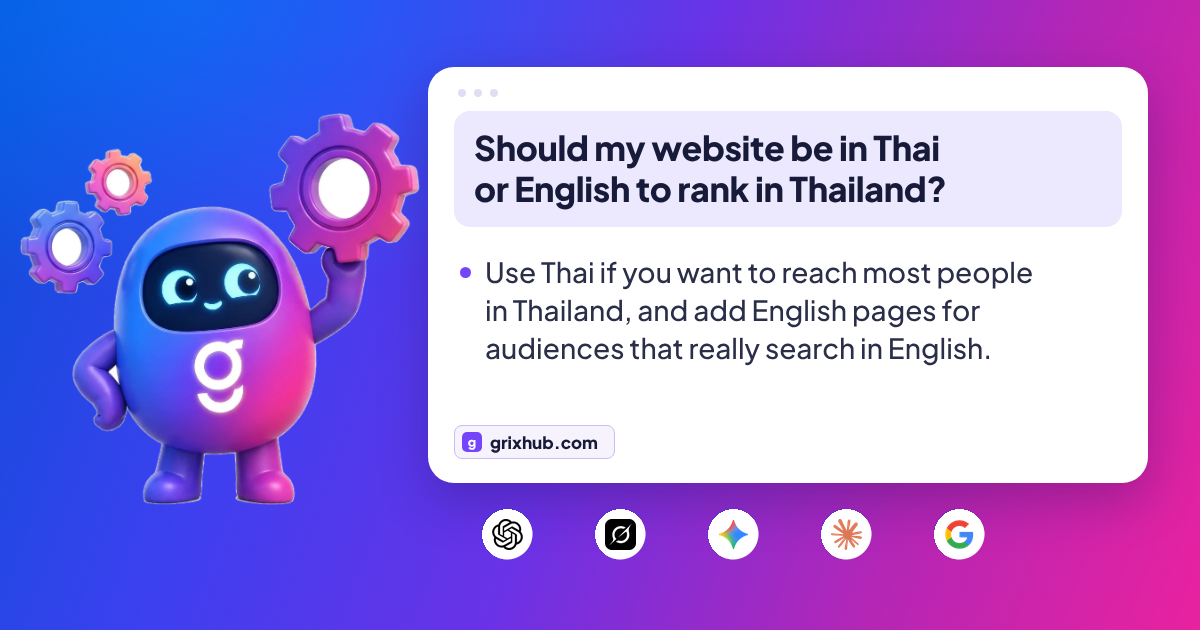
Should my website be in Thai or English to rank in Thailand?
Use Thai if you want to reach most people in Thailand, and add English pages for audiences that really search in English. Thailand ranked 116th of 123 countries in the EF English Proficiency Index 2025, so English-only sites reach a small slice of the market. Expats, tourists and B2B buyers are the main exceptions.
Do I need a .co.th domain to rank in Google in Thailand?
No, a .co.th domain is not required to rank in Thailand, although Google treats country-code domains as a strong local signal. A .co.th needs proof of a business or trademark that matches the name. A subfolder such as /th/ on your main domain, linked with hreflang, is simpler for most brands that also serve other countries.
What hreflang codes should I use for Thailand?
Use th for Thai pages and en or en-TH for English pages, depending on whether the English version is written for everyone or for people in Thailand. Every page must list itself and all its alternates, and an x-default can point to a language picker. A region code on its own, such as TH, is invalid.
How long does it take to rank a website in Thailand?
There is no fixed timeline, and Google says no one can guarantee a top ranking. Technical fixes can be picked up within days or weeks of a recrawl, new Thai content usually needs months to settle, and competitive terms that depend on links and reputation take longest. Plan in quarters, not weeks.
Does Google AI Mode work in Thai?
Yes, Google announced on 8 October 2025 that AI Mode supports Thai. Google’s help page also lists Thailand and the Thai language for AI Overviews. Pages need to be indexed and eligible for a snippet to appear as a link in either feature, so normal SEO still decides who gets cited.
Do I need cookie consent for analytics on a Thai website?
In most cases, yes, for any cookie that is not strictly necessary. Thailand has no separate cookie law, so cookies fall under the PDPA, and legal guides say explicit consent is needed before performance, functional and advertising cookies are set. This is general information, not legal advice, so check with a Thai lawyer.
Sources and further reading
- StatCounter: Search engine market share in Thailand (October 2026)
- StatCounter: Desktop vs mobile vs tablet market share in Thailand (September 2026)
- StatCounter: AI chatbot market share in Thailand (September 2026)
- DataReportal (Kepios): Digital 2027: Thailand (4 Nov 2026)
- DataReportal (Kepios): Digital 2026: Thailand (8 Nov 2025)
- Google Thailand blog: AI Mode now supports Thai (8 Oct 2025)
- Google: AI Mode expands to more than 35 new languages and 40 new countries (7 Oct 2025)
- Search Engine Roundtable: Google AI Mode expands to 35 new languages and 40 countries (9 Oct 2025)
- Google Search Help: Where AI Overviews are available (countries and languages)
- Google Search Central: AI features and your website (updated 10 Dec 2025)
- Google Search Central: Managing multi-regional and multilingual sites (updated 10 Dec 2025)
- Google Search Central: Tell Google about localized versions of your page (hreflang, updated 21 Sep 2026)
- Google Search Central: Locale-adaptive pages (updated 10 Dec 2025)
- Google Search Central: URL structure best practices (updated 21 Oct 2026)
- Google Search Central: Do you need an SEO? (updated 5 Jun 2026)
- Google Business Profile Help: Tips to improve your local ranking on Google
- web.dev: Web Vitals (good thresholds for LCP, INP and CLS)
- Search Engine Journal: Google's Martin Splitt shares 3 SEO tips for multilingual sites (15 Oct 2024)
- Search Engine Roundtable: Google questions the need for ccTLDs for some international websites (29 Dec 2025)
- Search Engine Roundtable: Google says hreflang doesn't guarantee indexing (13 May 2025)
- T.H.NIC: Registration guidelines for .co.th, .in.th, .or.th and other .th domains
- W3C Internationalization: Thai script resources
- Damrongkamoltip et al.: Comparing Thai word segmentation methods in the LST20 dataset (Journal of Computer and Creative Technology, Aug 2024)
- The Thaiger: Thailand ranks 116th of 123 in the EF English Proficiency Index 2025 (18 Dec 2025)
- Google, Temasek and Bain: e-Conomy SEA 2025, Thailand report
- The Reporter Asia: Telenor Asia Digital Lives Decoded, Thailand (21 Jan 2025)
- Ahrefs: Top websites in Thailand by organic search traffic (October 2026)
- LawPlus: Enforcement of Thailand's PDPA from 1 June 2022 (29 Apr 2022)
- Chambers Practice Guides: Data Protection and Privacy 2025, Thailand (Chandler Mori Hamada, 11 Mar 2025)
- Tilleke and Gibbins: Eight serious fines imposed in Thai data protection cases (1 Aug 2025)
- Google Search Central on YouTube: 3 Tips for International Websites
- Rajan Patel (Google) on X: AI Mode rolls out to new languages and countries (7 Oct 2025)
Keep reading

Written by Jade Teekhasaenee
Founder & Managing Director, Grixhub
Jade leads SEO and AEO strategy at Grixhub in Bangkok. He has technically audited websites for brands in Thailand and around the world, and he built GrixTrack to measure how often brands are mentioned and cited by ChatGPT, Gemini and Google AI Mode.

Want a second opinion on your SEO in Thailand?
We will check how your site handles Thai and English, whether Google and AI search can read every version, and what it takes to rank and get cited for the questions your buyers ask in Thailand.

Grixhub is a digital growth and technology company in Bangkok, Thailand: SEO, AEO, digital marketing, paid media management, websites, apps and AI automation.
 Registered company
Services
Digital marketing
SEO
AEO
Website development
App development
AI & automation
Paid Media Management
Google Ads
ChatGPT Ads
Facebook Ads
Instagram Ads
TikTok Ads
Contact
Email: jade@grixhub.com
Phone: +66 62 480 9604
LINE: Grixhub
Bangkok, Thailand
Company
About · Blog
Free AEO Audit call
Terms · GrixTrack Terms · Refund Policy · Privacy Policy · Cookie Policy · Image Licence
Follow us