AI search for law firms
How to Get Your Law Firm Recommended by ChatGPT
When someone asks ChatGPT for a lawyer, it names a few firms and cites where it found them. This guide shows how clients use AI to find a lawyer, which sources AI trusts, and how to earn those mentions without breaking lawyer advertising rules.
Key takeaways6 points
- ChatGPT named at least one actual law firm in about 99% of answers to lawyer-finding questions in a 2026 study of 38,173 AI answers, so being one of those names is now a real source of clients.
- 57% of US consumers have used or would use AI for a legal question (Clio, 2025), but most people still start on Google and very few hire straight from a chatbot. AI shapes the shortlist.
- AI tools lean on third parties: state bars, Martindale-Hubbell and Avvo each appeared in roughly half of AI answers about finding a lawyer in October 2026, and 96% of Perplexity's answers in one study cited a legal directory.
- The foundation is simple: let AI crawlers in, keep your Google Business Profile and directory profiles complete and identical, and write practice pages that answer real questions under a named lawyer.
- Lawyer advertising rules apply to everything an AI reads about you. Rules differ by state and country, so check yours before you publish claims, reviews or fees.
- Different AI tools rarely agree on which firms to name, so track a fixed set of client questions in each tool every month and judge progress over quarters.
To get your law firm recommended by ChatGPT, you need to be easy for AI to find and easy for it to trust: a website its search crawler can read, practice pages that answer real client questions, and consistent profiles on the bar listings, directories and review sites that AI already cites. When those pieces line up, ChatGPT has good reasons to put your firm’s name in its answer.
A few years ago, a person who needed a lawyer asked a friend, then typed something like “employment lawyer near me” into Google and called two or three firms from the map.
That still happens. But more people now describe their problem to ChatGPT first. They ask what their options are, whether they even need a lawyer, and then which firms near them handle this kind of case. ChatGPT answers with a short list of names and a few source links.
If your firm is on that list, you start the relationship with a recommendation. If it isn’t, that person may never hear your name, no matter how well your site ranks on Google.
The good news is that the way AI picks law firms isn’t a mystery. It reads sources you can see, many of which you can influence honestly. The less obvious part is that every one of those sources is also lawyer advertising, so the same professional rules apply. This guide covers both.
 How we put this guide together
This guide is written by Jade Teekhasaenee, who leads SEO and AEO at Grixhub, where our team has technically audited the websites of more than 70 brands. It draws on official documentation from OpenAI and Google, the ABA Model Rules and other bar rules, named studies of legal consumers and AI answers, and what our team sees when we check brands’ visibility in ChatGPT, Gemini and Google AI Mode. Every statistic was checked against its source on 11 November 2026. Grixhub is not a law firm, and nothing here is legal advice: check your own jurisdiction’s rules before you publish.
Can ChatGPT really recommend a law firm?
Yes. When people ask ChatGPT for a lawyer, it usually names specific firms. In a 2026 study of 38,173 AI answers, ChatGPT named an actual firm in about 99% of them, while Gemini mostly gave general advice instead.
Yes. Ask ChatGPT for a family lawyer in Houston or an immigration lawyer in Chicago and you will usually get named firms back, not just general tips.
The clearest data on this comes from a study by Forward Push, a law firm marketing agency. Between late April and early June 2026, it asked ChatGPT, Perplexity, Gemini and Claude the kinds of questions real clients type, across 25 practice areas and 15 US cities. After removing errors, it had 38,173 answers. ChatGPT and Claude named an actual law firm in about 99% of them and Perplexity in about 96%. Gemini named a firm in only about 12%, and mostly told people to check reviews and book consultations instead (Forward Push via EIN Presswire). The agency sells law firm marketing, so treat it as a useful snapshot rather than a neutral census, but the scale is large.
So the question isn’t whether AI recommends lawyers. It does. The question is whose names it picks and why.
To make the rest of this guide concrete, we’ll follow one made-up firm. Call it Northgate Employment Law: six lawyers in Chicago who handle wrongful termination, discrimination and wage claims. A laid-off warehouse manager opens ChatGPT and types: “I think I was fired for reporting a safety problem. Who are good employment lawyers in Chicago who take cases like this on contingency?”
ChatGPT searches the web, reads a mix of firm websites, bar listings, legal directories and rankings, and writes back something like “Here are a few firms that handle retaliation cases in Chicago” with three or four names and a Sources button underneath. Northgate wants to be one of those names, described accurately, with its own page among the sources.
Some of the work is technical and takes an afternoon. Most of it is reputation work that takes months, because AI recommends firms that other trusted sources already talk about.
What a law firm recommendation in ChatGPT looks like
Who are good employment lawyers in Chicago for retaliation cases, on contingency?
Three or four named firms, each with one line on why, plus a Sources button
State bar listingLegal directoryYour practice pageLawyer ranking
Illustration with a made-up firm. The source mix reflects the studies cited in this guide.
How do clients use AI to find a lawyer?
Mostly to understand their problem and build a shortlist. 57% of US consumers have used or would use AI for a legal question, but most still start on Google, compare two or more firms, and hire after a call.
Clients use AI in two ways: to understand their legal problem, and increasingly to ask which lawyers can help. The first is far more common today, and it shapes the second.
Asking AI about the legal problem
Clio’s 2025 Legal Trends Report surveyed 1,000 US adults, weighted to match the census (Clio 2025 Legal Trends Report). It found that 14% had already used AI to answer a legal question and another 43% had not but would, so 57% in total. Millennials (26%) and Gen Z (23%) were the most likely to have done it (2Civility).
What happened next is the interesting part. Of the people who used AI for a legal question, 53% felt the AI answered it well enough, 28% were told by the AI to contact a lawyer, and 12% were convinced their problem wasn’t worth pursuing (Clio). So AI is now a gatekeeper. It sends some people to lawyers and talks others out of calling one.
What happened when US consumers asked AI a legal question (Clio, 2025)
Source: Clio, 2025 Legal Trends Report, US consumers who had used AI for a legal question. Survey of 1,000 US adults.
Asking AI which lawyer to hire
Fewer people go straight from a chatbot to hiring a lawyer. AttorneySync, a legal marketing firm, recorded the screens of 320 US consumers searching for personal injury help in 2025. 54.4% started with a traditional search engine and 13.0% started with an AI tool such as ChatGPT. Fewer than 2% said they would use AI to find or hire a lawyer (AttorneySync).
In the UK, a Legmark survey of 1,000 adults found 17% would use ChatGPT or a similar tool to find a law firm for a personal matter, more than TikTok, YouTube, Reddit and paid social ads combined (Today’s Conveyancer).
Put together, the picture is a mixed journey. People ask AI to explain the problem, check names on Google, read reviews, and call more than one firm. AttorneySync found 67% contacted two or more lawyers before deciding. AI’s job in that journey is to decide which names make the shortlist and how they are described.
How clients use AI to find a lawyer
Sources: Clio, AttorneySync, Today’s Conveyancer. Different samples and methods, so compare with care.
For Northgate, this means two kinds of questions matter. “Can my employer fire me for reporting a safety issue in Illinois?” is where AI decides whether the person needs a lawyer at all. “Best retaliation lawyers in Chicago” is where it decides whom to name. Northgate needs to show up for both.
What is AI search for law firms?
AI search for law firms is getting your firm named and cited when people ask AI tools legal questions or ask for a lawyer. It covers ChatGPT, Google AI Overviews and AI Mode, Gemini, Perplexity and Copilot.
AI search for law firms is the work of making your firm the one AI tools name, describe accurately and cite when people ask legal questions or look for a lawyer. In the industry, this is usually called answer engine optimization, or AEO.
A search tool that replies to a question with a written answer built from several sources, usually with links to those sources. ChatGPT search, Google AI Overviews and AI Mode, Gemini, Perplexity and Microsoft Copilot are all answer engines.
If you’re new to the idea, our explainer on answer engine optimization and how it works covers the basics for any industry. Law firms have a few extra twists, which is why this guide exists.
The tools your clients use behave differently, so it helps to know who does what.
ChatGPT. The biggest by far. OpenAI said ChatGPT passed 900 million weekly users in February 2026 (TechCrunch). With search on, it reads live pages and lists its sources.
Google AI Overviews and AI Mode. AI answers inside Google Search. Google says pages only need to be indexed and eligible for a snippet to appear as supporting links, and that no special optimization is required (Google Search Central). For “find a lawyer” searches, the map pack and your Google Business Profile still do much of the work.
Gemini. Google’s assistant. In the Forward Push study it rarely named firms and leaned on general advice and directories instead.
Perplexity. A citation-heavy AI search engine. It shows numbered sources on every answer, which makes it a good window into which legal sites AI trusts.
Microsoft Copilot and Claude. Smaller audiences, but both name firms when asked.
The same foundations work across all of them, which is the good news. You don’t need six strategies. You need one solid base and a habit of checking each tool.
Write down the exact questions clients asked on their first call over the last three months. Those are the prompts that matter most, and they are often more specific than any keyword in your SEO reports.
Google Search Central · YouTube
Google Search Central · AI features in Search & your site, Search Console, SEO community insights (Q2 2025) · watch on YouTube
How does ChatGPT decide which law firms to recommend?
ChatGPT searches the web when a question needs current information, reads the pages its search tools return, including firm sites, directories, bar listings and rankings, and names the firms those sources support, with citations.
ChatGPT doesn’t keep a secret list of good lawyers. For a question like Northgate’s, it searches the web, reads what comes back and writes an answer based on those pages.
OpenAI launched ChatGPT search on 31 October 2024, adding live web results with links to the sources each answer used (Search Engine Roundtable).
— OpenAI (@OpenAI) October 31, 2024
It decides when to search. ChatGPT searches automatically when a question might benefit from web information. It may share de-identified search queries with third-party search providers such as Bing, and it uses a general location based on your IP address (OpenAI Help Center). In March 2026 OpenAI added optional location sharing so people can get more precise local results (Search Engine Roundtable).
It reads pages its crawler is allowed to reach. OpenAI’s OAI-SearchBot is the crawler that surfaces websites in ChatGPT search. Sites that block it won’t appear in ChatGPT search answers, though they can still show up as plain navigational links (OpenAI).
It shows local business details. Since December 2025, ChatGPT can open a local knowledge panel when someone clicks a business name in local results or on its map. Observers report that it draws on first- and third-party data, and one marketer saw a Google Business Profile change appear in ChatGPT quickly (Search Engine Roundtable).
It cites its sources. Answers that use search include inline citations and a Sources button listing every page used (OpenAI Help Center).
What OpenAI doesn’t publish is how it ranks those sources. But we can see the result. Ahrefs tested 15,000 long-tail prompts in 2025 and found only 8% of ChatGPT’s in-text citations ranked in Google’s top 10 for the same prompt (Ahrefs). So ChatGPT is not just repeating Google’s page one. A firm that ranks fifteenth on Google can still be cited if its page answers the exact question well.
How ChatGPT builds a lawyer recommendation
- 1Reads the question and locationIP-based area, or precise location if shared
- 2Decides to searchcurrent, local information needed
- 3Runs searchesits own index (OAI-SearchBot) plus providers such as Bing
- 4Reads the resultsfirm sites, bar listings, directories, rankings, reviews
- 5Writes the answernames firms the sources support, with citations
Sources: OpenAI Help Center and OpenAI crawler docs. OpenAI does not publish how it ranks sources.
We cover the general mechanics in more depth in our guide to earning citations in ChatGPT answers. For law firms, the step that matters most is step 4: what the sources say about you.
Which sources do AI tools trust when recommending lawyers?
Mostly third parties. State bar associations, Martindale-Hubbell and Avvo each appeared in roughly half of AI answers about finding a lawyer in October 2026, and directories and rankings supplied more citations than firm websites.
AI tools lean heavily on sources other than your own website when they recommend lawyers. Bar associations, legal directories and lawyer rankings show up again and again.
The most recent data we found comes from 5W Public Relations, which asked 24 lawyer-finding questions three times each on ChatGPT, Claude, Gemini and Perplexity on 26 October 2026, for 288 answers in total (5W Public Relations). State bar associations were named in 57.3% of answers. Martindale-Hubbell appeared in 47.6% and Avvo in 46.2%, close enough that the study can’t separate them statistically. LegalZoom (42.4%) and FindLaw (41.7%) followed.
Names that appeared most in AI answers about finding a lawyer (October 2026)
Source: 5W Public Relations, Legal AI Visibility Report 2026 v2, 288 answers from ChatGPT, Claude, Gemini and Perplexity APIs, measured 26 Oct 2026. Share of answers naming each.
Looking at the links behind those answers, directories and rankings supplied 30.5% of the 2,447 citations, company and brand sites 27.4%, and review and comparison publishers 11.4%. The single most cited domain was Wikipedia, at 6% of citations. One detail stands out: Kirkland & Ellis was named in 17% of answers, but its own website was cited in only 1.5% of grounded answers. AI knew the firm from what others wrote about it.
The Forward Push study points the same way. Across more than 30,000 Perplexity citations, Super Lawyers appeared in 15.6% and Justia in 13.2%, followed by Best Law Firms, Best Lawyers, BCG Attorney Search and Chambers. 96% of Perplexity’s answers cited at least one legal directory, while 68% cited a law firm’s own website (Forward Push via EIN Presswire).
ChatGPT itself tells people where to look. In Clio’s report, ChatGPT (GPT-5) was asked for tips on finding the best lawyer. Its answer told people to check reviews and ratings on Avvo, Martindale-Hubbell or Google, and to confirm the lawyer is licensed and in good standing with their state bar (Clio 2025 Legal Trends Report).
BrightLocal’s earlier study of 800 local searches in ChatGPT, run in November 2024, found business websites made up 58% of cited sources overall, mentions 27% and directories 15%. Legal directories such as Avvo, FindLaw, Justia, Best Lawyers, Super Lawyers, Lawyers.com, Best Law Firms and state bars all appeared in its long tail of sources (BrightLocal).
All three studies were run by companies that sell marketing services, and AI answers change week to week. We rely on the direction they share rather than any single percentage: third-party legal sources carry a lot of weight.
For Northgate, the lesson is uncomfortable but useful. Polishing the firm’s own website is necessary but not enough. Its bar profile, its directory listings and its presence in rankings and local press may decide whether ChatGPT names it.
Why do ChatGPT, Gemini and Perplexity recommend different firms?
Because each tool searches different sources and weighs them differently. In one 2026 study, ChatGPT and Perplexity named overlapping firms only about 6% of the time for the same question.
Each AI tool runs its own searches, reads its own mix of sources and writes its own answer, so the firms they name often differ completely.
In the Forward Push data, ChatGPT and Perplexity, given the same question, named overlapping firms only about 6% of the time. Attention was concentrated at the top: in each city and practice area, the top three firms captured about 34% of mentions, while roughly 64 other firms shared the rest, most named only once or twice (Forward Push via EIN Presswire).
How AI tools disagree about law firms
Source: Forward Push via EIN Presswire, 28 Jul 2026. Study by a law firm marketing agency; 25 practice areas, 15 US cities.
The tools also differ in style. Gemini named Martindale-Hubbell in 62.5% of answers in the 5W test, but Perplexity named it in only 20.8%. All four engines named state bars at very similar rates, between 55.6% and 58.3% (5W Public Relations). So “check your state bar” is close to universal advice, while which directory gets mentioned depends on the tool.
Even the same tool changes its answer. An informal test by the legal marketing firm Firesign in December 2024 asked ChatGPT for commercial litigation lawyers in Cleveland. The free and paid versions returned completely different lists, one leaning toward large firms and one toward small and midsize firms found in rankings (JD Supra). One query in one city proves little, but it matches what we see when we run the same prompt several times: answers move.
Three practical points follow.
Don’t judge from one screenshot. A partner who asks ChatGPT once and sees the firm named, or not named, has learned very little. You need repeated runs.
Check each tool separately. Being named in ChatGPT tells you nothing about Perplexity. Our guides on getting cited by Perplexity and showing up in Gemini answers cover the differences.
Aim for the top three. Because mentions cluster, moving from occasionally named to consistently named in your practice and city is where most of the value is.
What do lawyer advertising rules mean for AI search?
Everything AI reads about you is still lawyer advertising, so the usual rules apply. In the US that means ABA Model Rules 7.1 to 7.3 as adopted by your state; other countries, such as England and Thailand, have their own rules.
Your website, profiles, reviews and press quotes are the raw material AI uses, and in most places they also count as lawyer advertising. So the professional rules you already follow apply in full. AI search doesn’t create new exemptions, and it can repeat a careless claim to thousands of people.
This section is general information about how the rules interact with AI visibility, not legal advice. Rules differ by state and country, and ethics opinions change. Check your own bar’s rules, or ask an ethics counsel, before you publish claims, reviews or fees.
United States: ABA Model Rules 7.1 to 7.3
Rule 7.1, no false or misleading communications. The core rule reads: “A lawyer shall not make a false or misleading communication about the lawyer or the lawyer’s services.” A statement can also mislead by leaving something out (Attorney at Work). States have adopted it in the same or very similar words, and some are stricter. For AI visibility, this matters because past results, superlatives and comparisons are exactly the lines AI likes to quote.
Rule 7.2, specific rules on advertising. A lawyer may not give anything of value to someone for recommending the lawyer, with exceptions such as the reasonable cost of advertising. A lawyer may not claim to be a certified specialist unless certified by an approved or ABA-accredited organization that is clearly named. And communications must include the name and contact details of at least one responsible lawyer or firm (ABA Model Rule 7.2).
Rule 7.3, solicitation. A lawyer may not solicit work through live person-to-person contact when a significant motive is money, with narrow exceptions such as other lawyers and people with a prior relationship (ABA Model Rule 7.3). This matters when firms start answering questions in forums and social threads, which we’ll come back to.
Other countries
England and Wales. The Solicitors Regulation Authority’s Transparency Rules, in force since December 2018, require firms to publish price and service information for certain services they advertise, including residential conveyancing, probate, motoring offences, immigration and employment tribunals, plus a complaints procedure. In the SRA’s web sweep of 447 working firm sites, only 25% were fully compliant (Solicitors Regulation Authority). Here, clear prices are both required and exactly what AI looks for.
Thailand. The Lawyers Council of Thailand’s etiquette regulations point the other way. Clause 17 bars lawyers from advertising, or letting others advertise, fee rates or that no fee will be charged, and bars presenting names, qualifications or offices in a boastful way, while allowing modest, reasonable display of names and qualifications (Thai PBS). A Bangkok firm should not copy US or UK advice about publishing price lists.
Lawyer advertising rules that shape AI visibility
General information only. Check your own bar’s current rules.
The upside is that ethical marketing and AI-friendly marketing want the same things: accurate facts, a named responsible lawyer, plain explanations and claims you can back up. Firms that write carefully tend to write in a way AI can safely repeat.
How do you check whether ChatGPT recommends your law firm today?
Run a fixed set of real client questions for each practice area and city through ChatGPT, Gemini, Google AI Mode and Perplexity, several times each, and record who gets named, how you are described and which sources are cited.
Start with a prompt audit: a fixed list of real client questions, run in each AI tool several times, with the results written down. It takes a few hours and tells you more than any ranking report.
Here’s how we approach it at Grixhub.
Collect the questions. Pull 20 to 30 questions from intake notes, first-call recordings, contact form messages and the questions people ask on Reddit or local forums. Mix the two kinds we saw earlier: problem questions (“Can my employer cut my hours after I filed a complaint in Illinois?”) and lawyer-finding questions (“Which Chicago employment lawyers handle retaliation on contingency?”).
Cover each practice and place. A firm that does employment and immigration law in two cities needs prompts for each combination. AI answers are local and practice-specific.
Run each prompt more than once. Answers vary between runs. Our own tracker, GrixTrack, runs each prompt three times in ChatGPT, Gemini and Google AI Mode for exactly this reason. If you do it by hand, use a logged-out or fresh session, set the location you care about, and repeat.
Record four things per answer. Was your firm named? Was it described correctly? Which competitors were named? Which sources were cited? The last column is the most valuable: it’s your to-do list.
A law firm AI prompt audit in five steps
- 1Collect 20 to 30 real client questionsintake notes, calls, forms, forums
- 2Split by practice area and cityproblem questions + lawyer-finding questions
- 3Run each in ChatGPT, Gemini, AI Mode, Perplexity3 runs each, set location
- 4Record: named? described right? competitors? sources?
- 5Turn cited sources into a target listdirectories, rankings, media, your pages
When we run audits like this for brands in any industry, the gaps that keep a brand out of answers usually fall into three groups: AI can’t reach the site, the site never answers the question directly, or nobody else on the web talks about the brand.
For Northgate, imagine the audit shows ChatGPT naming two competitors for retaliation questions, citing a Super Lawyers list, a Justia profile and one competitor’s detailed retaliation guide. That’s specific. Northgate now knows which profile to fix, which list to look into and what kind of page it is missing.
If you want a deeper method for choosing questions, our guide to finding the questions people ask AI walks through it step by step.
How do you make sure AI can find your firm's website?
Allow OAI-SearchBot, Googlebot and Bingbot in robots.txt and at your firewall, make sure your main text is in the HTML, and check that your key pages are indexed in Google and Bing.
Before anything else, make sure AI tools can actually read your site. It’s the cheapest fix in this guide and the most often missed.
Check robots.txt. OpenAI runs separate crawlers, and each robots.txt setting is independent. OAI-SearchBot surfaces sites in ChatGPT search. GPTBot collects content that may be used to train models. ChatGPT-User fetches pages when a person asks something, and robots.txt rules may not apply to it because the visit is user-initiated (OpenAI). Some firms block GPTBot for training reasons, which is a fair choice. Just make sure the same rule doesn’t also block OAI-SearchBot, or your site won’t appear in ChatGPT search answers.
Check your firewall and CDN. Security tools sometimes block AI crawlers even when robots.txt allows them. Ask whoever manages your hosting to confirm that OAI-SearchBot, Googlebot and Bingbot get normal 200 responses.
Don’t forget Bing. OpenAI says ChatGPT may share search queries with providers such as Bing. Make sure your site is verified in Bing Webmaster Tools and your key pages are indexed there, not just in Google.
Keep the main text in the HTML. Practice area content that only loads after heavy JavaScript, or sits inside PDFs and image sliders, is harder for crawlers to read.
Allow time. OpenAI says robots.txt changes for search can take about 24 hours to take effect.
Can AI read your law firm’s website? 5 checks
- 1robots.txt allows OAI-SearchBotblocking GPTBot (training) is a separate choice
- 2Firewall or CDN is not blocking AI crawlers
- 3Key pages indexed in Google and Bing
- 4Practice page text is in the HTMLnot only in PDFs, images or scripts
- 5Wait about 24 hours after changesOpenAI’s stated timing for search
Source: OpenAI crawler docs; OpenAI Help Center.
Our free AI crawler checker tests a URL against the main AI user agents in your browser. If you decide to block training crawlers but keep search crawlers, our guide to blocking AI crawlers safely shows the exact robots.txt lines. And if your firm is invisible despite all this, work through why a website doesn’t show up in ChatGPT.
How should a law firm set up its Google Business Profile for AI search?
Complete it fully, follow Google's rules for firms and individual lawyers, keep name, address and phone identical everywhere, and keep it current. Google's AI features and ChatGPT's local results both draw on business listing data.
Your Google Business Profile is one of the most important inputs for local AI answers. Keep it complete, accurate and identical to every other listing you have.
For “lawyer near me” searches, Google’s map results still lead. AttorneySync observed the local pack on 77% of mobile searches with commercial intent, such as “personal injury lawyer near me” (AttorneySync). Business listing data also feeds AI answers. Google’s AI Overviews have been seen citing individual Google Business Profile reviews as sources, first spotted on doctors’ listings in September 2025 (Search Engine Roundtable). And ChatGPT’s local panels appear to use third-party data that reflected one business’s profile change quickly.
Firm profiles and individual lawyer profiles
Google has specific rules for practitioners such as lawyers. An individual lawyer should have their own profile only if they work in a public-facing role and can be contacted directly at the verified location during stated hours. When several lawyers practice at one location, the firm gets its own profile and each lawyer’s profile uses only the lawyer’s name. A solo lawyer at a branded firm should share one profile named “[firm]: [lawyer name]”. Practitioner profiles may include a title or degree, but unnecessary extra information in the business name is not allowed (Google).
That last point catches a lot of firms. “Northgate Employment Law” is fine. “Northgate Employment Law | Best Wrongful Termination Lawyer Chicago” breaks Google’s guidelines, and it is the kind of keyword-stuffed claim that can also raise Rule 7.1 questions.
What to fill in
Categories. Google asks you to pick the category that completes “This business is a”. Choose the one that best fits your main practice, then add others only where they are true.
Services and description. List each practice area in plain words and describe who you help. Keep it factual and modest, especially in jurisdictions with strict rules on self-promotion.
Hours, phone and website. Make sure each matches your website and directory profiles exactly. AI tools cross-check sources, and conflicting phone numbers or addresses make a firm look less certain.
Make a one-page “firm facts” sheet with your exact legal name, address format, phone, practice areas, languages, bar admissions and founding year. Use it for every profile so nothing drifts. Small inconsistencies multiply across dozens of listings.
For a Thai firm, the same profile matters, plus bilingual details. Many expat clients search in English while Thai clients search in Thai, so practice area descriptions and the website it links to should serve both.
How do reviews affect whether AI recommends a lawyer?
Reviews are one of the main ways AI and clients judge a firm. ChatGPT itself tells people to check Avvo, Martindale-Hubbell and Google reviews. Ask every client fairly, never offer incentives, and reply without revealing client information.
Reviews matter twice: AI reads them, and AI tells clients to read them. A steady stream of genuine reviews across the platforms clients use is one of the strongest signals you can build.
Remember ChatGPT’s own advice in Clio’s report: check reviews and ratings on Avvo, Martindale-Hubbell or Google. When AI tells a potential client to go and read your reviews, what they find there is part of the recommendation.
The bar is high. In AttorneySync’s recordings, the median rating of the results people clicked was 4.9 stars, and the median review count on the Google Local Services Ads profiles they clicked was 774 (AttorneySync). That’s personal injury, one of the most competitive practice areas, so your numbers will differ. But it shows clients compare.
Collecting reviews has rules of its own.
Google’s rules. You can ask clients to leave a review through a link or QR code, and Google recommends replying to reviews. Offering incentives such as free or discounted services in exchange for reviews is prohibited, as is offering incentives to change or remove negative reviews (Google).
Bar rules on testimonials. Client reviews you republish on your own site are communications about your services, so Rule 7.1 applies, and some jurisdictions add specific requirements for testimonials or past results. Check your state’s rules and ethics opinions before you quote reviews.
Confidentiality when replying. ABA Formal Opinion 496 (January 2021) says lawyers may not disclose information relating to a representation when responding to online criticism, and that a negative review alone is not grounds to reveal confidential information. It suggests not responding is often best, or replying that professional considerations preclude an online response and inviting the person to talk privately (American Bar Association).
“This client missed two deadlines we gave him and then blamed us when the settlement came in lower. We have the emails to prove it.”
“We take all feedback seriously. Professional obligations prevent us from discussing any matter online, but we would welcome the chance to talk with you directly. Please call our office manager.”
The “before” reply discloses facts about a representation, which the ABA warns against, and it reads badly to every future client and every AI tool that summarizes your reviews. The “after” reply is calm, discloses nothing and shows how you treat people.
For Northgate, the practical habit is simple: at the close of every matter, the responsible lawyer sends one short email asking for honest feedback on Google and one legal directory, with direct links. No gifts, no filtering, no scripts.
How do you get listed in the legal directories and rankings AI cites?
Start with the sources AI already cites for your practice and city: your state bar listing, then free profiles on Martindale-Hubbell, Avvo, Justia and FindLaw, then peer-reviewed rankings you genuinely qualify for. Keep every profile complete and consistent.
Work from your audit, not from a generic list. The directories that matter are the ones AI cites for your questions, in your city.
That said, the studies above give a sensible starting order for most US firms.
Your bar listing. State bars were the most named source in the 5W test, and ChatGPT tells people to verify licensing there. Make sure every lawyer’s bar record shows the correct firm, address and contact details. It’s free, and it’s the source of truth AI keeps pointing to.
Core directory profiles. Martindale-Hubbell, Avvo, Justia and FindLaw all appeared prominently in the studies. Claim each lawyer’s profile, complete practice areas, education and admissions, and link to the matching practice page on your site.
Rankings and peer recognition. Super Lawyers, Best Lawyers, Best Law Firms and, for corporate work, Chambers were among the sources Perplexity cited most in the Forward Push data. These are selective, so you can’t simply sign up. If you are recognized, mention it accurately on your site.
Specialist and local directories. Practice-specific associations, local bar sections and city business directories that show up in your audit are often easier wins than national lists.
| Source type | Examples | What to do | Rule to watch |
|---|---|---|---|
| Bar listings | State bar lawyer search | Check every lawyer’s record is correct | None special, just accuracy |
| Legal directories | Martindale-Hubbell, Avvo, Justia, FindLaw | Claim and complete each lawyer’s profile | Rule 7.2(b) for paid tiers and lead programs |
| Rankings | Super Lawyers, Best Lawyers, Chambers | Describe recognition accurately | Rule 7.1 on comparisons |
| Local and practice groups | Bar sections, associations, city directories | Join where you genuinely belong | Rule 7.2(c) on specialist claims |
Two cautions keep this ethical. First, Rule 7.2(b) bars giving anything of value for a recommendation, with exceptions such as the reasonable cost of advertising. Paid directory tiers and pay-per-lead programs can raise questions, so check how your state treats them. Second, describe rankings precisely. Attorney at Work’s advice is to say a lawyer “was listed in Best Lawyers in America” rather than calling them the best (Attorney at Work). That precise wording is also the kind of line AI repeats accurately.
Outside the US, the names change but the logic doesn’t. In Thailand, for example, check which directories, chambers of commerce pages and bilingual listings show up in your audit, and keep every profile modest and factual to stay within the Lawyers Council’s rules.
How should you write practice area pages that AI can quote?
Answer the client's question in the first sentence, then explain the process, timeline, fee structure where your rules allow, and who the page is for, under a named lawyer. Clear, specific passages are what AI lifts into answers.
Write each practice area page so its key passages can be lifted out and quoted on their own. Start every section with a direct answer, then explain.
Clients want facts and process. In the Legmark survey, 55% of UK adults named a clear, step-by-step explanation of the legal process as the biggest trust signal on a firm’s website, and “being a well-known national brand” ranked 13th of 14 factors (Today’s Conveyancer). What clients trust and what AI can quote turn out to be the same thing.
Write practice pages AI can quote
Before
- Passionate, aggressive advocates fighting for your rights…
- Nothing a client or AI can repeat
After
- Direct answer to one client question
- Steps and typical timeline
- Fee structure, where rules allow
- Named responsible lawyer
55% of UK adults: a step-by-step process explanation is the top trust signal
Source: Legmark survey of 1,000 UK adults via Today’s Conveyancer.
Here’s what that looks like for Northgate’s retaliation page.
At Northgate, we are passionate, aggressive advocates who fight tirelessly for workers’ rights. Our experienced team has the skills you need to win.
If you were fired or disciplined after reporting a safety problem in Illinois, you may have a retaliation claim. Our first step is a free 30-minute call with one of our employment lawyers to review the timeline and any documents. Retaliation cases usually involve a filing deadline, so it helps to call soon. We take many of these cases on contingency; we explain the fee terms in writing before you sign.
The “after” version is made up for illustration, and every detail in a real page has to be true for your firm and allowed in your jurisdiction. But notice what it does. It answers a real question in the first sentence, names the process, explains the fee structure in general terms and makes sense on its own. It also avoids promising outcomes or stating a deadline that varies case to case.
A few habits make the difference.
Use client questions as headings. “Can I be fired for reporting a safety issue in Illinois?” matches how people ask AI. “Our employment practice” matches nothing.
Be specific about your jurisdiction. Laws differ by state and country, and AI answers are local. Say which law applies and where you practice.
Explain fees where your rules allow. In England and Wales, some services require published prices. In the US, many firms explain hourly, flat fee or contingency structures. In Thailand, Clause 17 restricts advertising fee rates, so describe how fees are agreed rather than publishing a price list.
Name the responsible lawyer. It satisfies Rule 7.2(d) and gives AI a person to connect the page to.
Our guide to writing answer-first content has more before-and-after examples, and our AEO content checker scores a page for this structure. If you add an FAQ block, see how to make FAQs work for AI.
How do attorney bios and E-E-A-T help AI trust your firm?
Legal topics are YMYL, so Google gives extra weight to trust and expertise. Detailed attorney bios with admissions, experience and publications, linked from every page they write or review, make that expertise visible to people and AI.
Detailed, accurate attorney bios are one of the clearest trust signals a firm can publish. Legal questions sit in the category where search engines are most careful.
Google calls these “Your Money or Your Life” topics. Its guidance says that for YMYL topics, its systems give even more weight to content that shows strong experience, expertise, authoritativeness and trust (E-E-A-T), and that trust is the most important of those. It also encourages accurate authorship information, such as bylines, where readers might expect it (Google Search Central).
Complete bios. Each lawyer’s page should list bar admissions with years, education, practice areas, languages, professional memberships, publications and speaking. Keep it factual. Avoid “expert” and “specialist” unless you meet your jurisdiction’s rules for those words.
Bylines and reviewers. Every practice page and article should name the lawyer who wrote or reviewed it, link to their bio and show a real “last updated” date.
Consistency across the web. The same name, title and firm on the website, bar listing, directory profiles and LinkedIn. AI tools connect these mentions into a picture of the person. If one profile says “J. Rivera” at an old firm, that picture blurs.
Experience only you have. Explaining how a process actually unfolds, what clients usually ask in the first meeting or what the local court expects is information AI can’t invent. It’s also what makes a page worth citing over a directory summary.
A word on using AI to write all this. ABA Formal Opinion 512, issued in July 2024, says lawyers using generative AI must understand its capabilities and limits, protect client confidentiality, and check its output (ABA Business Law Today). The opinion is about client work, but the same caution fits marketing: a lawyer should review every page for accuracy before it goes live.
We explain the wider framework in our guide to E-E-A-T, and how AI connects people, firms and topics in our explainer on entity SEO.
Which schema markup should a law firm use?
Use LegalService or Attorney with Organization details on your firm pages, Person markup on attorney bios, and FAQPage only where the questions are visible. Google says no special schema is needed for AI features, but clear markup helps machines read your facts.
Use structured data to state your firm’s facts clearly, but don’t expect it to do the work of reputation. Google says there is no special schema required to appear in AI Overviews or AI Mode (Google Search Central).
So why bother? Because schema removes guesswork. It tells machines, in a fixed format, what your firm is called, where it is, what it does and who works there.
LegalService. Schema.org defines LegalService as a business that provides legally oriented services, advice and representation, such as law firms. It is a type of LocalBusiness, with Attorney and Notary listed as more specific types (Schema.org). Use it on your home page or office pages with your name, address, phone, hours, area served and links to your official profiles.
Person. On each attorney bio, mark up the lawyer’s name, job title, the firm they work for, and sameAs links to their bar listing and directory profiles. This ties the bio to the same person AI sees elsewhere.
FAQPage. Only where the questions and answers are visible on the page. Marking up hidden FAQs breaks Google’s guidelines.
Article. On guides and legal updates, with the author linked to their bio.
Don’t add review stars or aggregate ratings to your own pages that aren’t genuine and visible, and don’t mark up claims you can’t support. Structured data is still a communication about your services, so Rule 7.1 applies to it like any other copy.
Our free schema generator builds LegalService, Person and FAQPage markup you can paste in, and our guide to schema markup for AI search explains which types matter most.
How do you earn mentions beyond your own website?
Be useful where AI already looks: local and legal press, bar publications, podcasts, YouTube explainers and genuine forum answers. Share expertise rather than solicit, because Rule 7.3 limits direct solicitation in many places.
Mentions on sites you don’t control are what move a firm from occasionally named to consistently named. The work is slow and honest: be quotable, be visible and be helpful in public.
Think back to the 5W finding that Kirkland & Ellis was named far more often than its own site was cited. AI recommends firms that the rest of the web discusses. For a smaller firm, the same principle works at local scale.
Local and legal press. Offer reporters short, accurate explanations when a law changes or a local case is in the news. Local business journals were among the sources ChatGPT cited in Firesign’s Cleveland test.
Bar and association publications. Articles for bar journals, section newsletters and CLE talks create authoritative pages that list your name next to a topic.
YouTube and podcasts. Short videos that answer one client question each (“What happens at an Illinois unemployment hearing?”) are useful to people and give AI another source tied to your name.
Forums and community threads. Reddit, local Facebook groups and, in Thailand, Pantip are where people ask the raw questions. General educational answers under your real name can help.
Answering a stranger’s specific problem in a thread and offering your services can cross into solicitation or create an unintended lawyer-client relationship. Keep forum answers general, avoid advising on specific facts, and check your jurisdiction’s rules on solicitation and online communications.
Where AI learns about your law firm
Your firm
Directories and rankings supplied 30.5% of AI citations about finding a lawyer (5W, Oct 2026)
Source: 5W Public Relations, Legal AI Visibility Report 2026 v2.
For Thai firms, the channels shift a little. Clients often reach firms through LINE, and Pantip hosts many public threads about legal processes, so plain answers there and on your LINE Official Account page are worth the effort. The Lawyers Council’s rule against boastful self-promotion makes plain, helpful explanations the right tone anyway.
Our broader guide on getting cited by AI across platforms covers outreach in more detail.
How do you measure AI search results for a law firm?
Track how often each AI tool names and cites your firm for a fixed set of client questions, how you are described, AI referral visits in analytics, and how new clients say they found you. Judge trends over months, not single answers.
Measure AI visibility the same way every month: a fixed set of client questions per practice area and city, run several times in each tool, plus the traffic and intake data that show whether it turns into calls.
Four numbers cover most of what a firm needs.
Mention rate. The share of answers that name your firm. This is the closest thing to “being recommended”.
Citation rate. The share of answers that link to one of your pages. A firm can be named without being cited, as the Kirkland & Ellis example showed.
AI share of voice. Your mentions compared with competitors’ across the same prompts. Because mentions cluster at the top, this shows whether you are moving toward the top three.
Accuracy. Whether AI describes your practice areas, location and lawyers correctly. A wrong description is worth fixing even if you are named.
Then connect it to business results. Check AI referral sessions in GA4, watch branded searches in Search Console, and add “ChatGPT or another AI tool” as an option on your intake form’s “How did you hear about us?” question. Ask on the first call too, because someone who saw your name in an AI answer may search for you instead of clicking.
Speed of response also decides whether AI visibility turns into clients. AttorneySync found 40% of people would look for a different lawyer if they got no response, and 66% preferred a phone call as their main contact method (AttorneySync). Being named is wasted if nobody answers the phone.
You can do all this by hand in a spreadsheet. Our own tool, GrixTrack, tracks Google rankings by country, city and language alongside mentions and citations in ChatGPT, Gemini and Google AI Mode, and has a free plan with 10 keywords, 5 prompts, 1 project and 2 competitors. Our guide on measuring AI visibility explains the method, and this walkthrough of Search Console data covers the Google side.
How long does it take, and where should a law firm start?
Crawler fixes can apply within about a day, page and profile fixes over weeks, and the directory, review and press work that changes who AI recommends over three to six months or more. Start with access, profiles and your top five practice pages.
Plan in three phases: quick technical fixes in the first week, page and profile work over the first two months, and reputation building after that. Crawler fixes can show up within days; reputation work pays off over quarters.
Day 1: open the doors. Check robots.txt and firewall rules for OAI-SearchBot, Googlebot and Bingbot. OpenAI says search changes take about 24 hours.
Week 1: get a baseline. Run your prompt audit across practice areas and cities, three runs per prompt, and list every source AI cites.
Weeks 2 to 4: fix the facts. Make your Google Business Profile, bar listings and core directory profiles complete and identical. Use the firm facts sheet.
Weeks 2 to 8: rewrite five practice pages. Pick the five practice areas that matter most to revenue. Rewrite each answer-first, with a named lawyer, process, typical timeline and fee structure where your rules allow. Have an ethics-minded partner review them.
Months 2 to 6: build mentions. Start a fair review request process, pursue the directories and rankings your audit surfaced, and offer commentary to local and legal press.
Every month: re-run the audit. Compare mention rate, citation rate and accuracy. Adjust the target list as sources change.
Your law firm AI search timeline
- Days
- 1Day 1: Allow OAI-SearchBot, Googlebot, Bingbotabout 24 hours to apply
- Weeks
- 2Week 1: Prompt audit baseline20 to 30 questions x 3 runs
- 3Weeks 2 to 4: Fix Google Business Profile, bar and directory profiles
- 4Weeks 2 to 8: Rewrite 5 practice pages answer-first
- Months
- 5Months 2 to 6+: Reviews, rankings, press mentions
- 6Monthly: Re-run the audit and adjust
Timing for crawler changes: OpenAI. Other phases are typical ranges, not guarantees.
None of this guarantees a recommendation. AI tools change how they choose sources, and no one outside those companies controls the answers. What you can control is whether your firm is easy to find, easy to understand and well spoken of in the places AI reads.
If you work in other industries too, the same logic applies with different sources: see how it plays out for hotels in AI search and for B2B companies in AI search. And if you’d like a second pair of eyes, our AEO service starts with exactly the audit described above.
Frequently asked questions

How do I get my law firm recommended by ChatGPT?
Make your firm easy to find and easy to trust. Allow OpenAI’s search crawler on your site, keep your Google Business Profile and legal directory profiles complete and consistent, write practice area pages that answer client questions in plain words under a named lawyer, and earn mentions on the bar listings, directories, rankings and local media that AI already cites for your practice area and city.
Do clients really use AI to find a lawyer?
Yes, and the share is growing, but AI mostly shapes the shortlist rather than replacing search. Clio’s 2025 survey of 1,000 US adults found 57% have used or would use AI for a legal question. In AttorneySync’s 2025 study of 320 US legal searchers, 13% started with an AI tool and 54.4% started with a search engine.
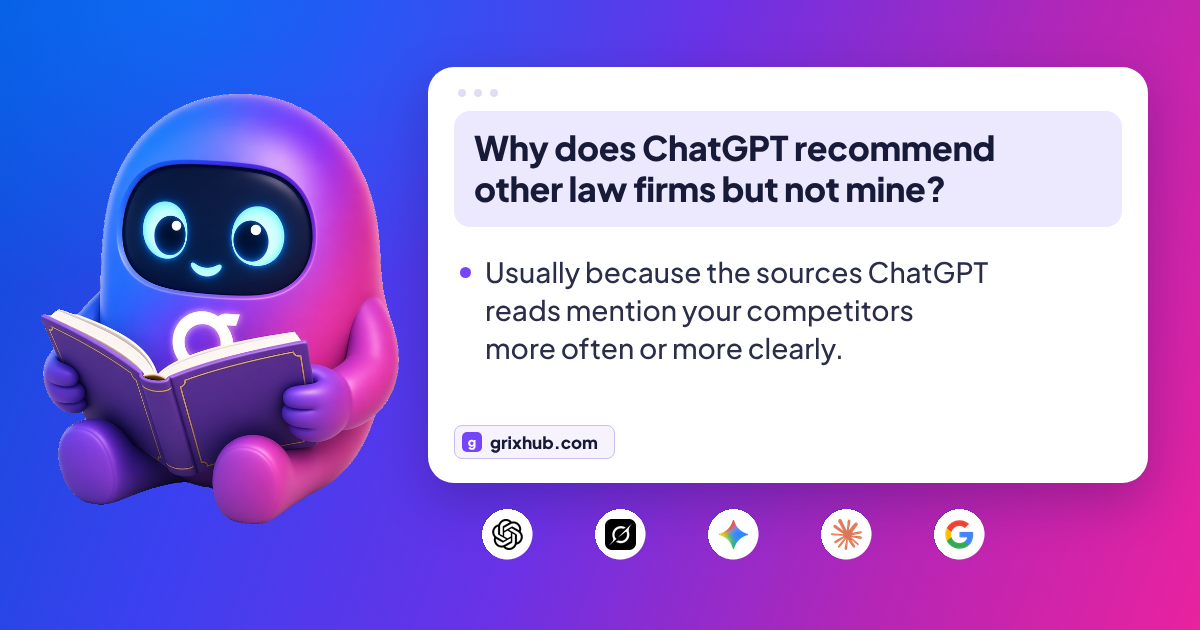
Why does ChatGPT recommend other law firms but not mine?
Usually because the sources ChatGPT reads mention your competitors more often or more clearly. Common causes are a site that blocks OpenAI’s search crawler, thin practice pages, missing or inconsistent directory and bar profiles, few reviews, and no coverage on the rankings and local media that AI cites for your city.
Is AI search optimization allowed under lawyer advertising rules?
Making accurate information easy for AI to find is generally just marketing, so the normal rules apply. In the US, ABA Model Rule 7.1 bars false or misleading communications, and states adopt their own versions. Other countries differ: Thailand’s Lawyers Council etiquette rules restrict advertising fees. This is general information, so check your own bar’s rules or an ethics counsel.
Which legal directories matter most for AI search?
The ones AI already cites for your practice and city. In 5W’s October 2026 test of four AI engines, state bar associations, Martindale-Hubbell and Avvo each appeared in roughly half of answers, with LegalZoom and FindLaw close behind. Another 2026 study found Super Lawyers and Justia were Perplexity’s most cited legal sources.
How long does it take for a law firm to show up in ChatGPT?
Crawler fixes can apply within about a day, because OpenAI says robots.txt changes for search take around 24 hours. Rewritten pages and profile fixes usually show up over weeks. Building reviews, directory rankings and media mentions that change who AI recommends usually takes three to six months or more.
Can a small law firm compete with big firms in AI answers?
Yes, especially for local and narrow questions. In one 2026 study, the top three firms per city and practice area took about 34% of AI mentions, and dozens of other firms shared the rest. AI also cites many pages that don’t rank on Google’s first page, so clear, specific pages from smaller firms can win.
Should lawyers use ChatGPT to write their website content?
Lawyers can use AI tools to draft, but they remain responsible for the result. ABA Formal Opinion 512 says lawyers must understand the tools’ limits, protect client confidentiality and check AI output. Every page should be reviewed by a lawyer for accuracy and compliance, and should include real experience AI can’t invent.
Sources and further reading
- Clio: 2025 Legal Trends Report (consumer survey of 1,000 US adults; PDF copy hosted by the Alaska Bar Association)
- Clio: What to do about legal clients using AI
- 2Civility (Illinois Supreme Court Commission on Professionalism): Clio's 2025 Legal Trends Report findings (29 Oct 2025)
- AttorneySync: 2026 Legal Consumer Choice Report (320 US legal searchers, 2025 data)
- Today's Conveyancer: What 1,000 consumers told Legmark about choosing a law firm (UK)
- Forward Push via EIN Presswire: Study of 38,000 AI searches on which law firms get named (28 Jul 2026)
- 5W Public Relations: Legal AI Visibility Report 2026, version 2 (measured 26 Oct 2026)
- BrightLocal: Uncovering ChatGPT search sources for local businesses (Dec 2024)
- JD Supra (Firesign): Revenge of the rankings, how AI uses awards and directories in lawyer searches (19 Dec 2024)
- OpenAI: Overview of OpenAI crawlers
- OpenAI Help Center: ChatGPT search
- Search Engine Roundtable: OpenAI releases ChatGPT search (1 Nov 2024)
- Search Engine Roundtable: ChatGPT gains local knowledge panels (22 Dec 2025)
- Search Engine Roundtable: ChatGPT enables location sharing for more localized results (31 Mar 2026)
- Search Engine Roundtable: Google AI Overviews citing individual reviews (8 Sep 2025)
- TechCrunch: ChatGPT reaches 900M weekly active users (27 Feb 2026)
- Ahrefs: Only 12% of AI-cited URLs rank in Google's top 10 for the original prompt (11 Aug 2025)
- Google Search Central: AI features and your website (updated 10 Dec 2025)
- Google Search Central: Creating helpful, reliable, people-first content
- Google Business Profile Help: Guidelines for representing your business on Google
- Google Business Profile Help: Tips to get more Google reviews
- American Bar Association: Model Rule 7.2, Communications concerning a lawyer's services: specific rules
- American Bar Association: Model Rule 7.3, Solicitation of clients
- Attorney at Work: Keep your marketing out of ethics traps (Model Rule 7.1)
- American Bar Association: Formal Opinion 496 guidance on responding to online criticism (Feb 2021)
- ABA Business Law Today: Formal Opinion 512 on generative AI tools (Oct 2024)
- Thai PBS: The 21 lawyer etiquette rules of the Lawyers Council of Thailand, including Clause 17 on advertising (15 Nov 2024, Thai)
- Solicitors Regulation Authority: Transparency Rules web sweep report
- Schema.org: LegalService
- OpenAI on X: Introducing ChatGPT search (31 Oct 2024)
- Google Search Central on YouTube: AI features in Search and your site (Q2 2025)
Keep reading

Written by Jade Teekhasaenee
Founder & Managing Director, Grixhub
Jade leads SEO and AEO strategy at Grixhub in Bangkok. He has technically audited the websites of more than 70 brands, and he built GrixTrack to measure how often brands are mentioned and cited by ChatGPT, Gemini and Google AI Mode.
Does AI recommend your law firm?
We will run the questions your future clients ask through ChatGPT, Gemini and Google AI Mode for your practice areas and cities, and show you which firms get named, which sources AI cites, and what it takes to get your firm into the answer.

Grixhub is a digital growth and technology company in Bangkok, Thailand: SEO, AEO, digital marketing, paid media management, websites, apps and AI automation.
Services
Digital marketing
SEO
AEO
Website development
App development
AI & automation
Paid Media Management
Google Ads
ChatGPT Ads
Facebook Ads
Instagram Ads
TikTok Ads
Contact
Email: jade@grixhub.com
Phone: +66 62 480 9604
LINE: Grixhub
Bangkok, Thailand
Company
About · Blog
Free AEO Audit call
Terms · GrixTrack Terms · Refund Policy · Privacy Policy · Cookie Policy · Image Licence
Follow us