Local AEO guide
AEO for Local Business: Get Cited by AI Near You
People now ask ChatGPT, Gemini and Google AI Mode which business to visit, and the answer names only a few. This guide shows how those tools pick local businesses, what the newest studies say, and the practical steps that make AI recommend yours.
Key takeaways6 points
- AEO for local business means making it easy for ChatGPT, Gemini, Perplexity and Google AI Mode to find, check and recommend your business when someone nearby asks for one.
- AI tools name only a few businesses per answer: SOCi's 2026 study of 350,000+ locations found ChatGPT recommended 1.2% of them, against a 35.9% appearance rate in Google's local 3-pack.
- Use is growing fast: in BrightLocal's 2026 survey, 45% of US consumers used ChatGPT or other AI tools for local recommendations, up from 6% a year earlier.
- Your own website and your Google Business Profile supply most local AI citations (42% and about 28.5% in BrightLocal's 2026 study of 1.9 million citations), followed by Yelp, Facebook and Tripadvisor.
- The work is familiar local SEO done thoroughly: a complete Google Business Profile, consistent listings, steady genuine reviews, one page per service, LocalBusiness schema and mentions on trusted local lists.
- AI answers change from one run to the next, so measure with repeated prompts from real locations over months, not a single screenshot.

AEO for local business (local answer engine optimization) is the work of making your business easy for AI tools such as ChatGPT, Gemini, Perplexity and Google AI Mode to find, check and trust, so they name you when someone nearby asks for a recommendation. It builds on local SEO, but the prize is different: not a spot in a list of ten, but one of the three or four names inside the answer.
Think about how people used to find a dentist, a plumber or a place for dinner. They typed a few words into Google, looked at the map, read some stars and called someone.
Many still do. But a growing share now asks a full question instead: “Who’s a good groomer near me for a nervous senior dog, open on Sundays?” The AI reads a handful of sources, then answers with a short list of names and a sentence on each.
If your business is on that list, you start with a recommendation. If it isn’t, that customer may never see you, no matter how good your map ranking is. And the studies in this guide show that AI tools are far pickier than the map pack.
The good news is that the way AI picks local businesses isn’t a mystery. It reads sources you can see, and most of them are sources you can improve honestly. This guide explains how each platform chooses, what the newest data says, and the exact steps to take, in order.
 How we put this guide together
This guide is written by Jade Teekhasaenee, who leads SEO and AEO at Grixhub, where our team technically audits websites for brands in Thailand and around the world. It draws on official documentation from Google and OpenAI, on named studies of local AI search from SOCi, BrightLocal, Yext and Whitespark, and on what our team sees when we check local businesses in ChatGPT, Gemini and Google AI Mode. Every statistic was checked against its source on 12 November 2026. AI tools change often, so we update this guide when they do.
What is AEO for local business?
AEO for local business means shaping your profile, listings, reviews, website and reputation so AI answer engines name your business when someone nearby asks. It is local SEO aimed at being recommended inside an AI answer, not only ranked on a map.
AEO for local business is answer engine optimization applied to a place: your shop, clinic, salon, restaurant or service area. The goal is simple to state. When someone near you asks an AI tool which business to choose, your name should be in the answer, described correctly, with a link back to you.
To keep this concrete, we’ll follow one example through the whole guide. Meet Paws & Bubbles, a made-up pet grooming salon in Bangkok’s Sathorn district. It has a Google Business Profile with decent reviews, a basic website and a LINE Official Account where most bookings happen. Business is fine. But the owner has noticed that some new customers say “ChatGPT told me about you,” and others mention competitors they found the same way.
Now picture a pet owner who types into ChatGPT: “Good dog groomer in Sathorn for an anxious senior poodle, open Sunday, with clear prices?” ChatGPT doesn’t show ten links. It looks at where the person is, searches the web, reads some listings, reviews and websites, and writes back three or four names with a short reason for each.
AEO for a local business is everything Paws & Bubbles does to be one of those names, and to be described accurately when it is. That covers its Google Business Profile, its listings on other sites, its reviews, its own web pages and what other websites say about it.
Optimizing a local business’s profiles, listings, reviews, website and mentions so AI answer engines recommend it for nearby, intent-rich questions such as “best X near me” or “who can do Y in Z neighborhood.”
If the term AEO is new to you, our plain-English guide to what answer engine optimization is covers the basics. And if you want to know how to track whether any of this is working, our pillar on measuring AI visibility and tracking AI citations is the companion to this guide.
What a local recommendation in an AI answer looks like
Good dog groomer in Sathorn for an anxious senior poodle, open Sunday, with clear prices?
Three or four named salons, one line on why each fits, a small map and a Sources button
Google Business ProfileReview siteYour services pageLocal best-of list
Illustration with a made-up salon. The source mix reflects the studies cited in this guide.
Do people really use AI to find local businesses?
Yes, and fast. BrightLocal's 2026 survey of 1,002 US consumers found 45% used ChatGPT or other AI tools for local recommendations, up from 6% a year earlier, and 40% trust AI recommendations.
Yes. The jump over the last year is the biggest change in local search in a long time.
BrightLocal runs a well-known Local Consumer Review Survey every year. The 2026 edition, published on 11 February 2026, surveyed 1,002 US adults. It found that 45% of consumers had used ChatGPT or other generative AI tools to get local business recommendations, up from just 6% in the 2025 survey. That made AI the third most popular source for local recommendations (BrightLocal).
Trust is following use. In the same survey, 40% of consumers said they trust AI platforms for business recommendations, 32% said they don’t, and 42% said they trust AI recommendations as much as traditional reviews.
AI is also reshaping how people read reviews. 82% of consumers read AI-generated review summaries, the short blurbs Google and others now show above the reviews, and 23% said they would rely on the summary alone. That matters for local AEO because the summary is written from your reviews. If your reviews are thin or old, the summary is too.
How consumers use AI to choose local businesses
Source: BrightLocal, Local Consumer Review Survey 2026, US consumers, published 11 Feb 2026.
Two caveats keep this in proportion. First, this is US data. Habits differ by country, and we don’t have an equally solid survey for every market. Second, using AI doesn’t mean people stop using Google. The same survey shows Google is still the most used place to read reviews, at 71% in 2026, down from 83% the year before. People mix sources. They might ask ChatGPT for a shortlist, then check Google Maps for photos and hours, then message the business.
The platforms themselves are also making local questions easier to ask. Google launched Ask Maps, a Gemini-powered conversational feature in Google Maps, in the US and India in March 2026 (Google). OpenAI added optional device location sharing to ChatGPT in late March 2026 so it can give more relevant local answers (Search Engine Roundtable). And Google AI Mode has been available in Thai since October 2025 (Google Thailand).
Why is getting recommended by AI harder than ranking on Google Maps?
Because AI answers name far fewer businesses. SOCi's 2026 study of 350,000+ locations found ChatGPT recommended 1.2%, Perplexity 7.4% and Gemini 11%, against a 35.9% appearance rate in Google's local 3-pack.
Because an AI answer has far fewer slots than a map, and the AI is much fussier about who fills them.
The clearest data comes from SOCi’s 2026 Local Visibility Index, released on 28 January 2026. SOCi analyzed more than 350,000 locations across 2,751 multi-location brands and compared how often they appeared in Google’s local 3-pack with how often AI assistants recommended them (SOCi).
The gap is large. Brands appeared in Google’s local 3-pack 35.9% of the time on average. ChatGPT recommended just 1.2% of locations. Gemini recommended 11% and Perplexity 7.4%. SOCi estimates AI visibility is three to 30 times harder to achieve than ranking well in traditional local search (Search Engine Land).
How often brand locations were shown or recommended (SOCi, 2026)
Source: SOCi 2026 Local Visibility Index (350,000+ locations, 2,751 multi-location brands), with platform rates via Search Engine Land.
Two other findings from SOCi are worth knowing. Only 45% of the retail brands that led traditional local search were also among the brands AI recommended most, so map strength alone doesn’t carry over. And the locations ChatGPT did recommend averaged 4.3-star ratings, which tells you reputation is part of the filter.
SOCi’s sample is big chains, not independent shops. A newer study helps fill that in. In September 2026, BrightLocal published a Local AI Visibility Study based on about 200,000 localized, non-branded searches for roughly 1,300 business locations, producing about 1.9 million AI citations. Google Maps mentioned a tracked business in 66% of searches. The AI surfaces mentioned it far less often: 38% in AI Overviews, 33% in ChatGPT and 32% in AI Mode (BrightLocal).
How often a tracked local business was mentioned (BrightLocal, 2026)
Source: BrightLocal, Local AI Visibility Study, published 16 Sep 2026. About 200,000 non-branded local searches for about 1,300 locations; share of searches mentioning the tracked business.
Why the difference? A map shows many pins and lets you scroll. An AI answer is a short piece of writing. BrightLocal found AI responses named about 4.1 businesses on average in ChatGPT, 3.5 in AI Mode and 2.5 in AI Overviews. Fewer slots means a higher bar.
The answers also move around. On repeat searches, BrightLocal found only 20% to 33% overlap between result sets (23% for ChatGPT, 21% for AI Mode, 33% for AI Overviews), compared with 99% agreement across attempts on Google Maps. So “we’re in ChatGPT” is never a yes-or-no fact. It’s a rate, and the job is to push that rate up.
How does ChatGPT choose local businesses?
ChatGPT works out roughly where you are, searches the web live, reads listings, reviews and business websites, and names the businesses its sources support. It uses third-party search providers such as Bing, and licensed data such as Yelp's.
ChatGPT builds a local answer in a few steps: it estimates where you are, decides to search, reads a set of sources, and writes an answer that names the businesses those sources support. OpenAI doesn’t publish exactly how it ranks them, but the inputs are documented well enough to act on.
Where you are
By default, ChatGPT collects general location information based on your IP address, according to OpenAI’s help center (OpenAI). Since late March 2026, users can also choose to share their device location. The setting is off by default, lives under Settings, Data Controls, and has two layers: approximate and precise. With precise location on, ChatGPT can use your device’s specific location, such as an exact address (PPC Land).
So the same “groomer near me” question can return different names for someone in Sathorn and someone 5 kilometers away in Ari, and different names again when location sharing is off. Keep that in mind when you test.
Where it searches
OpenAI’s help center says ChatGPT search may share disassociated search queries with third-party search providers such as Bing. Its own crawler, OAI-SearchBot, is used “to surface websites in search results in ChatGPT’s search features,” and OpenAI recommends allowing it in robots.txt (OpenAI crawler docs).
Damian Rollison of SOCi compared ChatGPT’s local answers with Bing side by side for Search Engine Land. His tests, plus ChatGPT’s own description of its process, suggested it scans the top 20 to 30 web results, looks more closely at 5 to 8 promising sources, and draws its answer from 3 to 5 of them (Search Engine Land). He stresses this is observation, not an official spec, so treat the numbers as a rough picture.
Which data it licenses
Local answers also draw on licensed data. In its full-year 2025 results on 12 February 2026, Yelp announced an agreement with OpenAI (Yelp). Reporting in July 2026 described the deal as licensing Yelp’s reviews, ratings, photos and business information so ChatGPT can show them inside local answers (PinMeTo). ChatGPT has also shown local results with a map and list view since its December 2024 search update (GSQI).
Search is also open to everyone. In February 2025, OpenAI made ChatGPT search available to all users, including people who aren’t logged in.
— OpenAI (@OpenAI) February 5, 2025
How ChatGPT builds a local recommendation
- 1Reads the question and locationIP-based area, or device location if shared
- 2Decides to searchlocal, current information needed
- 3Runs searchesOAI-SearchBot index plus providers such as Bing
- 4Reads the sourcesbusiness sites, listings, reviews, best-of lists
- 5Writes the answera few named businesses, a map and citations
Sources: OpenAI Help Center, OpenAI crawler docs, Search Engine Land. OpenAI does not publish how it ranks businesses.
What does this mean for Paws & Bubbles? Three things. Its website must be readable by OAI-SearchBot and indexed in Bing, not just Google. Its listings outside Google, Yelp included where Yelp is used, need to be accurate. And the pages ChatGPT is likely to read, such as local best-of lists, need to mention it. For the platform-specific playbook, see our guide on getting cited in ChatGPT answers.
How do Google AI Overviews, AI Mode and Ask Maps pick local businesses?
Google's AI features sit on top of Google Search and Maps, so your Google Business Profile, reviews and indexed website feed them. Google says there are no special requirements beyond being indexed and eligible for a snippet.
Google’s AI features pick local businesses from the same data Google Search and Google Maps already use: your Business Profile, reviews, photos and your indexed website. That’s the biggest difference from ChatGPT. Google owns the map data, so its AI doesn’t need to guess your hours from a third-party site.
Google’s own documentation is plain about the basics. There are “no additional requirements to appear in AI Overviews or AI Mode, nor other special optimizations necessary.” A page has to be indexed and eligible to show with a snippet. Google also lists “checking that your Merchant Center and Business Profile information is up-to-date” among its recommended practices, and notes that AI Overviews and AI Mode may use query fan-out, “issuing multiple related searches across subtopics and data sources” (Google Search Central).
Query fan-out matters locally. A question like “groomer in Sathorn for an anxious senior dog, open Sunday” might be split into searches for groomers in the area, Sunday hours, reviews mentioning anxious dogs and price pages. Every one of those is a chance for a clear page or profile detail to be picked up.
Ask Maps
On 12 March 2026, Google launched Ask Maps, “a new conversational experience that answers complex, real-world questions,” built on Gemini. Google says it draws on information from over 300 million places and reviews from more than 500 million contributors. It started in the US and India on Android and iOS (Google). Google’s help page says local suggestions mainly weigh “relevance, distance, and prominence,” personalize with your account activity, and that payment doesn’t influence results (Google Maps Help).
Those three words, relevance, distance and prominence, are the same three Google has long used for local ranking. Relevance is how well a profile matches the search, distance is how far the business is, and prominence is how well-known it is (Google Business Profile Help). So the classic local work still feeds Google’s new AI surfaces directly.
Where AI Overviews show up in local searches
AI Overviews don’t appear on every local search. A Whitespark case study from May 2025 manually checked 540 queries across six industries in three US cities. AI Overviews appeared on 68% of local business-type queries overall, but only 15% of pure local-intent queries like “plumber in Denver,” where the local pack showed 93% of the time. On informational and hybrid queries, such as “how much does a root canal cost” or “best way to find a family dentist near me,” AI Overviews dominated (Whitespark).
Where AI Overviews and the local pack appear, by query type
Plumbers, injury lawyers, dentists, optometrists, medical clinics, real estate agents in Houston, Phoenix and Denver
Source: Whitespark, case study by Miriam Ellis, 12 May 2025, 540 manually collected queries.
The lesson for Paws & Bubbles: the map pack still owns “groomer near me,” but the questions around it, such as “how often should a poodle be groomed” or “what does a full groom include,” are where AI Overviews appear and where the salon’s own helpful pages can be cited.
AI Mode can also call and book
Google is adding actions on top of answers. AI Mode can search across reservation platforms for restaurant availability in a US Labs experiment (Google), and when a business doesn’t list details like appointment availability online, “Google can make calls on your behalf to gather the details you need,” with examples including haircuts and pet grooming (Google Search Help). Publishing prices and availability clearly means fewer of those calls and a better chance of being shown. Our guide to optimizing for Google AI Mode goes further on that surface.
Google Search Central · YouTube
Google Search Central · AI features in Search & your site, Search Console, SEO community insights (Q2 2025) · watch on YouTube
How do Gemini and Perplexity pick local businesses?
Gemini is grounded in Google Maps data and leans on business websites, so accurate Google profiles and strong sites matter most. Perplexity leans more on directories and review sites such as Yelp, MapQuest and Tripadvisor.
Gemini and Perplexity read the same kinds of sources as ChatGPT, but they weight them differently, so it helps to know each one’s habits.
Gemini
Gemini has a home advantage: it’s grounded in Google Maps. In SOCi’s 2026 study, the profile information Gemini showed was accurate 100% of the time, against about 68% on ChatGPT and Perplexity. Gemini also recommended the most locations of the three AI tools, at 11% (Search Engine Land).
Gemini also likes business websites. Yext analyzed 6.8 million citations from about 1.6 million responses across Gemini, OpenAI and Perplexity models, collected between July and August 2025 for more than 200,000 locations. Gemini drew 52.15% of its citations from first-party websites, the highest of the three. Yext also notes that Gemini uses Google Business Profile data in its answers without citing it, because that data is Google’s own (Yext).
A smaller 2026 study points the same way. Steady Demand, a US local SEO agency, logged 14,472 AI citations from 1,487 queries across 50 large US metros and 10 local service categories. Business websites made up 59.9% of Gemini’s citations. The same study found Gemini named the same top business on only about 7.9% of repeat queries, while Google’s local pack returned the same top listing 90.2% of the time (PinMeTo). It’s an agency study with a modest sample, so use it as a direction, not a law.
Perplexity
Perplexity leans more on directories and review platforms. In Yext’s data, Perplexity sent more than 364,000 listing citations to MapQuest and more than 239,000 review citations to Tripadvisor, and industry-specific directories reached 24% of its citations for unbranded subjective questions like “best groomer near me” (Yext). Perplexity has also used Yelp data for local answers, including maps, photos and review quotes, since March 2024 (Maginative).
For Paws & Bubbles, that means two different priorities. For Gemini, the Google Business Profile and the salon’s own site do most of the work. For Perplexity, consistent profiles on the directories and review sites that cover pet services in its city matter more.
Don’t pick a favorite AI tool. The studies show each one has different habits, and you can’t control which one a customer uses. The fixes that help all of them, an accurate profile, consistent listings, reviews and clear pages, are where to spend first.
Which sources does AI cite for local businesses?
Mostly business websites and listings. BrightLocal's 2026 study of about 1.9 million local AI citations found business websites made up 42% and Google Business Profile about 28.5%, followed by Yelp at 9.5%, Facebook at 2.2% and Tripadvisor at 1.8%.
Mostly sources you own or can manage: your website and your listings. That’s good news, because it means a local business has real control.
BrightLocal’s September 2026 study is the largest recent look at this. Across about 1.9 million citations in ChatGPT, AI Mode and AI Overviews, business websites accounted for 42% of all citations and 93% of the unique domains cited. Google Business Profile accounted for about 28.5% of citations. Yelp followed at 9.53%, Facebook at 2.23% and Tripadvisor at 1.79% (BrightLocal).
Share of local AI citations by source (BrightLocal, 2026)
Source: BrightLocal, Local AI Visibility Study, 16 Sep 2026, about 1.9 million citations across ChatGPT, AI Mode and AI Overviews. The Google Business Profile share is 28.63% in BrightLocal’s table and 28.5% in its text.
Yext’s 2025 study reached a similar conclusion from a different angle. Of its 6.8 million citations, more than 2.9 million came from brand websites and more than 2.9 million from listings, while reviews and social added more than 545,000. Yext estimates that brands can directly influence or manage the sources behind about 86% of AI citations. Forums were small, at about 2% (Yext). Note that the data comes from Yext’s clients and prospects, mostly multi-location brands.
The mix shifts by industry. In Yext’s data, listings made up 52.61% of citations in healthcare, while websites led in financial services (48.16%) and retail (47.62%). Food service had the highest review share, at 13.28%. So a restaurant should care a lot about review platforms, while a clinic should care a lot about the health directories that list it.
Older data shows how fast this moves. When BrightLocal ran 800 local searches in ChatGPT in November 2024, business websites made up 58% of sources, and Yelp, Facebook and Google Maps didn’t appear as directory sources at all (BrightLocal). By 2026, Yelp was the third biggest source in its larger study. Platforms change their data deals, so the safe strategy is to be accurate everywhere rather than to chase one source.
Forums are the wild card. Yext measured them at about 2%, but Steady Demand’s 2026 study found Reddit at 13.7% of citations, more than all local directories combined (PinMeTo). The difference likely comes from the categories and query types each study used. Either way, what real people say about you in public threads can end up in an answer.
How is local SEO for AI search different from classic local SEO?
The foundations are the same, but AI search puts more weight on what other sites say about you and on dedicated service pages. In Whitespark's 2026 survey, presence on best-of lists and a page for each service ranked as the top two AI visibility factors.
Local SEO for AI search uses the same foundations as classic local SEO, but it shifts the weight. Google Maps rankings lean hard on your Business Profile and proximity. AI answers lean more on evidence from around the web: lists, articles, reviews on trusted sites and pages that explain each service.
The best evidence here is Whitespark’s 2026 Local Search Ranking Factors survey, published on 6 November 2025 and led by Darren Shaw. It asked 47 local search experts to rate factors, and it includes a separate list of factors for AI search visibility (Whitespark).
The top AI visibility factor was presence on expert-curated best-of lists. Second was a dedicated page for each service. Then came prominence on industry-relevant domains, the quality of unstructured citations such as newspaper articles, blog posts, government sites and industry associations, and the authority of third-party sites where your reviews appear. Whitespark notes that three of the top five AI factors are citation factors.
Top 10 local AI search visibility factors
Source: Whitespark, 2026 Local Search Ranking Factors, survey of 47 local search experts, published 6 Nov 2025. Expert opinion, not a measured correlation.
Notice what’s missing from the top of that list: anything to do with tricks. No special files, no magic markup. It’s a picture of a business that is genuinely well known and clearly described.
Here’s how the two kinds of local visibility compare in practice.
| Area | Classic local SEO (map pack) | Local SEO for AI search |
|---|---|---|
| Main surface | Google local pack and Maps | ChatGPT, Gemini, Perplexity, AI Overviews, AI Mode, Ask Maps |
| Slots | 3 in the pack, many on the map | About 2 to 4 names per answer |
| Strongest inputs | Business Profile, proximity, reviews | Website, profiles and listings, best-of lists, press, reviews on trusted sites |
| Stability | Very stable from search to search | Changes from run to run and place to place |
| How to measure | Rank tracking by map grid | Mention rate over repeated prompts by location |
The practical upshot is reassuring. If you’ve done local SEO properly, you’re not starting from zero. You’re adding a layer: more evidence from other sites, and pages that answer real questions about each service.
How do you get cited by AI as a local business?
Work on six things in order: let AI crawlers read your site, complete your Google Business Profile, make your listings consistent, earn steady genuine reviews, publish one clear page per service, and earn mentions on trusted local lists and media.
You get cited by AI as a local business by giving it the same things a careful human researcher would want: a site it can read, a complete and accurate profile, matching details everywhere, recent honest reviews, clear pages about each service and independent sources that vouch for you.
We break the work into six parts. Each gets its own section below, but it helps to see the whole plan first, because the parts depend on each other. Great service pages don’t help much if AI crawlers are blocked. Lots of reviews don’t help if your name and address differ across five directories.
The six parts of local AEO
Your business
Business websites and listings supplied most local AI citations in BrightLocal’s and Yext’s studies
Sources: BrightLocal, Yext, Whitespark.
Crawler access. AI tools can only cite what they can fetch. For ChatGPT, that means allowing OAI-SearchBot in robots.txt; OpenAI says changes take about 24 hours to apply for search (OpenAI). Also check that your firewall or CDN isn’t quietly blocking AI crawlers, and that your key pages are indexed in both Google and Bing. Our free AI crawler checker tests this in a minute.
Google Business Profile. This feeds Google’s AI features and Ask Maps directly, and it was the second largest source of local AI citations in BrightLocal’s 2026 study.
Consistent listings. AI tools cross-check. If your hours say one thing on Google and another on Facebook, you give them a reason to doubt you, or to describe you wrongly.
Reviews. Ratings act as a filter, and review text tells the AI what you’re good at.
Service pages. A dedicated page for each service was the second strongest AI factor in Whitespark’s survey.
Local mentions. Best-of lists, local news and association pages were the strongest AI factors of all.
Paws & Bubbles would tackle them roughly in that order, because the early items are fast and cheap and the later items take months. The rest of this guide walks through each one, starting with how to find out where you stand today.
How do you check whether AI recommends your business today?
Write 15 to 30 real customer questions, run each in ChatGPT, Gemini, Google AI Mode and Perplexity at least three times from your service area, and record whether you are named, how you are described, who else is named and which sources are cited.
You check by asking the AI tools the questions your customers ask, several times, from where your customers are, and writing down what happens. One screenshot proves little, because local answers change from run to run and from street to street.
Start with the questions. Pull them from real sources: what people ask on the phone, in LINE or WhatsApp chats, in reviews and at the counter. For Paws & Bubbles, that might include:
- “Best dog groomer in Sathorn”
- “Groomer near me for an anxious senior dog”
- “Cat grooming Bangkok open on Sunday”
- “How much is a full groom for a poodle in Bangkok?”
- “Dog groomer near Chong Nonsi with English-speaking staff”
Mix “best X near me” questions with questions about problems, prices and specific needs. AI answers for the specific ones are often less crowded, and that’s where a smaller business can win first.
Then run each question in ChatGPT, Gemini, Google AI Mode and Perplexity. Run each at least three times, because BrightLocal found only 20% to 33% overlap between result sets on repeat searches (BrightLocal). Location matters just as much. BrightLocal found AI answers for points in the same town overlapped only 36.2% in ChatGPT and about 47% in AI Mode and AI Overviews. If you serve several neighborhoods, test from several.
For every answer, record four things: whether you’re named, whether the description is right (hours, prices, services, area), which competitors are named, and which sources are cited. That last column is the most useful. It’s your shopping list. If ChatGPT keeps citing a local “best groomers in Bangkok” article that doesn’t mention you, that article is a target.
This is slow by hand. It’s the reason we built GrixTrack, our tracker at Grixhub, which runs each prompt three times in ChatGPT, Gemini and Google AI Mode and records mentions and citations, alongside Google rankings by country, city and language. It has a free plan with 10 keywords, 5 prompts, 1 project and 2 competitors, which is enough for a small business to get a baseline. You can see it on the GrixTrack page, and our guide on AI visibility and AI share of voice explains the metrics.
Logged-in AI tools personalize answers based on your history. Test in a clean session when you can, and don’t panic if a single run leaves you out. Look at the rate across runs.
How do you optimize your Google Business Profile for AI?
Verify it, use your real-world name with no keywords, choose the fewest and most specific categories, fill in services, attributes, hours, holiday hours and photos, keep everything current, and reply to reviews. Google's AI features draw on this data, so accuracy beats tricks.
You optimize a Google Business Profile for AI the same way you optimize it for people: make it complete, accurate and current, and follow Google’s rules to the letter. Google’s AI features and Ask Maps read this data directly, and BrightLocal found Business Profiles behind about 28.5% of local AI citations, so it’s one of the highest-value hours you can spend.
Start with Google’s own advice. Its help page says “businesses with complete and accurate info are more likely to show up in local search results,” recommends verifying your business, keeping hours accurate including special hours, replying to reviews and adding photos. It also says plainly: “There’s no way to request or pay for a better local ranking on Google” (Google Business Profile Help).
The fields that matter most for AI
Name. Use your real-world name exactly as it appears on your storefront. Google’s guidelines say “including unnecessary information in your business name isn’t permitted,” and list location information as a banned extra (Google guidelines). “Paws & Bubbles” is right. “Paws & Bubbles Best Dog Grooming Sathorn Bangkok” breaks the rules and can get the profile suspended.
Categories. Google says to “use as few categories as possible” and to choose ones that are “as specific as possible, but representative of your main business.” Categories tell the AI what you are. Pick the precise one for your main business, then add a few accurate secondary ones.
Services and attributes. List each service, ideally with a short description and a price or price range. Fill in attributes that customers filter on, such as accessibility, payment options, languages or appointment requirements. When someone asks for a groomer “with clear prices” or “that speaks English,” these details are what an AI can match.
Hours. Keep regular and holiday hours current. Wrong hours are one of the quickest ways to lose trust, from people and from AI. SOCi found profile information shown by ChatGPT and Perplexity was accurate only about 68% of the time, so make sure the source data at least is right.
Address or service area. Storefronts show their address. Service-area businesses, such as a mobile groomer, should hide their address and set a service area, which Google says “shouldn’t extend farther than about 2 hours of driving time” from the base.
Photos and description. Add real photos of the place, the team and the work, and a plain description of what you do and who you serve. Avoid stuffing keywords; write it the way you’d explain your business to a new customer.
Google Business Profile for AI: do and don’t
Don’t
- Add keywords or a location to your name
- Use categories as keywords
- Create duplicate profiles
- Pay or reward people for reviews
Do
- Verify the profile
- Fewest, most specific categories
- Services, prices, attributes, photos
- Accurate regular and holiday hours
- Reply to every review
“There’s no way to request or pay for a better local ranking on Google.”
Sources: Google Business Profile Help, Google guidelines for representing your business, Google Maps content policy.
If you run several locations, Google’s guidelines say all locations should share the same name and the same category when they offer the same service, with only one profile per location. Consistency across your own profiles is the first step toward consistency across the web.
One more habit: check your profile every month. Customers and Google can suggest edits, and those edits sometimes change hours, categories or phone numbers without you noticing. A profile that was perfect in January can be wrong by March.
Why do NAP consistency and business listings matter to AI?
AI tools cross-check your name, address, phone and hours across many sites, and listings make up a large share of what they cite. Inconsistent details make AI less likely to trust you and more likely to describe you wrongly.
They matter because AI tools read many sources about the same business and look for agreement. Listings also make up a huge share of what AI cites: in Yext’s study, more than 2.9 million of 6.8 million citations came from listings, and for OpenAI models listings were 48.73% of all citations (Yext).
Short for name, address and phone number: the core details that identify a local business. Most local SEOs now include website, hours and categories in the same consistency check.
Think about it from the AI’s side. It finds Paws & Bubbles on Google with Sunday hours, on Facebook with “closed Sunday,” and on an old directory with the phone number from before the move. Which is right? It can’t call to check. It can either leave the salon out, or pick one and risk telling a customer the wrong thing. Neither helps.
So the job is a cleanup, then a habit.
Make a master record. Write down your exact business name, address format, phone, website, hours, categories and a two-sentence description. Every listing should match it.
Claim the listings that matter. Google Business Profile first. Then the places AI tools are known to cite: Yelp (licensed to OpenAI, and the third biggest source in BrightLocal’s 2026 study), Facebook, Tripadvisor where you’re in hospitality, Apple Maps through Apple Business Connect, and Bing Places, since Bing is one of ChatGPT’s search providers. BrightLocal’s 2026 survey found the share of consumers reading reviews on Apple Maps rose from 14% to 27% in a year (BrightLocal).
Add your industry’s directories. Yext found healthcare answers drew 52.61% of their citations from listings, and Perplexity’s industry-specific directory share reached 24% for some query types. Every industry has its own: health directories for clinics, legal directories for law firms, booking platforms for salons and restaurants.
Fix the old ones. Search your old phone number and old address. Old listings and data aggregator copies often outlive a move by years.
The Thailand version
In Thailand, the list looks a little different. Google Maps is still the base layer. Wongnai is a major listing and review platform for restaurants and beauty businesses. LINE is where many customers contact businesses: LINE Thailand reports 56 million users and more than 12 billion conversations through LINE Official Accounts in 2025 (Relevant Audience, citing LINE Thailand). AI tools don’t read private LINE chats, but your LINE OA ID on your profile and website gives customers the contact route they expect.
There’s also a bilingual wrinkle. Many Thai businesses have a Thai name and an English name, and listings use them inconsistently. Pick how you present both, for example “Paws & Bubbles (พอว์ส แอนด์ บับเบิ้ลส์)”, and use it the same way everywhere, including the address format. Our guide to doing SEO in Thailand covers bilingual search in more depth.
How do reviews affect AI recommendations?
Reviews act as both a filter and a description. Locations ChatGPT recommended averaged 4.3 stars in SOCi's study, and AI tools quote review themes to explain why a business fits. Steady, recent, genuine reviews with owner replies help most.
Reviews affect AI recommendations in two ways. They’re a filter, because AI tools tend to recommend well-rated businesses. And they’re a description, because the AI reads review text to learn what you’re good at and repeats those themes in its answer.
The filter is clear in the data. In SOCi’s 2026 study, locations recommended by ChatGPT averaged 4.3 stars, Perplexity’s 4.1 and Gemini’s 3.9. Underperforming financial brands had average ratings near 3.4 stars and replied to fewer than 5% of reviews (Search Engine Land). Whitespark’s experts ranked high Google ratings and the authority of third-party review sites among the top ten AI visibility factors.
The description part is easy to miss but just as important. Google’s own Maps team describes Ask Maps sifting through community reviews to answer specific needs, like finding a quiet bar.
— Google Maps (@googlemaps) March 30, 2026
Now apply that to Paws & Bubbles. If twenty reviews mention “patient with my nervous old dog,” an AI has evidence for the “anxious senior dog” question. If reviews only say “great service,” it has nothing specific to repeat. You can’t write your customers’ reviews, and you shouldn’t try, but you can ask in a way that invites detail: “If you have a minute, tell other owners what your dog came in for and how it went.”
What customers expect has also shifted. BrightLocal’s 2026 survey of US consumers gives the clearest benchmarks.
What customers expect from your reviews
Source: BrightLocal, Local Consumer Review Survey 2026, 1,002 US adults.
Recency stands out. Because AI review summaries and AI answers lean on what’s current, a business with 300 reviews from three years ago can look weaker than one with 60 reviews from the last six months. Steady beats bursty.
Stay inside the rules
Google’s policy bans reviews “that have been paid for, directly or in kind,” offering incentives such as discounts or free services for reviews, and selectively asking only happy customers for reviews (review gating). It also covers conflicts of interest such as employees reviewing their employer (Google Maps policy). Breaking these rules risks removed reviews and profile penalties, and it fills your profile with exactly the bland, suspicious text that doesn’t help an AI.
The honest system works fine: ask every customer, make it easy with a short link or QR code at the counter and in your LINE follow-up message, and reply to every review, good or bad. BrightLocal found 50% of consumers are put off by templated replies, so write them like a person.
What should your website's service and location pages include?
One page per service, each opening with a direct answer and covering what is included, who it suits, price or price range, duration, the areas you serve, hours and how to book. Business websites are the single biggest source of local AI citations.
Your website should give AI tools a clear, quotable page for every service you want to be recommended for. Business websites made up 42% of local AI citations in BrightLocal’s 2026 study, and a dedicated page for each service ranked second among AI visibility factors in Whitespark’s survey. A single “Services” page with ten bullet points doesn’t give an AI much to work with.
For Paws & Bubbles, that means separate pages for dog grooming, cat grooming, de-shedding treatments, puppy first grooms and so on. Each page should answer the questions a customer would ask before booking.
Open with the answer. The first two sentences should say what the service is, who it’s for, where you do it and roughly what it costs. That’s the passage an AI is most likely to lift.
Give real specifics. What’s included, how long it takes, prices or price ranges, what to bring, how to prepare, what happens with anxious or elderly animals. Specifics are what match the long, detailed questions people ask AI.
Name your area naturally. Whitespark’s experts ranked city and neighborhood relevance of content sixth among AI factors. Mention the districts and landmarks you serve where it’s genuinely useful, such as nearby transit stations, parking or service radius. Don’t build dozens of thin “groomer in [district]” pages; one real location page per actual location is enough.
Show who’s behind it. Named staff, their experience and certifications, real photos and recent reviews quoted with permission all help both people and AI decide you’re credible.
Add an FAQ that’s real. Use the questions from your prompt audit and your inbox. Keep answers short and direct.
At Paws & Bubbles, we love pets! Our passionate team offers premium grooming services with a personal touch. Contact us today to learn more about our amazing packages.
Paws & Bubbles offers full dog grooms in Sathorn, Bangkok, for all sizes, including anxious and senior dogs. A full groom takes about 2 to 3 hours and includes a bath, haircut, nail trim and ear cleaning. Prices start from a listed base price by size. Open Tuesday to Sunday, 10:00 to 19:00, five minutes’ walk from BTS Chong Nonsi.
The “before” version has no fact an AI could repeat. The “after” version answers the exact questions in our example prompt: where, for whom, what’s included, how long, when open and how to get there. (In a real page, the price would be the actual number.) You can score a page for this kind of structure with our free AEO content checker.
Two technical points finish the job. Keep important text in the HTML, not only inside images, PDFs or menus that load with JavaScript. And make sure each page is indexed in both Google and Bing, since ChatGPT uses Bing as one of its search providers. Prices and opening hours that exist only inside images or PDFs are an easy gap to fix.
The same approach scales to any local industry. Our guides for dentists in AI search and real estate agents in ChatGPT show what these pages look like in those fields.
Which schema markup helps local businesses in AI search?
LocalBusiness structured data, using the most specific subtype, with your name, address, phone, URL, geo coordinates, opening hours and price range. It is not required for AI features, but it helps machines read your details correctly when it matches your visible page.
The most useful schema for a local business is LocalBusiness structured data, using the most specific subtype that fits. It isn’t required for AI features, and it won’t make an AI recommend you on its own, but it removes guesswork about your core facts.
Google is clear on both points. For AI Overviews and AI Mode, “there’s also no special schema.org structured data that you need to add,” and any structured data should match the visible text on the page (Google Search Central). For local business markup, Google says you can use it to tell Google about business hours, departments and more. The required properties are address and name, and the recommended ones include geo coordinates, openingHoursSpecification, priceRange, telephone, url, menu and servesCuisine for restaurants. Google also advises using “the most specific LocalBusiness sub-type possible” (Google Search Central).
For Paws & Bubbles, a sensible setup would be:
On the home page or contact page: a LocalBusiness block with the exact name from the master record, the full address, telephone, url, geo coordinates, openingHoursSpecification including any seasonal hours with validFrom and validThrough, and priceRange.
On each service page: a Service block that names the service, links it to the business as the provider and states the area served. Keep the wording identical to the visible page.
On the FAQ section: FAQPage markup only where the questions and answers are visible on the page, word for word.
One rule trips people up. Google’s review snippet guidelines say that if a business controls the reviews about itself, its pages using LocalBusiness or Organization markup “are ineligible for star review feature” (Google Search Central). So marking up testimonials you collect yourself won’t earn stars. Your real reputation lives on Google and third-party review sites, which is where AI looks anyway.
Our free schema generator builds valid LocalBusiness JSON-LD in your browser. Test it with Google’s Rich Results Test before publishing, and update it whenever your hours or address change. Stale schema that contradicts your profile is worse than none.
Schema is a translation layer, not a ranking trick. When your visible page, your Business Profile and your schema all say the same thing, AI tools have one consistent story to tell about you.
How do you earn the best-of lists, press and forum mentions AI trusts?
Find the lists, articles and threads AI already cites for your area, then earn a place honestly: deliver work worth recommending, pitch genuinely useful local stories, join associations and community events, and answer questions in public forums without spamming.
You earn them the slow, honest way: by being worth recommending, then making sure the people who write local lists, articles and forum answers know about you. This is the part of local AEO that takes longest, and it’s also the part Whitespark’s experts ranked highest. Presence on expert-curated best-of lists was the number one AI visibility factor, and three of the top five factors were about mentions on other sites (Whitespark).
Start with your prompt audit. The sources column shows exactly which lists and articles the AI tools already trust for your category and city. For Paws & Bubbles, that might be a city magazine’s “best groomers” roundup, a pet blog’s neighborhood guide and a few forum threads. Those are your targets.
Best-of lists. Many are written by editors who visit, call or read reviews. Make it easy for them: a short, factual media page with your story, photos, prices and contact details. Avoid paid “award” schemes that sell badges to anyone; they’re rarely the lists AI cites, and some readers see through them.
Local press and blogs. Local journalists want local stories. A salon could share practical advice for pet owners during the rainy season, or host a free nail-trim day for a shelter. Real stories earn real coverage, and each article is an unstructured citation of the kind Whitespark’s experts value.
Associations and community. Trade associations, chambers of commerce, business districts and charity partners often list members on their websites. These are trusted, relevant domains, and the third most important AI factor in Whitespark’s list was prominence on industry-relevant domains.
Forums. Reddit made up 13.7% of citations in Steady Demand’s 2026 study, though only about 2% in Yext’s. In Thailand, Pantip plays a similar role for many local questions. The rule is simple: answer as a helpful expert, say who you are, and never post fake recommendations. Forum users and moderators spot astroturfing fast, and a thread calling you out is the last thing you want an AI to read.
Track mentions, not just links. For local AI visibility, an article that names your business, your area and what you’re good at helps even without a link, because AI tools read the text.
How do you measure local AI visibility over time?
Track your mention rate across a fixed set of local prompts, run several times per platform from your service area each month, plus description accuracy, competitor share, cited sources and AI referral visits. Judge trends over months, not single runs.
You measure local AI visibility as a rate over time, not a ranking. Each month, run the same set of local prompts on each platform several times from the places your customers are, and track how often you’re named.
The core metrics are straightforward.
Mention rate. The share of runs in which your business is named. If Paws & Bubbles appears in 9 of 30 ChatGPT runs, its mention rate is 30%. Compare it with BrightLocal’s 2026 averages, 32% to 38% for the AI surfaces it studied, to get a rough benchmark (BrightLocal).
Description accuracy. When you’re named, are the hours, prices, services and area right? Errors point to a listing or page that needs fixing.
Share of voice. Your mentions compared with your main competitors’ across the same prompts. That tells you whether you’re gaining ground or just riding a platform change that lifts everyone.
Cited sources. Which pages and listings appear as citations, and whether your own pages appear more often over time.
AI referral traffic. Visits from chatgpt.com, perplexity.ai and gemini.google.com in your analytics, plus calls and bookings people attribute to AI. Ask new customers how they found you, and add “ChatGPT or another AI tool” as an option on your booking form.
Distance is worth watching too. BrightLocal found 52.8% to 59.3% of AI picks were within 5 kilometers of the searcher and 71.7% to 78.2% within 10 kilometers, but ChatGPT sometimes reached much farther: the radius covering 90% of its results was 287 kilometers, against 38 to 64 kilometers for Google’s surfaces. If you serve a wide area, test from several points in it.
Our pillar guide on how to track AI citations and mentions sets out a full measurement plan, including how to build a prompt set and how often to run it.
Platforms change often. A sudden jump or drop across all businesses usually reflects an update to the AI tool, not something you did. That’s why competitor share of voice is a better guide than your raw mention rate alone.
How long does local AEO take, and where should you start?
Technical fixes can apply within a day, profile and listing cleanups take a few weeks, and reviews, service pages and local mentions build over three to six months or more. Start with crawler access and your Google Business Profile.
Local AEO works on three clocks. Technical fixes are fast, profile and listing cleanups take weeks, and reputation work takes months. Start with the fast, cheap items, because they make everything after them count.
Day 1. Check that robots.txt and your firewall allow OAI-SearchBot, Googlebot and Bingbot. OpenAI says robots.txt changes take about 24 hours to apply for ChatGPT search. Make sure your key pages are indexed in Google and Bing.
Week 1. Run your prompt audit to get a baseline: 15 to 30 questions, four platforms, three runs each, from your service area.
Weeks 2 to 4. Fix your Google Business Profile and your master record, then clean up Yelp, Facebook, Apple Maps, Bing Places and your industry directories. In Thailand, add Wongnai where it fits and your LINE OA details.
Weeks 2 to 8. Rewrite or create one page per main service, answer-first, with real prices, hours and areas. Add LocalBusiness schema that matches.
Months 2 to 6 and beyond. Build steady reviews with replies, and earn mentions on the lists, local media, associations and forums your audit showed AI trusts.
Every month. Re-run the prompts, compare mention rate and share of voice, and adjust.
Your local AEO timeline
- Days
- 1Day 1: Allow OAI-SearchBot, Googlebot, Bingbotabout 24 hours to apply for ChatGPT search
- Weeks
- 2Week 1: Prompt audit baseline15 to 30 questions x 4 platforms x 3 runs
- 3Weeks 2 to 4: Google Business Profile and listings cleanup
- 4Weeks 2 to 8: One answer-first page per service, plus schema
- Months
- 5Months 2 to 6+: Reviews, best-of lists, press, forums
- 6Monthly: Re-run prompts and adjust
Timing for crawler changes: OpenAI. Other phases are typical ranges, not guarantees.
How soon will Paws & Bubbles show up more often? Nobody can promise a date, and anyone who does is guessing. AI answers vary by run, location and platform, and the platforms keep changing. What we can say is that the businesses AI recommends tend to share the same traits: complete profiles, consistent details, strong recent reviews, clear pages and real mentions around the web. Each step above moves you closer to that picture.
If you’d like a second pair of eyes, our AEO service starts with exactly this kind of local audit across ChatGPT, Gemini and Google AI Mode, and turns the findings into a prioritized fix list.
Frequently asked questions

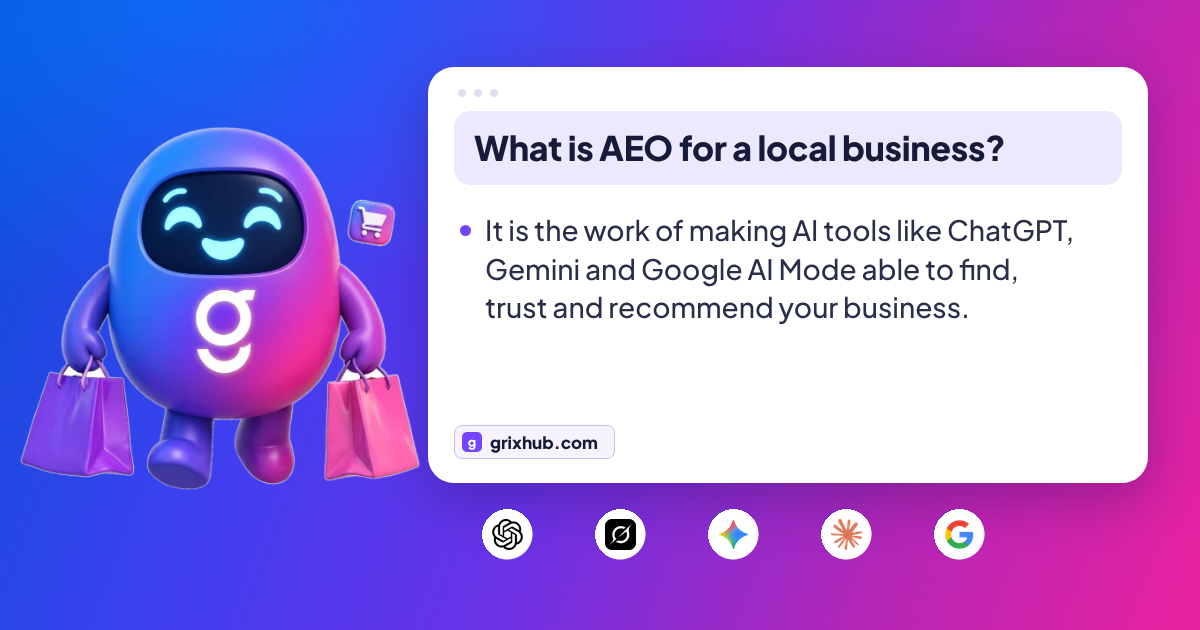
What is AEO for a local business?
It is the work of making AI tools like ChatGPT, Gemini and Google AI Mode able to find, trust and recommend your business. In practice that means a complete Google Business Profile, consistent listings, genuine reviews, clear service pages and mentions on trusted local sites, so an AI answer has good reasons to name you when someone nearby asks.
How do I get my business recommended by ChatGPT?
Make your business easy for ChatGPT to find, check and trust. Allow OAI-SearchBot in your robots.txt, keep your website, Google Business Profile, Yelp and other listings complete and consistent, publish one clear page per service, and earn reviews and local mentions. ChatGPT searches the web live, so it can only recommend what it can read and confirm.
How do I optimize my Google Business Profile for AI?
Fill in every field accurately and keep it current. Verify the profile, use your real-world name with no keywords, pick the fewest and most specific categories, add services, attributes, hours, holiday hours and photos, and reply to reviews. Google’s AI features and Ask Maps draw on Maps and Business Profile data, so accuracy matters more than tricks.
Is local SEO for AI search different from normal local SEO?
Mostly no, but the weighting shifts. The foundations are the same: a strong Google Business Profile, accurate listings, reviews and a useful website. AI search puts extra weight on what other sites say about you, such as best-of lists, local press and forums, and on dedicated pages for each service.
Do reviews affect whether AI recommends my business?
Yes, reviews are one of the main signals. SOCi found locations recommended by ChatGPT averaged a 4.3-star rating, and Whitespark’s 2026 expert survey lists high Google ratings and reviews on authoritative third-party sites among the top AI visibility factors. Ask every customer for an honest review and reply to all of them.
Do I need schema markup to show up in AI answers?
No, it is not required. Google says there is no special schema needed for AI Overviews or AI Mode. LocalBusiness schema that matches your visible page still helps machines read your name, address, phone, hours and services correctly, so it is a cheap, sensible addition.
How long does local AEO take to work?
Simple fixes can show up within days, and reputation work takes months. A crawler unblock applies in about 24 hours for ChatGPT search, profile and listing fixes usually take a few weeks to flow through, and reviews, best-of lists and press mentions build over several months of steady work.
Can a small local business compete with big chains in AI search?
Yes, and sometimes more easily than in classic search. AI answers favor businesses that are clearly described, well reviewed and specific about what they do and where. A small business with one strong page per service, a complete profile and real local mentions can be named ahead of a chain with thin location pages.
Sources and further reading
- SOCi: In AI-driven discovery, few brands are chosen, most disappear (2026 Local Visibility Index, 28 Jan 2026)
- Search Engine Land: AI local visibility is up to 30x harder than ranking in Google (SOCi report coverage, 2026)
- BrightLocal: Local Consumer Review Survey 2026 (11 Feb 2026)
- BrightLocal: Local AI Visibility Study (16 Sep 2026)
- BrightLocal: Uncovering ChatGPT search sources for local businesses (Dec 2024)
- Yext Research: AI citations, user locations and query context (9 Oct 2025)
- Whitespark: 2026 Local Search Ranking Factors (6 Nov 2025)
- Whitespark: Case study, the prevalence of AI Overviews in local search (12 May 2025)
- Google Business Profile Help: Tips to improve your local ranking on Google
- Google Business Profile Help: Guidelines for representing your business on Google
- Google Maps Help: Prohibited and restricted content (fake engagement)
- Google Search Central: AI features and your website (updated 10 Dec 2025)
- Google Search Central: Local business structured data (updated 8 Sep 2026)
- Google Search Central: Review snippet structured data (updated 8 Sep 2026)
- Google: How we're reimagining Maps with Gemini, Ask Maps (12 Mar 2026)
- Google Maps Help: Ask questions in Google Maps
- Google Search Help: Use AI Mode to check local availability and pricing
- Google: AI Mode in Search gets new agentic features and expands globally (21 Aug 2025)
- Google Thailand Blog: AI Mode now available in Thai (8 Oct 2025)
- OpenAI Help Center: ChatGPT search
- OpenAI: Overview of OpenAI crawlers
- PPC Land: ChatGPT quietly rolled out location sharing (28 Mar 2026)
- Search Engine Roundtable: ChatGPT enables location sharing for more localized near me results (31 Mar 2026)
- Search Engine Land: How does ChatGPT conduct local searches? (Damian Rollison, SOCi)
- Yelp: Full-year 2025 results, agreement with OpenAI (12 Feb 2026)
- PinMeTo: ChatGPT gains Yelp reviews and ratings for local answers (24 Jul 2026)
- PinMeTo: Gemini's local AI search cites business websites most (Steady Demand AI Citation Ledger, 20 Aug 2026)
- Maginative: Perplexity adds Yelp data to its local search (12 Mar 2024)
- Search Engine Roundtable: Google Ask Maps fully available in US and India (1 Apr 2026)
- Glenn Gabe (GSQI): ChatGPT search new features, maps and local listings (Dec 2024, updated Feb 2025)
- Relevant Audience: LINE Thailand puts 56 million users and 12 billion Official Account conversations behind its 2026 business stack (12 Aug 2026)
Keep reading

Written by Jade Teekhasaenee
Founder & Managing Director, Grixhub
Jade leads SEO and AEO strategy at Grixhub in Bangkok. He has technically audited websites for brands in Thailand and around the world, and he built GrixTrack to measure how often brands are mentioned and cited by ChatGPT, Gemini and Google AI Mode.
Does AI recommend your business near you?
We will run the questions your customers ask through ChatGPT, Gemini and Google AI Mode from your area, show you which businesses get named and why, and give you a clear list of fixes for your profile, listings, reviews and pages.

Grixhub is a digital growth and technology company in Bangkok, Thailand: SEO, AEO, digital marketing, paid media management, websites, apps and AI automation.
 Registered company
Services
Digital marketing
SEO
AEO
Website development
App development
AI & automation
Paid Media Management
Google Ads
ChatGPT Ads
Facebook Ads
Instagram Ads
TikTok Ads
Contact
Email: jade@grixhub.com
Phone: +66 62 480 9604
LINE: Grixhub
Bangkok, Thailand
Company
About · Blog
Free AEO Audit call
Terms · GrixTrack Terms · Refund Policy · Privacy Policy · Cookie Policy · Image Licence
Follow us