Industry guide
AI Search for Real Estate Agents: How to Get Found in ChatGPT
Buyers and sellers now ask ChatGPT, Gemini and Google AI Mode which agent to call and which homes to see. This guide shows how those tools pick agents and listings, what the portal apps in ChatGPT change, and the steps that get your name into the answer.
Key takeaways6 points
- AI search for real estate agents means being named, described correctly and cited when buyers and sellers ask ChatGPT, Gemini or Google AI Mode for an agent or a home.
- Buyers already do this: 20% of US prospective buyers and homeowners used AI tools for homebuying research in the past year (Bank of America, 2026), mostly for affordability, the buying process and neighborhoods.
- Most agents are missing. Local Falcon ran 37,500 AI searches in August 2026 and 91.5% of established, website-publishing agents were never named.
- Google Business Profile supplied 36.6% of the citations in that study, Zillow 15.9%, and agent websites only about one in nine, so profiles matter as much as your own site.
- Listings reach ChatGPT through portal apps from Zillow, Redfin and Realtor.com, which display MLS data under their own agreements. Agents can't upload listings to ChatGPT directly, but complete, accurate listings and profiles travel with them.
- Every AI-facing page is still real estate advertising, so fair housing law, the NAR Code of Ethics, state license rules and the FTC's fake review rule all apply.

AI search for real estate agents is the work of making sure that when buyers and sellers ask ChatGPT, Gemini or Google AI Mode for a good agent or a home in your area, your name, your listings and your pages are part of the answer. It builds on local SEO, but the goal is different: you want to be named and described accurately inside a written answer, not just ranked in a list of links.
For years the path to an agent was fairly predictable. A buyer asked a friend for a referral, browsed listings on a portal, and maybe searched “realtor near me” and called someone from the map.
Most of that still happens. What has changed is the step before it. A growing share of buyers now open ChatGPT and ask a full question first: what they can afford, which neighborhoods fit their commute and their budget, whether to rent or buy, and finally who they should talk to. ChatGPT answers with a short list of names, a few source links and, since late 2025, live listings from Zillow, Redfin and Realtor.com right inside the chat.
If your name is on that short list, you start the conversation with a recommendation. If it isn’t, that buyer may never hear of you, however many homes you sold last year. The data on this is blunt: in a study of 37,500 AI searches across the 100 largest US cities, 91.5% of established agents with their own websites were never named at all.
The good news is that AI doesn’t pick agents at random. It reads sources you can see and, honestly, influence: your Google Business Profile, your portal profiles, your reviews and your own pages. The catch is that all of those are real estate advertising, so fair housing law and your licensing and ethics rules apply to every word. This guide covers both sides.
 How we put this guide together
This guide is written by Jade Teekhasaenee, who leads SEO and AEO at Grixhub, where our team technically audits websites for brands in Thailand and around the world. It draws on official documentation from OpenAI, Google, Zillow, Redfin and schema.org, on named studies of home buyers and AI answers (Bank of America, Realtor.com, NAR, Local Falcon and BrightLocal), on the Fair Housing Act, the NAR Code of Ethics and the FTC’s review rule, and on what our team sees when we check brands’ visibility in ChatGPT, Gemini and Google AI Mode. Every statistic was checked against its source on 12 November 2026. Grixhub is not a brokerage or a law firm, and nothing here is legal advice: check your own state, country and MLS rules before you publish.
What is AI search for real estate agents?
It is optimizing your profiles, pages and reputation so AI tools such as ChatGPT, Gemini and Google AI Mode name you, describe you correctly and cite your pages when people ask about agents or homes in your area.
AI search for real estate agents is a specific case of answer engine optimization: shaping what AI tools can find and trust about you, so they put your name in the answer when someone asks about buying or selling in your market.
That sounds abstract, so let’s follow one business through this guide. Call it Lakeside Home Group: a made-up four-agent team in Austin, Texas, that works mostly with first-time buyers and with sellers moving up to larger homes. The team ranks reasonably well on Google for a few neighborhood searches and gets most of its business from referrals.
A young couple relocating for work opens ChatGPT and types: “We’re moving to Austin with a $450,000 budget and a 30-minute commute to the Domain. Which neighborhoods should we look at, and who are good buyer’s agents for first-time buyers?”
ChatGPT searches the web, reads a mix of portal pages, review sites, Google Business Profile data and a few agent websites, and writes back an answer: three or four neighborhoods with a line on each, then three or four agents or teams with a short reason for each, and a Sources button underneath. It may also suggest opening the Zillow or Redfin app in the chat to browse homes on a map.
Lakeside wants three things from that moment: to be named, to be described accurately, and to have its own first-time buyer page among the cited sources.
Optimizing an agent’s or brokerage’s website, listings, profiles and reputation so AI answer engines, such as ChatGPT, Gemini, Google AI Overviews, AI Mode and Perplexity, name and cite them when people ask real estate questions.
It overlaps heavily with classic local SEO. Google’s own documentation says there are no special requirements for its AI features beyond being indexed and eligible for a snippet in normal Search (Google Search Central). What changes is the target. You’re no longer only trying to rank a page. You’re trying to be the agent a model feels safe repeating. If you’re new to the idea, our guide to what AEO is and how answer engines pick sources covers the basics, and our step-by-step AI search optimization guide walks through the platform-by-platform playbook.
What an agent recommendation in ChatGPT looks like
Who are good buyer’s agents in Austin for first-time buyers with a $450,000 budget?
Three or four named agents or teams, each with one line on why, plus a Sources button and an offer to browse homes in a portal app
Google Business ProfileZillow agent directoryRealtor.comYour first-time buyer page
Illustration with a made-up Austin team. The source mix reflects Local Falcon’s August 2026 study of AI answers about agents.
Can ChatGPT really recommend a real estate agent?
Yes. AI tools name specific agents and teams for city searches, but they spread those mentions thinly. In a 2026 study of 37,500 AI searches, 91.5% of established, website-publishing agents were never named once.
Yes. Ask ChatGPT, Gemini or Google AI Mode for the best real estate agent in a big US city and you’ll usually get names back, not just generic advice about interviewing three agents.
The largest public study of this so far comes from Local Falcon, a local search tracking company. In August 2026 it ran three searches (“best realtor near me”, “best real estate agent near me” and “top rated real estate agent near me”) on five platforms (Google AI Overviews, Google AI Mode, Gemini, ChatGPT and Grok) from 25 grid points around the center of each of the 100 largest US cities. That’s 37,500 searches. It then matched the agents it found against RealTrends Verified’s 2026 production rankings (Local Falcon).
The results show that AI does recommend agents, a lot of them. It named 3,757 distinct agents or teams, about 42 per city. But the people you’d expect to see often weren’t there. Of the ranked agents and teams who publish their own websites, 91.5% were never named once. Of the top 10 individual producers in each city who have websites, only 106 of 499 (21.2%) were cited by any platform.
Local Falcon’s summary is worth repeating: “Production volume is invisible to a language model.” A model can only recommend you for what it can read. If your sales record, your specialties and your reviews live in your CRM and your past clients’ heads, an AI answer has nothing to work with.
Two more findings shape the strategy in this guide. First, recommendations concentrate fast: in the average city, the most-cited agent took 26.6% of agent citations and the top four took 56.1%. Second, the platforms disagree. 82.6% of named agents appeared on only one platform, and just 72 agents were named by all four platforms that link to agent websites. As Local Falcon puts it, “There is no single AI ranking to win” (Inman covered the study in detail).
How often AI names real estate agents
Source: Local Falcon, The Realtor AI Visibility Index, published 18 Aug 2026. Local Falcon sells local search tracking, so treat it as a large snapshot rather than a census.
At the brand level, a few names dominate. InboundREM’s April 2026 dataset of AI answers across 11 countries had Sotheby’s International Realty in 60% of luxury answers and RE/MAX in 29% of residential agent answers (InboundREM; sample size not published, so treat it as directional). Big franchise names get mentioned. Individual agents have to earn it locally, and being good at selling homes isn’t enough on its own.
How do home buyers use ChatGPT and other AI tools?
Mostly for early research: affordability, how buying works, and which neighborhoods fit. About one in five US prospective buyers and homeowners used AI tools for homebuying research in the past year, and buyers still want an agent for tours and contracts.
Home buyers mostly use ChatGPT for the research they used to do alone before calling anyone: working out what they can afford, learning how the process works, and comparing neighborhoods.
The cleanest recent numbers come from Bank of America’s 2026 Homebuyer Insights Report. Sparks Research surveyed 2,000 US adults (1,000 homeowners and 1,000 renters) online between 13 April and 10 May 2026. One in five prospective buyers and current homeowners (20%) said they had used AI tools or chatbots for homebuying research in the past year, rising to 28% of millennials and 32% of Gen Z (Mann Report).
What they used it for is the useful part for agents. Among prospective buyers who used AI, 57% used it to estimate affordability, mortgage payments or closing costs, 55% for general education about the buying process, and 52% to research neighborhoods, market trends or property values. The same survey found that buyers still prefer a human for touring homes (55%) and for legal or contract advice (54%).
What US buyers who used AI used it for (Bank of America, 2026)
Source: Bank of America 2026 Homebuyer Insights Report via Mann Report. Sparks Research, 2,000 US adults, 13 Apr to 10 May 2026. Base: prospective buyers who used AI; multiple answers allowed.
Realtor.com’s own survey gives a wider, more enthusiastic number. In August 2025 it asked 1,000 US adults who were interested in buying or selling a home, or had done so in the past two years, where they get housing information. 82% said they use AI for real estate insights, with ChatGPT used by 67% and Gemini by 54% (Realtor.com via PR Newswire). The gap between 20% and 82% comes from different questions and samples: Realtor.com asked people already in the market about any real estate insight.
The Realtor.com survey also asked which sources were a good use of time. Agents still came first, but AI was close behind, ahead of friends and family, TV, social media and the news.
Share who said each housing information source was a good use of time (Realtor.com, 2025)
Source: Realtor.com survey, fieldwork 7 to 8 Aug 2025, 1,000 US adults who were in the market or had bought or sold in the past two years. Not representative of all Americans.
None of this replaces agents. NAR’s 2025 Profile of Home Buyers and Sellers, which covers transactions from July 2024 to June 2025, found that 88% of buyers and 91% of sellers used an agent or broker (NAR), and 43% of buyers found their agent through a referral (Virginia Realtors). The same report put the median first-time buyer age at a record 40.
What AI changes is who gets considered before that call. NAR’s own June 2026 coverage described AI as an “early step” in the journey (NAR). For Lakeside, the takeaway is simple: the questions buyers ask AI first (affordability, process, neighborhoods) are the questions its website should answer best.
You’ll see much bigger claims online, such as “60% of buyer searches now begin in AI.” We couldn’t trace those to a published method, so we left them out. The surveys above publish their sample and dates.
What are the Zillow, Redfin and Realtor.com apps in ChatGPT?
They are portal apps that run inside ChatGPT. Zillow's launched on 6 October 2025, Redfin's on 6 February 2026 and Realtor.com's on 30 March 2026. They show listings and tools in the chat, then send buyers to the portal to tour or contact an agent.
They are apps that the big US portals built with OpenAI’s Apps SDK, so a buyer can search listings and use portal tools without leaving ChatGPT.
OpenAI introduced apps in ChatGPT on 6 October 2025 at its DevDay event, with Booking.com, Canva, Coursera, Expedia, Figma, Spotify and Zillow as launch partners. You can call an app by starting a message with its name, and ChatGPT can also suggest an app when it fits the conversation. OpenAI’s own example is exactly our topic: a conversation about buying a home can surface Zillow so the user can browse listings on an interactive map (OpenAI). At launch, apps were available to logged-in users on Free, Go, Plus and Pro plans outside the European Economic Area, Switzerland and the UK.
You can now chat with apps in ChatGPT.
— OpenAI (@OpenAI) October 6, 2025
Zillow. Zillow’s app went live the same day for logged-in US users on Free, Plus and Pro plans. A user types something like “Zillow, show me homes for sale in Kansas City” and gets for-sale homes and rentals with photos, maps, prices, core facts, broker and MLS attribution and required disclosures. Tours, agent contact and financing happen on Zillow.com, one click away (Zillow).
Redfin. Redfin followed on 6 February 2026. Its app surfaces listings that Redfin says are “updated directly from the MLS,” lets users refine the search by chatting (its example is “Can you show me homes within 10 miles of a hospital?”), and hands off to Redfin for tours, a Redfin agent or financing (Redfin).
Realtor.com. Realtor.com launched on 30 March 2026 with a different angle. Its app focuses on “pre-search” questions: an affordability calculator, conversational budgeting, neighborhood discovery and rent-versus-buy, then it routes serious buyers back to Realtor.com to see full listings, contact an agent and book tours. Listings in ChatGPT show only a preview, and the company says using MLS data to train the model is “strictly prohibited” (Real Estate News).
It isn’t only a US story. By February 2026, REA Group had launched a realestate.com.au app in ChatGPT for Australian buyers, and France’s Leboncoin had opened its classifieds to ChatGPT search (Online Marketplaces). Portals are also building the same experience on their own sites: Zillow put a conversational “AI mode” into limited beta on 25 March 2026, with a Fair Housing Classifier that checks both user questions and AI responses (Zillow).
How home search moved into AI answers, 2025 to 2026
- 2025
- 16 Oct 2025: Apps in ChatGPT launch, Zillow among the firstUS, logged-in Free, Plus and Pro users
- 2Dec 2025: Google tests home listings in mobile searchpaid partnership with ComeHome
- 2026
- 36 Feb 2026: Redfin app in ChatGPTlistings updated from the MLS
- 4Feb 2026: realestate.com.au app in ChatGPT (Australia)
- 525 Mar 2026: Zillow AI mode betaFair Housing Classifier on questions and answers
- 630 Mar 2026: Realtor.com app in ChatGPTaffordability, neighborhoods, listing previews
- 7Jun 2026: Google says listings will reach all 50 statesvia HouseCanary and participating MLSs
Sources: OpenAI, Zillow, Redfin, Real Estate News, Online Marketplaces, Search Engine Roundtable, Real Estate News.
If you want to see what the Zillow experience looks like in practice, OpenAI’s DevDay keynote includes a live demo: ChatGPT suggests a city, the Zillow app opens a map of homes for sale, and the presenter narrows it to three-bedroom homes with a yard by simply asking.
OpenAI · YouTube
OpenAI · OpenAI DevDay 2025: Opening Keynote with Sam Altman · watch on YouTube
The key detail for agents is the handoff: buyers browse in ChatGPT but contact an agent on the portal, so your listings and portal profile become one of the first things they see.
How do you get real estate listings in ChatGPT?
Through the portals. Your MLS listings appear in ChatGPT when Zillow, Redfin or Realtor.com show them in their apps under their own MLS agreements, with broker attribution. You can't upload listings to ChatGPT yourself, but you control how complete and accurate they are.
You get real estate listings in ChatGPT indirectly: the listings you enter in your MLS flow to the portals, and the portals’ ChatGPT apps display them. There is no form for agents to submit listings to OpenAI, and you shouldn’t try to build one.
Zillow has been the most specific about how this works. It says its app is “IDX-compliant” and “operated by, and controlled by Zillow.” Zillow decides which fields are shown and applies guardrails so prohibited fields don’t surface. It is “not sending OpenAI a feed of MLS data”: ChatGPT sends a request, and Zillow sends back a response that only appears inside the Zillow app. Zillow also states that “OpenAI cannot train on IDX data.” Listings carry broker and MLS attribution with the required disclosures, and tour requests and agent connections still run through Zillow’s existing channels (Zillow). At the time of writing the app showed most listing types, including agent-listed, for-sale-by-owner, foreclosure and auction homes and rentals, but not builders’ new construction or Canadian listings.
Not everyone agrees the rules allow this. Two days after the launch, Victor Lund of WAV Group argued that IDX licenses cover display on a broker’s own site and apps, not transmission to a third-party platform like ChatGPT, and San Diego MLS CEO Saul Klein said it was unclear whether policy was violated and passed the question to his attorneys. Zillow responded that listings are attributed to the listing agent and MLS and that the experience runs within its existing MLS agreements (HousingWire). The same question came up again when Redfin launched (HousingWire).
That debate is for MLSs and portals to settle. What an individual agent controls is more than you might think.
The listing itself. The portal apps show what the MLS sends them. Every field filled in, accurate room counts, and remarks that name what’s nearby (schools, transit, parks) give a conversational search more to match. “Homes within 10 miles of a hospital” only finds your listing if the data supports it.
Your attribution. Broker and agent attribution travels with the listing, which is free exposure inside ChatGPT if your name, brokerage and contact details match your portal profile, website and Google Business Profile.
Your own pages. Normal ChatGPT search reads the open web, so a good page about a neighborhood or building can be cited even when a portal shows the listing.
Your MLS’s rules. Follow your MLS’s IDX display rules, and don’t copy MLS data anywhere your license doesn’t allow.
Listings in ChatGPT: what portals control and what you control
The portal app controls
- Which listing fields are shown in the chat
- Sorting and filters
- Where tour and agent requests go
- Its MLS licensing and data guardrails
You control
- Complete, accurate MLS fields and photos
- Remarks that name nearby schools, transit and parks
- Consistent name, brokerage and contact details
- Your own area pages that ChatGPT search can cite
Zillow: “OpenAI cannot train on IDX data”
Ecommerce brands face a similar split between platform feeds and their own pages; our guide to getting products into ChatGPT Shopping shows how that works for product catalogs, and the logic carries over: feed quality decides whether you’re eligible, your own content decides whether you’re chosen.
How are Google AI Mode and Google's own listings changing home search?
Google AI Mode leans heavily on Google Business Profile when it names agents, and Google is separately rolling out MLS-sourced home listings in mobile search through HouseCanary's ComeHome, with attribution and click-to-contact for listing agents.
Google is changing home search in two ways at once: its AI features answer agent and neighborhood questions, and Google itself has started showing home listings in search results.
AI Mode and AI Overviews. These sit on top of Google’s normal index. Google says they may run “multiple related searches across subtopics and data sources” to build an answer, and that a page only needs to be indexed and eligible for a snippet to be shown as a supporting link (Google Search Central). For agent questions, though, Google’s AI leans on its own local data. In Local Falcon’s study, 72.5% of Google AI Mode’s citations for agent searches came from Google Business Profile listings, with Yelp at 4.8% and Zillow at 4.4%. AI Overviews spread its sources more widely, including Zillow (13.2%), FastExpert (10.5%), Reddit (9.6%) and US News (9.0%) (Local Falcon).
Google’s own listings. In December 2025, Google began testing a carousel of homes for sale in mobile results for searches like “homes for sale chicago” and “homes for sale austin.” Google described it as “a curated selection of properties brought to you in paid partnership between Google and ComeHome” (Search Engine Roundtable). In June 2026, Google said the program, run through HouseCanary’s ComeHome under agreements with each MLS, would reach consumers in all 50 states that summer. Listing brokers get “prominent attribution” and agents get click-to-contact on listing pages at no extra cost, while “promoted” buyer’s agents can appear through Local Services Ads (Real Estate News). By July, four MLSs had signed on: Bright MLS, California Regional MLS, San Diego MLS and My State MLS (RISMedia).
So for Google, the agent’s checklist looks like this: a complete Google Business Profile for AI Mode, indexable pages for AI Overviews, and, if your MLS participates, accurate listings with your attribution in Google’s own carousel. We cover AI Mode specifically in how to optimize for Google AI Mode.
For a team like Lakeside that has spent years on its website and almost nothing on its Google Business Profile, that is exactly backwards for Google’s AI.
How does ChatGPT decide which agents to recommend?
When a question needs current local information, ChatGPT searches the web, reads portal pages, directories, review sites and agent websites, and names the agents those sources support. It uses approximate location from your IP address, or precise location if you share it.
ChatGPT decides by searching and reading. When a question needs current or local information, it runs web searches, reads what comes back, and names the agents that the sources it trusts actually support.
Here’s what we know from OpenAI’s documentation. ChatGPT searches the web automatically when a question might benefit from it. Search queries can be sent to third-party search providers, with Bing named as an example, and ChatGPT uses general location information based on your IP address to make results more relevant (OpenAI Help Center). OpenAI also runs its own search crawler, OAI-SearchBot, which is “used to surface websites in search results in ChatGPT’s search features” (OpenAI).
Two newer features make local answers sharper. Since late March 2026, users can opt in to share their device location, including precise location, so “near me” questions return nearby results (Search Engine Roundtable). And since December 2025, clicking a business name in ChatGPT can open a local knowledge panel; one business owner reported that his panel mirrored his Google Business Profile and updated shortly after he changed it (Search Engine Roundtable).
What OpenAI doesn’t publish is how it ranks sources. So we have to look at what it actually cites. In Local Falcon’s agent study, ChatGPT took 39.8% of its citations from Zillow, 18.0% from Realtor.com, 7.3% from HomeLight and 5.5% from Expertise.com. It leaned harder on portals and directories than any other platform. And when it cited Zillow, the link usually pointed to a city-wide agent directory page (86.9% of Zillow citations overall), not an individual agent profile.
So a recommendation gets built from the city’s agent directories, a few “best agents” roundups, review sites and some agent websites, and ChatGPT names the agents who show up repeatedly with consistent signals. A half-empty Zillow profile gives it little reason to pick Lakeside.
Search for your own city’s agent directory pages on Zillow and Realtor.com and see who appears near the top and how their profiles read. That’s one of the main pages ChatGPT reads before it answers. If our guide on getting cited by ChatGPT is new to you, it explains the general mechanics.
Which sources do AI tools cite when recommending real estate agents?
Mostly profiles, not agent websites. In Local Falcon's 2026 study, Google Business Profile supplied 36.6% of citations, Zillow 15.9%, FastExpert 6.3% and Realtor.com 5.7%, while agents' own websites made up roughly one citation in nine.
AI tools mostly cite profiles and directories when they recommend agents. Your own website matters, but it’s a minority of the sources.
Across all five platforms in Local Falcon’s August 2026 study, the ten most-cited sources were Google Business Profile (36.6%), Zillow (15.9%), FastExpert (6.3%), Realtor.com (5.7%), Yelp (4.3%), US News (2.8%), HomeLight (2.3%), Expertise.com (1.8%), RealTrends (1.3%) and Reddit (1.1%). Agents’ own websites made up roughly one citation in nine. Homes.com didn’t make the overall top ten (Local Falcon).
Top sources cited in AI answers about real estate agents (US, August 2026)
Source: Local Falcon, 37,500 searches on ChatGPT, Gemini, Google AI Mode, AI Overviews and Grok in the 100 largest US cities, Aug 2026. Share of all citations. Agent websites combined: about 1 in 9.
Three things stand out for agents.
Google Business Profile is the biggest single source. That’s mostly because of Google’s own AI products, but it also matters for ChatGPT’s local panels. A separate BrightLocal study of about 200,000 local AI searches across all kinds of local businesses, published in September 2026, found Google Business Profile accounted for about 28.6% of directory citations and was cited for 94.17% of the businesses in its dataset (BrightLocal).
Portal directories beat individual profiles. Most Zillow citations pointed at city-wide agent directory pages. You can’t edit those pages, but your profile, reviews and recent sales determine whether you appear on them and how.
Third-party “best agents” lists carry weight. Sites like FastExpert, Expertise.com, US News and RealTrends each picked up a share. These are the real estate equivalent of the directories and rankings we see cited for lawyers in our law firm AI search guide. Being included honestly, through real production data and reviews, is worth more than another blog post.
Agent websites still matter, and Gemini in particular drew more from agents’ own sites than any other platform did. The pattern among the most-cited agent sites is telling, and we’ll come back to it in the content section: 18 of the 25 most-cited agent websites had a “best agents in [city]” page, usually naming their own owner first.
Why do ChatGPT, Gemini and Google AI Mode name different agents?
Because each one reads different sources. ChatGPT leans on Zillow and Realtor.com, Google AI Mode on Google Business Profile, Gemini on FastExpert and agent websites, so the same question returns different names. Answers also change between runs and between locations.
They name different agents because they read different sources, and because AI answers aren’t fixed rankings in the first place.
The per-platform split in Local Falcon’s study is the clearest explanation we’ve seen. ChatGPT is portal-heavy. Google AI Mode is almost entirely Google Business Profile. Gemini draws on FastExpert, Zillow and, more than any other platform, agents’ own websites. AI Overviews mixes portals, review sites, Reddit and US News. Grok leans on Zillow, US News, FastExpert and Yelp.
Where each AI platform looks when it names agents
Source: Local Falcon, Aug 2026, “best realtor near me” style searches in the 100 largest US cities. Perplexity was not in this study.
On top of that, answers move. BrightLocal ran the same local searches repeatedly over 60 days and found that only 20% to 33% of businesses overlapped between repeat runs on average (ChatGPT 23%, AI Mode 21%, AI Overviews 33%). Answers also changed with location inside the same town: overlap across grid points was 36.2% for ChatGPT and about 47% for Google’s two AI surfaces. ChatGPT named an average of 4.1 businesses per answer, AI Mode 3.5 and AI Overviews 2.5 (BrightLocal).
One more BrightLocal detail matters for agents. Storefront businesses were mentioned slightly more often than service-area businesses (33.6% versus 29.4%). Many agents run as service-area businesses with a hidden address, which is often the right setup under Google’s rules, but it means the rest of your signals need to work harder.
So one screenshot of one answer tells you almost nothing. Our guide on how to measure AI visibility covers that method in depth, and we’ll set up a simple version for Lakeside below.
What do fair housing and advertising rules mean for AI search?
Everything you publish for AI to read is still real estate advertising. The Fair Housing Act bans ads that show a preference based on protected characteristics, the NAR Code of Ethics requires a true picture and your firm name, and the FTC bans fake and incentivized reviews.
They mean that every page, profile and FAQ you write to win AI answers follows the same rules as any other real estate advertising. AI search creates no loopholes; it multiplies the places a careless sentence gets repeated.
The Fair Housing Act. In the US, 42 U.S.C. 3604(c) makes it unlawful to publish any notice, statement or advertisement about the sale or rental of a dwelling that indicates a preference, limitation or discrimination based on race, color, religion, sex, handicap, familial status or national origin (Cornell LII). That applies to a neighborhood guide written for ChatGPT exactly as it applies to a print ad. “Perfect for young professionals,” “great for families” or descriptions of who lives in an area can cross the line. Describe the home and the area (square footage, the park two blocks away, the commute), not the people you imagine living there.
The federal guidance changed recently, but the law didn’t. HUD had issued guidance on applying the Fair Housing Act to advertising through digital platforms on 29 April 2024. In a Federal Register notice published on 6 April 2026, HUD listed it among eight fair housing guidance documents it withdrew, effective 17 September 2025 (Orrick InfoBytes). Withdrawing guidance doesn’t change the text of the statute above, and state and local fair housing laws can go further.
The NAR Code of Ethics. If you’re a Realtor, Article 12 requires you to “present a true picture” in advertising and marketing, and Standard of Practice 12-5 requires your firm’s name to be disclosed “in a reasonable and readily apparent manner.” NAR’s guidance notes that calling something marketing rather than advertising doesn’t avoid this, that a team name alone isn’t the company name, and that online ads can meet the rule with a link to a page showing the required disclosures, though many states require the company name in the ad itself (NAR; the article is from NAR’s archive, so check the current Code).
The FTC’s review rule. The FTC’s final rule, announced on 14 August 2024, bans fake reviews (including AI-generated ones), buying reviews that depend on a positive or negative sentiment, undisclosed reviews from insiders, and review suppression through threats or intimidation (FTC). Reviews are one of the strongest signals AI tools read, which makes them tempting to game. Don’t.
Rules that shape real estate AI visibility
General information only, not legal advice. Check your state, country and MLS rules.
Sources: Cornell LII, NAR, FTC, Google, checked 12 Nov 2026.
AI writing tools are fast at producing neighborhood descriptions, and they happily repeat the coded phrases that fair housing rules exist to stop. Have a person check every AI-assisted page against your brokerage’s fair housing guidance before it goes live.
How do you check whether AI recommends you today?
Run a fixed set of 20 to 30 real buyer and seller questions in ChatGPT, Gemini, Google AI Mode and Perplexity, three times each, with the right location. Record whether you're named, how you're described, who else appears and which sources are cited.
You check by running the questions your clients really ask, on each AI platform, several times, and writing down what comes back. A single search on your own phone isn’t a test.
Here’s the process we’d use for Lakeside Home Group.
Collect 20 to 30 real questions. Pull them from intake notes, buyer consultations, listing appointments, emails and texts. Mix three kinds: agent-finding questions (“best buyer’s agent in Austin for first-time buyers”), area questions (“is Mueller a good neighborhood for a $450,000 budget?”), and process questions (“how much are closing costs for a buyer in Texas?”). Our guide to prompt research has more ways to find them.
Split by side and place. Buyer questions and seller questions produce different answers and different sources. So do neighborhoods. Group your prompts so you can see where you’re strong and where you’re missing.
Run each prompt three times per platform. Use ChatGPT, Gemini, Google AI Mode and Perplexity. Set the location to your market (or test from it), because BrightLocal showed answers change with location even inside one town. Three runs smooth out the variation from run to run.
Record five things. Were you named? Was the description accurate? Which competitors appeared? Which sources were cited? Did a portal app appear?
Turn sources into a target list. If ChatGPT keeps citing the Zillow Austin directory, US News and two local “best agents” lists, those are your targets. If Google AI Mode names agents with 150 reviews and you have 12, that’s your gap.
A real estate AI prompt audit in five steps
- 1Collect 20 to 30 real client questionsagent-finding, area and process questions
- 2Split by buyer or seller and by area
- 3Run each in ChatGPT, Gemini, AI Mode and Perplexity3 runs each, location set to your market
- 4Record: named? described right? competitors? sources? portal app?
- 5Turn cited sources into a target listprofiles, directories, lists, your own pages
Our recommended method. Answers vary between runs and locations (BrightLocal, Sep 2026).
Doing this by hand once is a good start. Doing it every month is where it gets tedious, which is why we built GrixTrack: it tracks mentions and citations in ChatGPT, Gemini and Google AI Mode, runs each prompt three times, and also tracks Google rankings by country, city and language. The free plan covers 10 keywords, 5 prompts, 1 project and 2 competitors, which is enough for a solo agent to watch the questions that matter most.
How do you make sure AI can read your real estate website?
Allow the search crawlers (OAI-SearchBot for ChatGPT search, Googlebot, Bingbot, PerplexityBot), make sure your firewall isn't blocking them, keep key pages indexed, and put important text in the HTML rather than only in images, PDFs or IDX widgets.
You make your site readable by letting the right crawlers in and putting your important content where they can see it. This is the fastest part of the whole job, and it’s often where agent websites quietly fail.
Allow the search crawlers. ChatGPT search relies on OAI-SearchBot. Blocking GPTBot only signals that your content shouldn’t be used to train OpenAI’s models; OpenAI says each setting is independent, so you can block training and still appear in search. After a robots.txt change, OpenAI says it can take about 24 hours for its search systems to adjust (OpenAI). Make sure Googlebot and Bingbot are allowed too, since Google’s AI features use Google’s index and ChatGPT can send queries to providers such as Bing. If you’re weighing what to block, our guide to blocking AI crawlers walks through the trade-offs.
Check the firewall, not just robots.txt. Many real estate sites run on platforms with a CDN or bot protection in front. Those can block AI crawlers even when robots.txt allows them. Our free AI crawler checker tests whether the main AI bots can reach a page.
Watch your IDX setup. Many agent websites show listings through an IDX widget or iframe that loads after the page. That’s fine for listings, which the portals already cover, but don’t let your whole site depend on it. Your bio, your area pages and your FAQs should be plain HTML text.
Keep key pages indexed. Check Google Search Console and Bing Webmaster Tools for your homepage, about page, team bios and area pages. A page that isn’t indexed can’t be a supporting link in AI Overviews or AI Mode.
Don’t hide facts in images. Badges as images, sales numbers in PDFs and testimonials in script-loaded sliders are invisible to most crawlers. Put each claim, with its source and year, in text.
In our made-up example, Lakeside’s bot protection blocks several AI crawlers and its neighborhood guides are image-heavy PDFs. Both problems are common on agent sites, and both take days, not months, to fix.
How should real estate agents set up Google Business Profile for AI search?
Create a profile that follows Google's individual practitioner rules, use your real-world name without keywords, set an accurate address or service area, fill every field, and earn steady, genuine reviews. Google AI Mode took 72.5% of its agent citations from these profiles.
Set it up exactly the way Google’s guidelines describe, then make it the most complete, most accurate version of you anywhere online. For Google’s AI, it’s close to the whole game.
Know which profile you should have. Google’s guidelines define an individual practitioner as “a public-facing professional, typically with their own customer base.” Practitioners in public-facing roles can have their own profile, but they must be contactable directly at the verified location during stated hours, and support staff shouldn’t create profiles. Where several practitioners work at one location, the brokerage gets its own profile and each practitioner’s profile carries only their name. If you are the only public-facing practitioner at a branded location, Google suggests sharing one profile named “[brand/company]: [practitioner name]” (Google Business Profile Help).
Use your real name only. Your profile name should match your real-world name. Adding service or location keywords (“Jane Doe Realtor Best Austin Homes”) isn’t permitted and can get the profile suspended.
Get the location right. Virtual offices and mailboxes aren’t eligible. If you serve clients at their homes or at listings rather than at an office, set it up as a service-area business, hide the address, and keep the service area within roughly two hours’ drive of your base, as Google’s guidelines describe.
Fill every field that’s true. Primary category, the areas you serve, hours, phone, website link to the right page (your team or bio page, not just the homepage), services such as buyer representation and listing services, languages spoken, photos of you and your team, and regular posts about real market activity.
Keep it consistent. The same name, brokerage, phone and website on Google, Zillow, Realtor.com, Yelp and your own site. AI tools cross-check sources, and conflicting details give them a reason to pick someone else.
We go deeper on the local side, including how Google Business Profile feeds AI answers for every kind of local business, in our guide to AEO for local businesses.
How do reviews and portal profiles affect AI recommendations?
Strongly. ChatGPT took 39.8% of its agent citations from Zillow and 18% from Realtor.com, and Google's AI reads Google reviews. Complete profiles with recent, genuine reviews and verified sales give AI something specific to repeat about you.
Reviews and portal profiles are the evidence AI tools quote when they explain why an agent is worth calling. Without them, your name has nothing to stand on.
A ChatGPT recommendation is a name plus a reason, and the reason has to come from somewhere. With more than half of ChatGPT’s agent citations coming from Zillow and Realtor.com in Local Falcon’s study, those profiles usually supply it.
Complete every portal profile you hold. Zillow, Realtor.com, Homes.com and regional portals. State who you help, where and for how long, link recent sales where allowed, and use the same name and headshot everywhere.
Ask for reviews the same way every time. Ask every closed client at the same point, with the same short message and a direct link. Steady, recent reviews look more trustworthy than a burst of twenty in one week.
Stay on the right side of the FTC. No reviews written by you or your staff, no reviews from family without disclosure, no gift cards conditioned on five stars, and no AI-generated reviews. The FTC rule covers all of these.
Answer reviews like a professional. Thank people specifically. Respond to criticism calmly and without client details. Prospective clients read replies, and so do AI tools.
Earn a place on third-party lists honestly. Lists from RealTrends, US News, FastExpert and Expertise.com showed up repeatedly in AI citations. Find out how each one decides who’s included (production data, reviews, an application) and meet the criteria rather than paying for a badge that says nothing.
The same pattern shows up in other trust-heavy industries. Hotels depend on booking and review platforms in the same way; our guide to getting hotels recommended by AI covers how that plays out there.
What content should a real estate agent publish to get cited by AI?
Answer-first pages about the areas you serve, the buying and selling process in your market, and who you help, with specific numbers, dates and named places. Pages that answer one real client question clearly are what AI tools quote.
Publish pages that answer the exact questions buyers and sellers ask AI, in your market, with specifics a model can repeat. That’s what turns your website from a brochure into a source.
Go back to the Bank of America numbers. Buyers who use AI ask about affordability, the buying process and neighborhoods. Those three topics are your content plan.
Area pages. One page per neighborhood you really work in. Open with a two-sentence answer to the most common question, then add dated median prices with a source, home types, commute times, and named parks, schools and transit. Describe the place, not the people.
Process pages for your market. Buyer closing costs in your state, typical time from offer to close, how buyer agreements work locally. Answer first, then explain.
Who-you-help pages. “First-time buyers in Austin” or “selling an inherited home in Travis County.” These match how people phrase questions to ChatGPT and give AI a clear reason to name you for a situation.
Verified proof. Your production, in text, with the source and year (“RealTrends Verified, 2026”), your license number and brokerage, and the neighborhoods where you’ve closed deals.
Now, about the “best agents in [city]” pages. Local Falcon found that 18 of the 25 most-cited agent websites had one, usually listing their own owner first. It plainly works on today’s AI tools. But think about Article 12 before copying it. A page that ranks yourself as the top agent in your city, dressed up as a neutral guide, is hard to square with presenting “a true picture.” Our recommendation is a transparent alternative: a guide to choosing an agent in your city that explains what to look for, says clearly that you’re one of the options and why, and links to independent sources such as RealTrends or your portal reviews. It answers the same question without misleading anyone.
Write agent pages AI can quote
Before
- Dedicated, results-driven agents passionate about helping you find your dream home…
- Nothing a buyer or an AI can repeat
After
- Direct answer to one client question first
- Dated prices, commute times, named parks and schools
- Who you help, where, with verified production
- Firm name and license, no fair housing red flags
Buyers who use AI ask most about affordability (57%), the process (55%) and neighborhoods (52%)
Illustration with a made-up team. Data: Bank of America 2026 via Mann Report.
Here’s how that looks for Lakeside’s first-time buyer page.
At Lakeside Home Group, we’re passionate about helping first-time buyers achieve the dream of homeownership. Our dedicated team goes above and beyond to make your journey smooth and stress-free.
Most first-time buyers we work with in Austin look at three-bedroom homes in the $400,000 to $475,000 range in neighborhoods such as Mueller, Windsor Park and North Lamar. From an accepted offer, a typical financed purchase closes in 30 to 45 days. Here’s what each step costs and how long it takes.
The “after” version is still a made-up example, and a real page would date and source every price. But it answers a question with specific places and numbers, and it makes sense on its own. Our AEO content checker scores a page for that answer-first structure in your browser.
Forums matter in some markets too: Reddit made Local Falcon’s top-ten source list, and our guide on whether Reddit helps AI visibility explains how to take part without breaking community rules.
Which schema markup should a real estate agent use?
Use RealEstateAgent, a schema.org type under LocalBusiness, for your business or practitioner page, with name, address or areaServed, telephone and employee details that match your visible content and Google Business Profile. Schema helps machines understand you but is not required for AI features.
Use the schema.org RealEstateAgent type on your main business page and keep every value identical to what visitors see and to your Google Business Profile.
RealEstateAgent sits under LocalBusiness, which itself inherits from both Organization and Place (schema.org). That means you can use the usual local business properties: name, address, telephone, email, openingHours, areaServed, priceRange, employee for each agent on the team, and sameAs links to your Google Business Profile, Zillow and Realtor.com profiles. For team pages, a Person entry for each agent, connected to the brokerage with worksFor, makes the relationship explicit.
Keep expectations realistic. Google says there’s no special schema needed to appear in AI Overviews or AI Mode, and that structured data should match the visible text on the page (Google Search Central). Schema doesn’t earn recommendations on its own. What it does is remove ambiguity: it tells machines that “Lakeside Home Group” is a real estate agent, where it operates, who works there and which profiles belong to it.
Two cautions. Don’t add review markup for reviews collected on other sites; that isn’t what review snippets are for. And don’t put listing data in schema in ways your MLS rules don’t allow. Our free schema generator builds valid LocalBusiness-style markup, and our guide to schema markup for AEO explains which types actually help.
Does AI search work the same for agents outside the US, for example in Thailand?
The principles are the same everywhere, but the sources change. Outside the US, AI tools read local portals, Google Business Profile and local forums and chat apps, and the ChatGPT portal apps are country-specific. In Thailand that means portals such as DDproperty, Google Business Profile, LINE and bilingual pages.
The method is the same in every country: be readable, be consistent, be reviewed, and answer real questions. What changes is which sources the AI tools find in your market.
Most data in this guide is from the US, where the big studies have been done, and the portal apps are country-specific: Zillow’s app launched for US users, realestate.com.au has its own for Australia. In markets without a portal app, ChatGPT relies on ordinary web search, so local portals, Google Business Profile and your own pages carry even more weight.
Take Thailand, where our team is based. Buyers browse listings on portals such as DDproperty, which publishes its own data on where Thais search for homes; its 2025 platform data ranked Bangkok first for both buying and renting, with Watthana the top district (The Nation). Much of the actual conversation then moves to LINE, where agents share listings and answer questions. LINE OpenChat alone reached 24 million monthly active users in Thailand in November 2026 (Malay Mail). The catch is that LINE chats are closed to crawlers, so AI tools can’t see any of that expertise.
That shapes the advice for agents in Thailand and similar markets.
Publish in both languages. Foreign buyers ask ChatGPT in English, local buyers ask in Thai, and the answers draw on different pages. A condo guide for one Bangkok district in Thai and English, with the same facts, gives both audiences something to cite.
Make your LINE expertise public. Turn the questions you answer every week on LINE into public pages: foreign ownership quotas for condos, transfer fees, what a building’s common fees cover. Then link your LINE Official Account from those pages.
Complete your Google Business Profile and portal profiles. Google’s AI features work the same way in Thailand, and the same profile rules apply.
Check local advertising rules. Advertising and consumer protection rules differ by country. The fair housing rules in this guide are US law; outside the US, check your own country’s rules and any professional association you belong to.
The same logic applies in other trust-based industries; for example, our guide on how B2B buyers use ChatGPT to shortlist vendors shows how shortlisting works when the buyer does most of the research alone.
How do you measure results, and where should an agent start?
Start with crawler access and your Google Business Profile in week one, run a prompt audit as your baseline, fix portal profiles and five key pages over the next two months, then build reviews and mentions for six months or more. Measure mention rate and citations monthly.
Measure the things AI search actually changes, and start with the fixes that are fast and cheap before the work that takes months.
What to measure. Track four numbers every month: mention rate (the share of your prompts where you’re named), accuracy (whether the description is right), citation rate (how often your own pages or profiles are cited) and AI referral traffic to your site. Add the leads that mention ChatGPT or “AI” in your intake form; ask every new client how they found you and record the answer. Then compare by platform and by area, because the earlier data shows they behave differently.
How long it takes. Crawler changes are the quickest: OpenAI says about 24 hours for ChatGPT search. Profile and page changes need to be recrawled and reread, so think in weeks. Reviews, list inclusions and mentions on trusted sites take months, and that’s the work that moves you from occasionally named to regularly named.
Your real estate AI search roadmap
- Days
- 1Day 1: Allow OAI-SearchBot, Googlebot and Bingbot; check the firewallabout 24 hours to apply in ChatGPT search
- Weeks
- 2Week 1: Prompt audit baseline20 to 30 questions x 3 runs x 4 platforms
- 3Weeks 1 to 3: Fix Google Business Profile and portal profilessame name, brokerage, phone and link everywhere
- 4Weeks 2 to 8: Rewrite 5 key pages answer-firstareas, process, who you help
- Months
- 5Months 2 to 6+: Reviews, list inclusion, local mentions
- 6Monthly: Re-run the audit and adjust
Crawler timing: OpenAI. Other phases are typical ranges, not guarantees.
For Lakeside Home Group, week one means unblocking the AI crawlers and running a 25-question baseline. The next few weeks go to its Google Business Profile, its Zillow and Realtor.com profiles, and a review request for every closed client. Over two months it rewrites five pages: first-time buying in Austin, Texas closing costs and three neighborhood guides. Then it keeps going, because agents who get named consistently are the ones whose evidence keeps growing.
None of this is a trick, and none of it is guaranteed. AI tools change their sources, portals change their apps, and answers vary from run to run. But the work itself (being findable, consistent, reviewed and genuinely useful) is the same work that wins referrals. If you’d like help with it, our AEO service starts with exactly this audit.
Frequently asked questions

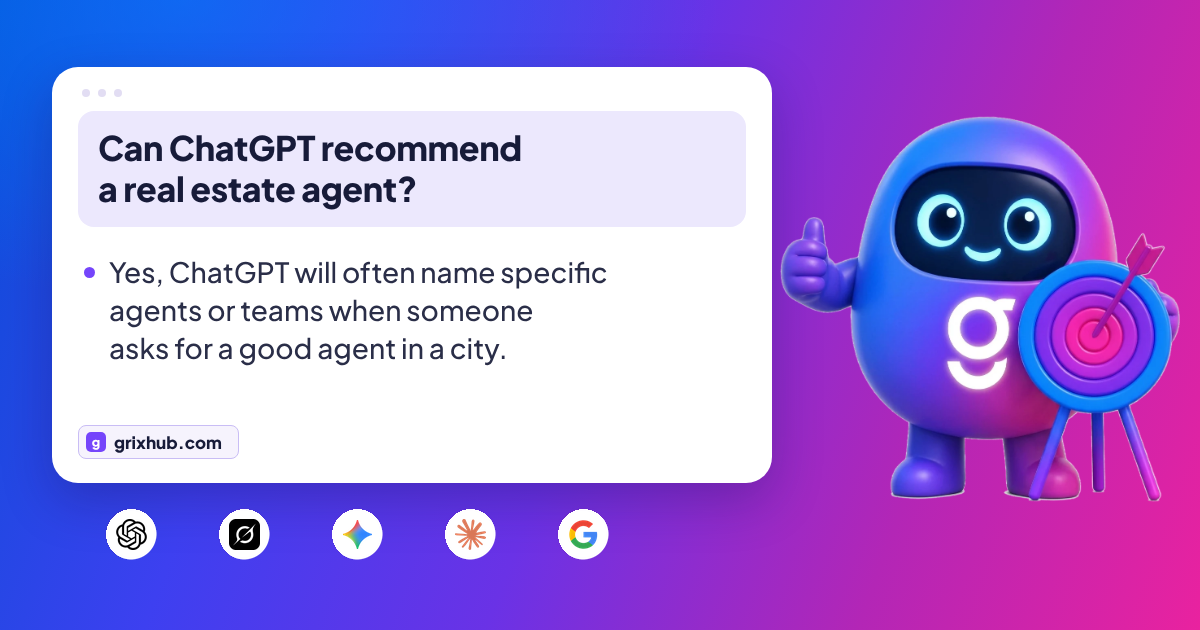
Can ChatGPT recommend a real estate agent?
Yes, ChatGPT will often name specific agents or teams when someone asks for a good agent in a city. In Local Falcon’s August 2026 study it leaned heavily on Zillow and Realtor.com pages to do that, so an agent with a complete, well-reviewed portal profile and a clear website has a better chance of being named.
How do home buyers use ChatGPT?
Mostly for research before they talk to anyone. Bank of America’s 2026 survey found the top uses were estimating affordability and mortgage costs (57%), learning how the buying process works (55%) and researching neighborhoods and market trends (52%). Buyers still prefer a real estate professional for tours and contract advice.
How do I get my real estate listings in ChatGPT?
You can’t upload listings to ChatGPT yourself; they appear through portal apps such as Zillow, Redfin and Realtor.com, which display MLS listings under their own licenses with broker attribution. Keep your MLS entries complete and accurate, because that data is what those apps show, and build pages about your areas so ChatGPT search can cite you.
Why doesn't ChatGPT mention me even though I sell a lot of homes?
Because AI tools can’t see production volume unless a source says it. Local Falcon found that only 21.2% of the top 10 producers per city were cited at all. AI names agents whose profiles, reviews and pages it can read, so sales records need to show up in public, crawlable places.
Is Google Business Profile important for real estate agents in AI search?
Yes, it is the single biggest source in the data we found. Google Business Profile supplied 36.6% of citations across AI answers about agents and 72.5% of Google AI Mode’s citations in Local Falcon’s 2026 study. Follow Google’s rules for individual practitioners and keep the profile complete.
Do fair housing rules apply to AI search content?
Yes. The Fair Housing Act bans housing ads that show a preference based on race, color, religion, sex, disability, familial status or national origin, and that covers web pages, profiles and anything you write for AI to quote. Describe homes and amenities, not the people you think should live there.
How long does it take to show up in AI answers as an agent?
Technical fixes can apply within about a day, but being named usually takes months. Crawler changes take around 24 hours for ChatGPT search, profile and page fixes take weeks to be picked up, and reviews and mentions on trusted sites build over several months.
Sources and further reading
- Zillow: Zillow debuts the only real estate app in ChatGPT (6 Oct 2025)
- Zillow: How Zillow's app in ChatGPT expands listing reach and protects industry rules (9 Oct 2025)
- OpenAI: Introducing apps in ChatGPT and the new Apps SDK (6 Oct 2025)
- OpenAI on X: You can now chat with apps in ChatGPT (6 Oct 2025)
- OpenAI on YouTube: OpenAI DevDay 2025 Opening Keynote with Sam Altman
- Redfin: Redfin debuts its home search app in ChatGPT (6 Feb 2026)
- Real Estate News: Realtor.com, the latest portal to launch a search app in ChatGPT (30 Mar 2026)
- Online Marketplaces: ChatGPT integrations for Redfin, REA Group and Leboncoin (13 Feb 2026)
- Zillow: Zillow debuts AI mode (25 Mar 2026)
- Realtor.com survey: 82% of Americans use AI for housing market information (9 Oct 2025, 1,000 US adults)
- Mann Report: Bank of America 2026 Homebuyer Insights Report (23 Jun 2026, 2,000 US adults)
- NAR: AI becomes early step in homebuying journey (30 Jun 2026)
- NAR: Top 10 takeaways from NAR's 2025 Profile of Home Buyers and Sellers (3 Nov 2025)
- Virginia Realtors: Key takeaways from NAR's 2025 Profile of Home Buyers and Sellers (8 Dec 2025)
- Local Falcon: The Realtor AI Visibility Index (18 Aug 2026, 37,500 AI searches)
- Inman: 91.5% of established agents don't show up in AI search (20 Aug 2026)
- InboundREM: AI search real estate winners, April 2026 dataset (27 May 2026)
- BrightLocal: What 200k local AI searches tell us about which businesses get recommended (16 Sep 2026)
- BrightLocal: Uncovering ChatGPT search sources for local businesses (12 Dec 2024, 800 searches)
- HousingWire: Does Zillow's ChatGPT integration violate MLS rules? (8 Oct 2025)
- HousingWire: Redfin launches a ChatGPT app, raising MLS data licensing questions (6 Feb 2026)
- Search Engine Roundtable: Google tests property listings in search results (15 Dec 2025)
- Real Estate News: Google to serve up real estate listings nationwide (11 Jun 2026)
- RISMedia: Google enters the portal wars (14 Jul 2026)
- OpenAI: Overview of OpenAI crawlers
- OpenAI Help Center: ChatGPT search
- Search Engine Roundtable: ChatGPT enables location sharing for more localized near me results (31 Mar 2026)
- Search Engine Roundtable: ChatGPT gains local knowledge panels (22 Dec 2025)
- Google Search Central: AI features and your website (updated 10 Dec 2025)
- Google Business Profile Help: Guidelines for representing your business on Google
- Schema.org: RealEstateAgent
- Cornell LII: 42 U.S. Code 3604, discrimination in the sale or rental of housing
- Orrick InfoBytes: HUD withdraws eight fair housing guidance documents (10 Apr 2026)
- NAR: Advertising, no team is an island (Article 12, archive, 2017)
- FTC: Final rule banning fake reviews and testimonials (14 Aug 2024)
- Malay Mail / Media OutReach: LINE OpenChat reaches 24 million monthly active users in Thailand (5 Nov 2026)
- The Nation: DDproperty 2025 platform data on where Thais search for homes (17 Jan 2026)
Keep reading

Written by Jade Teekhasaenee
Founder & Managing Director, Grixhub
Jade leads SEO and AEO strategy at Grixhub in Bangkok. He has technically audited websites for brands in Thailand and around the world, and he built GrixTrack to measure how often brands are mentioned and cited by ChatGPT, Gemini and Google AI Mode.
Does AI recommend your real estate business?
We will run the questions your buyers and sellers really ask through ChatGPT, Gemini and Google AI Mode, show you which agents and sources get named in your area, and map out what it takes to get your name into those answers.

Grixhub is a digital growth and technology company in Bangkok, Thailand: SEO, AEO, digital marketing, paid media management, websites, apps and AI automation.
 Registered company
Services
Digital marketing
SEO
AEO
Website development
App development
AI & automation
Paid Media Management
Google Ads
ChatGPT Ads
Facebook Ads
Instagram Ads
TikTok Ads
Contact
Email: jade@grixhub.com
Phone: +66 62 480 9604
LINE: Grixhub
Bangkok, Thailand
Company
About · Blog
Free AEO Audit call
Terms · GrixTrack Terms · Refund Policy · Privacy Policy · Cookie Policy · Image Licence
Follow us