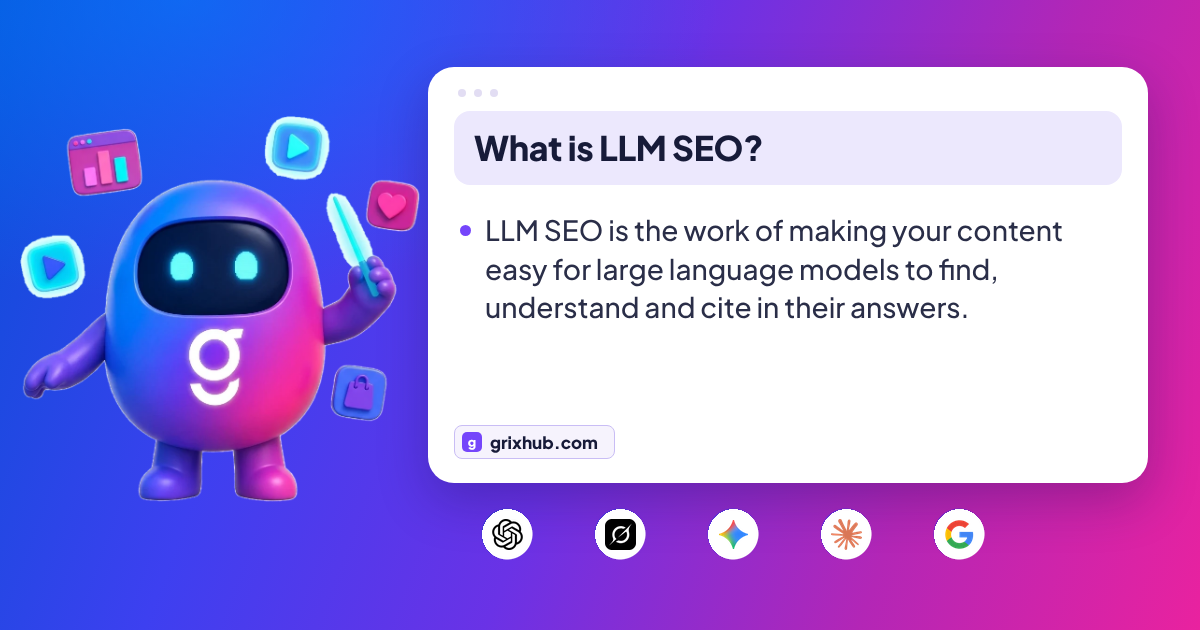
LLM SEO guide
LLM SEO: How to Optimize Content for LLMs
LLMs don't read your page the way a person does. They fetch it, cut it into passages, score each passage against a question and quote the few that hold up. This guide shows how that works and how to write content that survives every step.

Key takeaways6 points
- To optimize content for LLMs, make every important passage easy to fetch, easy to lift out on its own, and easy to verify, because AI search tools retrieve and cite passages, not whole pages.
- Answer engines run several searches per question, pull candidate pages, score small units of text against the question and quote the best ones. Perplexity and Microsoft both say they work at the passage or fact level.
- Position matters: in Kevin Indig's analysis of 1.2 million ChatGPT results, 44.3% of citations came from the first 30% of a page's text (Practical Ecommerce, March 2026).
- Google says you don't need to chop content into tiny chunks, write differently for AI or add llms.txt. Write for people, with one clear idea per section, and you serve both.
- Facts with names, numbers, dates and sources travel best. In the KDD 2024 GEO study, adding citations lifted visibility of fifth-ranked sources by 115%.
- Off-site mentions, fresh facts and a crawlable page decide whether your best passage is ever seen, so LLM SEO is content work plus normal technical SEO.

To optimize content for LLMs, you make each important passage on your page easy for an AI system to fetch, lift out on its own, understand and verify, so tools like ChatGPT, Gemini and Perplexity quote it when they answer a question. That is what people mean by LLM SEO.
Here’s the part most guides skip. A large language model doesn’t read your page top to bottom like a visitor. When it searches the web, it grabs a handful of pages, breaks them into smaller units, scores those units against the question and keeps only a few. Everything else on the page might as well not exist.
So a page can rank well and still never get quoted, because the one paragraph that answers the question is buried, vague or only makes sense if you read the three paragraphs before it.
The fix isn’t to rewrite your site for robots. Google has said plainly that you shouldn’t. The fix is to write the way a good editor always wanted you to: one idea per section, the answer first, real facts with names and numbers, and nothing important hidden.
Below, you’ll see how LLMs actually read, split, retrieve and cite content, what Google, OpenAI, Perplexity and Microsoft say about it, what the research shows, and the step-by-step process we use to make a page easy to quote.
 How we put this guide together
This guide is written by Jade Teekhasaenee, who leads SEO and AEO at Grixhub, where our team technically audits websites for brands in Thailand and around the world. It draws on the official documentation from Google, OpenAI, Perplexity and Microsoft, on peer-reviewed retrieval research and industry citation studies, and on what we see when we check which passages ChatGPT, Gemini and Google AI Mode quote for real customer questions. Every statistic was checked against its source on 9 November 2026, and where a study has limits (small sample, correlation only, vendor data) we say so.
LLM SEO explained: what does it actually mean?
LLM SEO is optimizing your content and your brand so large language models find, understand and cite you when they answer. It is SEO aimed at the passage an AI quotes, not only the page that ranks.
LLM SEO is the practice of shaping your content so that large language models can use it as a source. When someone asks ChatGPT, Gemini, Perplexity, Copilot or Google AI Mode a question, the model writes an answer and credits a few sources. LLM SEO is the work of being one of those sources, and being described correctly when you are.
You’ll see other names for the same thing. Some people say LLMO (large language model optimization). Others say generative engine optimization, or GEO, or AEO. The labels differ, but the goal is the same: get your brand and your pages into AI-written answers.
The practice of making web content easy for large language models to retrieve, understand and cite, covering crawler access, passage-level writing, verifiable facts, entity clarity and off-site mentions.
What makes LLM SEO its own topic is the unit of competition. Classic SEO is a contest between pages. A page ranks, a person clicks, and the person reads whatever they want on it. LLM SEO is a contest between passages. The model reads the page for you and keeps one or two sentences. If those sentences are good, you get cited. If they aren’t, a competitor’s sentences get cited instead, even when your page ranks higher.
It also changes what counts as your content. LLMs don’t only read your website. They read reviews, forums, news stories and lists that mention you. So LLM SEO has an on-site half (pages that are easy to quote) and an off-site half (a reputation that other sites back up).
This guide focuses on the on-site half: how LLMs read and use your text, and how to write so they use it well. If you want the full playbook that also covers each platform, start with our guide on optimizing for AI search step by step. If you want the writing method in depth, our pillar on writing answer-first content is the companion to this page.
From a question to a cited passage
How long does it take to register a company in Thailand as a foreigner?
One short answer, built from 2 or 3 passages, each with a source link
[1][2] Your passage[3]
Based on: Google Search Central (AI features, query fan-out), Perplexity Search API post (25 Sep 2025), Microsoft Bing (6 May 2026)
How do LLMs actually read your content?
In two ways. Some of your text was in the model's training data long ago, but answers that cite sources come from live retrieval: the AI searches, fetches pages and reads selected passages at answer time.
LLMs meet your content in two very different ways, and it helps to keep them apart.
Training. A model like GPT or Gemini learned language and general facts from a huge snapshot of text, collected months or years before you use it. If your brand was written about widely before that snapshot, the model may “know” you. But training is slow, you can’t see it, and the model can’t point to a source for something it only remembers.
Retrieval. When an AI tool needs current or specific information, it searches. Google describes this in its guide to generative AI features as retrieval-augmented generation, also called grounding: Search’s core ranking systems retrieve pages from the index, the model reviews what’s in them, and the answer shows links to the supporting pages. ChatGPT works the same way when it searches. OpenAI’s help page on ChatGPT search says it searches automatically when a question might benefit from web information, and may share disassociated queries with third-party search providers such as Bing.
Almost every citation you see in an AI answer comes from retrieval, not training. That’s good news. Retrieval happens today, on today’s version of your page. If you fix a page, the next retrieval sees the fix.
Connecting a language model’s answer to documents it retrieved at answer time, so the answer can be checked and the sources can be linked. Google uses the term interchangeably with retrieval-augmented generation (RAG).
One question becomes many searches
Retrieval rarely means one search. Google says AI Overviews and AI Mode may use a “query fan-out” technique, issuing several related searches across subtopics and data sources to build one response. In its newer guide, Google’s example for a question about lawn weeds includes fan-out searches like “best herbicides for lawns” and “remove weeds without chemicals.”
John Mueller described the same thing on Google’s Search Off the Record podcast in December 2025: AI systems run many searches on the user’s behalf and combine them into one answer (Search Engine Roundtable).
Then the model reads only parts of the page
After fetching, the system doesn’t hand the model your whole site. It works with selected pieces. Perplexity says its infrastructure “divides documents up into fine-grained units” that are “individually surfaced and scored against the original query.” Microsoft says AI assistants break pages into smaller parts through parsing, and that “these modular pieces are what get ranked and assembled into answers.”
That one sentence from Microsoft is the heart of LLM SEO. The thing being ranked is the piece, not the page.
Which crawlers feed ChatGPT, Gemini, Perplexity and Copilot?
ChatGPT search uses OAI-SearchBot, Perplexity uses PerplexityBot, Gemini and AI Overviews use Google's normal index, and Copilot is built on Bing. Block the search crawler and you can't be cited.
OpenAI. OpenAI runs three. OAI-SearchBot is for search, and OpenAI says sites that opt out of it “will not be shown in ChatGPT search answers, though can still appear as navigational links.” GPTBot collects content for training foundation models, and blocking it only signals that your content shouldn’t be used for training. ChatGPT-User fetches a page when a user’s action asks for it, and OpenAI notes robots.txt rules may not apply to it. OpenAI also says robots.txt changes can take about 24 hours to take effect for search.
Perplexity. PerplexityBot surfaces and links websites in Perplexity’s results and, per Perplexity, isn’t used to crawl content for foundation models. Perplexity-User fetches pages for user actions and generally ignores robots.txt. Changes can take up to 24 hours to show up.
Google. AI Overviews, AI Mode and Gemini’s search grounding use Google’s normal index. Google says a page only needs to be indexed and eligible to show with a snippet, with no extra technical requirements. If Googlebot can crawl and index you, you’re eligible.
Microsoft. Copilot’s answers are grounded in Bing’s index. In May 2026, Microsoft described a grounding index that builds on the same crawlers and quality signals as search but adds a new layer for answers (more on that below).
Which bot to allow for AI search citations
robots.txt changes can take about 24 hours for OpenAI and up to 24 hours for Perplexity
Sources: OpenAI crawlers overview, Perplexity crawlers docs, Google Search Central AI features page, checked 9 Nov 2026
The practical rule is simple. Allow the search crawlers (OAI-SearchBot, PerplexityBot, Googlebot, Bingbot). Decide on training crawlers like GPTBot separately, as a business choice. Blocking a training crawler doesn’t remove you from AI search, but blocking a search crawler does.
robots.txt isn’t the only gate. A CDN or firewall rule that blocks “AI bots” can return errors to OAI-SearchBot or PerplexityBot even when robots.txt allows them. Google’s own checklist tells you to confirm that your CDN or hosting layer allows crawling too. Our free AI crawler checker tests both.
How does retrieval turn a page into chunks?
Retrieval systems split a page into small units, often a few hundred tokens or a single fact, then match each unit to the question by keywords and by meaning. A unit that loses its context when cut out is hard to match.
Once a page is fetched, the system breaks it into units it can compare against the question. Engineers call these units chunks, passages or spans. Each platform does it differently, and none publishes its exact method, but the published research and platform statements describe the same basic pattern.
A small piece of a document, such as a paragraph, a section under a heading or a single fact, that a retrieval system stores, scores and returns on its own.
How big is a chunk? In its write-up on retrieval, Anthropic says chunks are “usually no more than a few hundred tokens”. That’s roughly a few short paragraphs. Microsoft goes further in its May 2026 post on grounding and says the unit of value is “discrete, supportable facts with clear provenance” rather than whole pages.
How are chunks matched? Two methods usually run side by side. Keyword matching (often an algorithm called BM25) finds chunks that share exact words with the question. Embeddings turn text into numbers that capture meaning, so a chunk about “setting up a business” can match a question about “registering a company.” Anthropic describes combining both and merging the results.
What goes wrong? Cutting text into pieces strips away context. Anthropic’s example is a chunk that reads “The company’s revenue grew by 3% over the previous quarter.” Out of context, that chunk doesn’t say which company or which quarter, so it’s hard to retrieve for a question about a specific company, and risky to quote.
Anthropic’s fix, which it calls contextual retrieval, adds a short explanation of where the chunk sits before indexing it. The results show how much missing context costs.
Fewer failed retrievals when chunks keep their context
Reduction in top-20 retrieval failures versus plain chunks
Source: Anthropic, Introducing Contextual Retrieval, 19 Sep 2024. Anthropic’s own benchmark across several datasets.
You can’t control how ChatGPT or Perplexity chunk your page. But you can control whether your passages need repair. A passage that already names its subject, its time frame and its numbers doesn’t lose anything when it’s cut out. That’s the single most useful idea in LLM SEO, and we’ll turn it into a writing method in a moment.
Microsoft makes the same point from the platform side. Its May 2026 grounding post says “chunking/transformations must preserve meaning and claims used in the answer.” Jordi Ribas, who leads search and AI at Microsoft, summed up the shift when the post went live.
— Jordi Ribas (@JordiRib1) May 6, 2026
Research on retrieval units points the same way. A 2023 study, Dense X Retrieval, found that indexing text as propositions, which the authors describe as “atomic expressions within text,” significantly outperformed passage-level units in retrieval tasks. In plain words: the smaller and more self-contained a statement is, the easier it is for a system to find the right one.
Why do some passages get cited and others ignored?
Cited passages tend to sit early on the page, answer the question directly in a full sentence, and contain specific names and facts. Studies of ChatGPT, AI Mode and Gemini citations all show a strong pull toward the top of the page.
Once the candidate chunks are scored, a few get used. The research on which ones win is young, but three patterns keep showing up.
1. Earlier text gets cited more
Kevin Indig, a former head of SEO at G2, analyzed 1.2 million ChatGPT results containing 18,012 citations. He found that 44.3% of ChatGPT’s citations came from the first 30% of the page’s text. Daniel Shashko at Bright Data looked at 42,971 citations across 520 queries on six platforms and found that 74.8% of AI Mode and Gemini citations came from the first half of the page, and 46.1% from the first 30%. Both studies were reported by Practical Ecommerce in March 2026.
Where on the page AI citations come from
Sources: Kevin Indig (1.2M ChatGPT results, 18,012 citations) and Daniel Shashko, Bright Data (42,971 citations, 520 queries), via Practical Ecommerce, 9 Mar 2026
This lines up with older lab research. In “Lost in the Middle”, Stanford and partner researchers found that language models perform best when the relevant information sits at the beginning or end of their input, and that performance significantly degrades when they have to use information from the middle of long contexts. Retrieval systems and models are different layers, but both reward putting the answer where it’s easy to find.
2. Full, short, quotable sentences win
Shashko’s data also showed that every citation was a full sentence, and 92.4% of AI Mode and Gemini citations were sentences of 6 to 20 words. About 70% of AI Mode and Gemini citations linked with a “#:~:text=” fragment that jumps the reader straight to the cited sentence. In other words, Google’s AI isn’t just citing your page. It’s pointing at one sentence on it.
3. Specific beats vague
The third pattern is about content, and it comes from the best-known academic study on the topic. We’ll cover it in detail in the section on verifiable facts, but the short version is that passages with citations, quotations and statistics were used far more often than passages without them.
Treat these position numbers as patterns, not laws. The Indig and Shashko datasets are large but come from consultants and a data vendor, they measure correlation, and the platforms change weekly. The practical lesson is robust anyway: don’t hide your best answer at the bottom of the page.
What does Google say about optimizing content for LLMs?
Google says normal SEO is enough. Its May 2026 guide says you don't need llms.txt, special markup, chunking or rewriting for AI, and that unique, non-commodity content stands out.
Google has been unusually direct on this topic, and its position is worth knowing word for word, because a lot of LLM SEO advice contradicts it.
In July 2025, Gary Illyes told a Google Search Central event that “to get your content to appear in AI Overview, simply use normal SEO practices. You don’t need GEO, LLMO or anything else.” In December 2025, Danny Sullivan and John Mueller spent a podcast episode making the same case: SEO for AI is essentially SEO, and Sullivan suggested GEO is best treated as a subset of it.
Then, in May 2026, Google published a full help document called “Optimizing your website for generative AI features on Google Search”, announced on the Search Central blog. It includes a mythbusting section that lists what you don’t need to do. Search Engine Roundtable’s coverage called out the same items.
Google’s mythbusting list for generative AI search
You don’t need
Still worth doing
Source: Google Search Central, Optimizing your website for generative AI features, last updated 10 Jul 2026
The positive advice is just as useful. Google says its AI systems look at a variety of sources, so a unique viewpoint helps. It warns against recycling what others have already said or what “could easily be produced by a generative AI model.” It separates commodity content, based on common knowledge anyone could write, from non-commodity content that “provides unique expert or experienced takes that go beyond common knowledge.”
That’s a sharper instruction than it looks. If an LLM can already write your paragraph from its training data, it has no reason to cite you for it. The passages that earn citations add something the model can’t produce alone: your prices, your process, your test results, your local knowledge.
Google also warns that creating separate pages for every query variation, mainly to manipulate AI responses, violates its scaled content abuse policy. So “one page per prompt” isn’t LLM SEO. It’s a spam risk.
Google Search Central · YouTube
Google Search Central · SEO, AIO, GEO, your site, & third-party support to optimize for LLMs · watch on YouTube
In that Search Off the Record episode, published in January 2026, Danny Sullivan addresses the most common LLM SEO tip directly, which brings us to the biggest debate in this field.
Should you chunk your content for LLMs?
Not in the sense of chopping pages into tiny fragments. Google says no, and it hurts readers. But writing one clear, self-contained idea per section is good editing that also suits passage-level retrieval.
“Chunk your content” is probably the most repeated LLM SEO tip of the last two years. The idea is that LLMs like bite-sized text, so you should break pages into many tiny sections. Google has pushed back hard.
In the January 2026 podcast, Danny Sullivan said he keeps hearing advice to “turn your content into bite-sized chunks, because LLMs like things that are really bite size”, and responded: “we don’t want you to do that.” He added: “We don’t want people to have to be crafting anything for Search specifically.” Google’s May 2026 guide put it in writing: “There’s no requirement to break your content into tiny pieces for AI to better understand it.”
On the other side, Mike King of iPullRank published a detailed rebuttal in January 2026. His argument is that retrieval systems select passages rather than whole pages, so passage structure affects visibility whether Google likes the word or not. In a test with his own tool, splitting a paragraph that mixed two topics into two paragraphs raised the similarity score for one topic by 19.24%, and adding a heading raised the other by a further 17.54%. Those are similarity scores from his own tool, not measured changes in AI citations, so read them as a demonstration rather than proof.
Our position: both sides are describing the same good page
When you look past the headlines, the two camps agree on more than they admit.
Google’s objection is to fragmentation: pages chopped into dozens of thin, two-line sections written for machines. That makes pages worse for people, and Google says its systems “improve… to reward content written for humans.” Nobody serious defends that.
King’s point is about focus: a passage that mixes two ideas matches neither well. That’s not a machine trick. It’s what editors have always called “one idea per paragraph.”
A guide split into 40 headings of two sentences each, repeated keyword phrases, a separate “AI version” of the page, every paragraph rewritten as a definition.
A guide with one heading per real question, a direct answer in the first sentence, two to four supporting paragraphs, and each paragraph about one thing.
Microsoft’s own guidance lands in the same place. It warns that long walls of text “blur ideas together and make it harder for AI to separate content into usable chunks”, and that headings “act like chapter titles that define clear content slices.” That’s an argument for structure, not for fragments.
So here’s the rule we use with brands: write for a busy human reader who skims headings and reads the first sentence of each section. If that reader gets a complete, accurate answer from every section, the page is already well chunked. You never need to write a second version for robots.
How do you write passages that still make sense when cut out?
Name the subject, the time frame and the key number inside the passage itself. Avoid pronouns and phrases like as mentioned above that point to text the retriever won't see.
This is where LLM SEO becomes a writing skill. The goal is a passage that keeps its full meaning when a retrieval system lifts it out of the page and shows it to a model with no surrounding text.
Think back to Anthropic’s example: “The company’s revenue grew by 3% over the previous quarter.” The sentence is fine on a page where the heading says “ACME Corp, Q2 2023 results.” Out of context, it’s almost useless. The fix isn’t clever. It’s to put the missing context back into the sentence.
Make a passage self-contained
Loses meaning when cut out
Keeps meaning when cut out
Example adapted from Anthropic, Introducing Contextual Retrieval, 19 Sep 2024
Let’s apply this to a running example. Imagine a hypothetical Bangkok firm that helps foreigners register companies in Thailand. Its service page has a section headed “How long does it take?” and the section starts: “It usually takes us about a month, depending on the paperwork.”
A person reading the page understands. A retriever doesn’t. “It” could be anything, “us” is unnamed, and “the paperwork” is vague. Rewritten for a retriever and a reader at once, it becomes something like: “Registering a private limited company in Thailand as a foreigner usually takes about four weeks with [Firm name], once the shareholder documents are signed.” (The firm would use its own real timeline, of course. The point is the structure.)
Name the subject in the first sentence of every section. Don’t start with “It,” “This” or “They.” Start with the thing: the service, the product, the place.
Put the time frame inside the claim. “In 2026,” “as of November 2026,” “per session,” “per month.” Numbers without a time frame get stale and get distrusted.
Kill backward references. Phrases like “as mentioned above,” “see the previous section” and “the second option” point to text the retriever may not include. Repeat the key noun instead. It feels redundant to you. To a reader skimming one section, it’s clarity.
Keep one claim per sentence where it matters. The Dense X Retrieval research found that small, self-contained statements are easier to retrieve than long passages. You don’t need to write in bullet fragments, but your key claim should be one clean sentence a model could quote whole.
Use your brand name where a human would accept it. If every passage says “we,” a quoted passage never carries your name. Mentioning the brand once per key section, in a natural way, means a cited sentence also works as a mention.
Test a passage by pasting just that paragraph, with nothing else, into a blank document. Ask: would a stranger know who this is about, when it applies and what the number means? If not, add the missing words.
For a Thai and English business, there’s one extra check. If your Thai page writes your brand in Thai script and your English page writes it in Latin letters, make sure each version names the brand both ways at least once. LLMs answer in the user’s language, and they need to know the two spellings are the same company.
How should headings work for LLMs?
Make each heading a real question or a clear topic, then answer it in the first sentence under it. Headings tell retrievers where one passage ends and another begins, and match the way people prompt.
Headings do two jobs for LLMs. They mark where one passage ends and the next begins, and they carry meaning that gets attached to the passage under them.
Microsoft’s guidance says headings act “like chapter titles that define clear content slices” for AI. It also notes that question-and-answer formats work well, because assistants “can often lift these pairs word for word into AI-generated responses.” King’s test above found that adding a heading raised a passage’s similarity score on its topic.
The pattern is simple: question heading, answer sentence, supporting detail.
Back to our hypothetical company registration firm. A heading like “Timeline” says very little. “How long does company registration in Thailand take?” says exactly what the section answers, uses the words people type into ChatGPT, and gives the retriever a strong match for fan-out searches on timing.
Use the customer’s words, not yours. If customers ask “how much does it cost,” don’t title the section “Investment.” Your inbox, your sales calls and your LINE chats are the best source of heading wording you’ll ever find.
Don’t stuff every heading with the keyword. Google’s guide says AI systems understand synonyms and general meaning. Vary the wording the way a person would.
Answer in the first sentence, every time. This is the habit that ties everything together, and it’s the subject of our full guide to answer-first content. If the heading asks a question and the first sentence answers it, the passage is quotable even when it’s lifted out alone.
You can test this quickly with our free AEO content checker, which flags sections whose opening sentence doesn’t answer the heading.
How long should sections and pages be for LLMs?
There's no magic length. SE Ranking found ChatGPT cited sections of 120 to 180 words more than very short ones, and longer articles more than short ones, but Google says there's no ideal length. Write what the answer needs.
Length is where LLM SEO advice gets the most contradictory, so let’s look at the only large dataset we have and then at what Google says.
SE Ranking analyzed 216,524 pages from 129,000 domains in 20 niches and compared them with how often ChatGPT cited them. Search Engine Journal reported the results in November 2025. Two findings are about length.
ChatGPT citations by section and page length
Average citations per page
Source: SE Ranking, 216,524 pages on 129,000 domains, via Search Engine Journal, 26 Nov 2025. Correlations, not causes.
Sections of 120 to 180 words between headings averaged 4.6 citations, while sections under 50 words averaged 2.7. Articles over 2,900 words averaged 5.1 citations, while articles under 800 words averaged 3.2.
Notice what that says about the chunking debate. The tiny-section approach, with lots of headings and a couple of lines under each, is exactly what performed worst. Sections with enough room to answer and explain did better.
Now the caveats. Search Engine Journal’s write-up calls these “directional correlations rather than proof.” Long articles tend to come from sites with more links and more authority, and SE Ranking found referring domains were the strongest predictor of citations. Length may be riding along with authority rather than causing anything.
Google’s guide is blunt: “There’s no ideal page length.” Make pages for your audience.
So here’s how we translate it into practice:
A section should be long enough to answer and explain. For most questions that’s a one-sentence answer plus two to four short paragraphs. Something in the 120 to 180 word range is a reasonable default, not a rule.
A page should be as long as the topic. A pricing page can be short. A guide that answers 15 related questions will be long, and that’s fine, as long as each section stands on its own.
Don’t pad. Padding pushes your best passages further down the page, and the position data says that’s where citations thin out.
How do you make facts easy for LLMs to verify?
Add specific numbers, named sources, dates and short quotations, and keep them consistent everywhere. In the KDD 2024 GEO study, citations, quotations and statistics were the edits that raised visibility most.
LLMs and the systems around them are built to avoid confident wrong answers. That makes verifiable facts one of your strongest levers.
The best evidence comes from “GEO: Generative Engine Optimization” by Pranjal Aggarwal and colleagues, including researchers at Princeton, presented at KDD 2024. The team built a benchmark of 10,000 queries, rewrote source pages in nine different ways and measured how much each rewrite changed the source’s visibility in generated answers. They report that the best methods can boost visibility by up to 40%, and by up to 37% on Perplexity.
The winners were the methods that added substance: citing sources, adding quotations from credible sources and adding statistics instead of vague claims. Keyword stuffing, the classic old SEO move, performed worse than doing nothing.
The most interesting result is who benefited. Lower-ranked sources gained the most.
GEO study: visibility gains for the source ranked fifth
The top-ranked source lost 30.3% visibility with Cite Sources
Source: Aggarwal et al., GEO: Generative Engine Optimization, KDD 2024, Table 2. Lab benchmark, not a live platform test.
For the source ranked fifth in search results, adding citations raised visibility by 115.1%, quotations by 99.7% and statistics by 97.9%. The top-ranked source, by contrast, lost 30.3% with the same Cite Sources method. In the study’s setup, substance could beat position.
Keep the limits in mind. This was a lab benchmark built in 2023 with an older generation of models, and only part of it was tested on a live engine. Use it as evidence for the direction, not for the exact percentages.
Microsoft’s 2026 grounding post explains why this direction makes sense. It says “grounding must measure strength of evidence”, that “evidence needs clear provenance and varying evidentiary weight,” and that abstaining is valid “when support is missing, stale, or conflicting.” A passage with a named source and a date is strong evidence. A passage that says “studies show” is weak evidence.
What this looks like on a page:
Replace adjectives with numbers. “Fast turnaround” becomes “documents filed within three business days.” Use your real numbers, and only numbers you can stand behind.
Name the source inside the sentence. “According to Thailand’s Department of Business Development” is stronger than a footnote, because the attribution survives when the sentence is cut out.
Quote real people sparingly. A short quote from your lead consultant or a named expert adds weight. Never invent one.
Keep facts identical everywhere. If your site says four weeks and your Google Business Profile says six, you’ve created exactly the kind of conflict Microsoft says a grounding system may refuse to resolve.
How do you help LLMs understand who and what you are?
Use clear, consistent names for your brand, people, products and places, and connect them on the page and across the web. LLMs cite sources they can tie to a specific, well-described entity.
LLMs reason about entities: brands, people, products, places and concepts. A page that makes its entities obvious is easier to retrieve, easier to trust and easier to describe correctly.
Here’s how to make your entities clear without writing like a robot.
Use one name, consistently. Pick the official form of your brand name and use it the same way on your site, your Google Business Profile, your social profiles and your directory listings. Variants confuse matching.
Define what you are early. Your About page and service pages should say plainly what the business is, where it operates and who it serves, in one sentence. That sentence is often the one LLMs reuse when they describe you.
Name your people. A named author with a real bio and a team page gives systems a person to connect expertise to. This matters for the trust signals Google calls E-E-A-T, and it gives AI answers something concrete to say.
Connect related entities. If your firm handles company registration, work permits and accounting, say so on each relevant page and link the pages together. Internal links help crawlers find pages, and Google lists findability through internal links as a basic requirement for AI features.
Mark it up where it fits. Organization, Person, Product and LocalBusiness structured data describe entities in a form machines read directly. Google says structured data isn’t required for AI features, but it should always match the visible text, and it helps with rich results. Our guide to entity SEO goes deeper on this, and our schema generator builds the markup.
Ask ChatGPT, Gemini and Perplexity “What is [your brand]?” with search on. Whatever they say is how LLMs currently understand your entity. If the description is wrong or thin, the fix usually starts with your About page and your profiles on other sites.
For Thai businesses, entity clarity has a bilingual twist. Make sure your Thai name, English name and any abbreviation all appear together somewhere official, such as the About page, so a model can connect “บริษัท” mentions on Pantip with English mentions on review sites.
Do tables, lists and schema help LLMs read content?
Tables and lists help when the content really is a comparison or a sequence, because they create clean, reusable units. Schema helps machines read entities, but Google says it isn't required for AI features and FAQ schema showed no lift in SE Ranking's data.
Formatting is where LLM SEO advice often turns into box-ticking. Here’s what the platforms actually say.
Lists and tables. Microsoft says “bulleted lists, numbered steps, and comparison tables break complex details into clean, reusable segments.” That’s true when the content is a list or a comparison by nature: steps in a process, prices for three packages, features of two products. A table of three packages with price, duration and what’s included is about as quotable as content gets.
Q&A pairs. Microsoft also says assistants can lift question-and-answer pairs “word for word.” A genuine FAQ section that answers real customer questions can help. A wall of invented FAQs written to catch prompts won’t. Our guide to optimizing FAQs for AI covers how to write them well.
Schema. Google is clear that “structured data isn’t required for generative AI search, and there’s no special schema.org markup you need to add.” Microsoft is warmer and describes schema as data “machines can interpret with confidence.” The data is mixed. In SE Ranking’s ChatGPT study, pages with FAQ schema averaged 3.6 citations against 4.2 without, which the researchers put down to FAQ pages often being simpler support pages.
Formatting that helps LLMs, and formatting that doesn’t
Sources: Microsoft Advertising (8 Oct 2025), Google AI optimization guide (2026), SE Ranking via Search Engine Journal (26 Nov 2025)
Our rule: format for the shape of the content. Use a table when you’re comparing things, a list when there’s a sequence, and paragraphs when you’re explaining. Add schema that matches what’s visible, using our guide to schema markup for AEO, and don’t expect it to rescue weak text.
Microsoft notes that AI systems may not render content hidden in tabs or expandable menus, and that key information only in images “often reduces accuracy.” If a price or a key fact lives inside a collapsed accordion or a graphic, put it in visible text too.
How fresh does content need to be for LLMs?
Fresh enough that every fact is still true. SE Ranking found pages updated within three months drew more ChatGPT citations, and Microsoft says stale facts can directly produce wrong answers.
Freshness matters more for AI answers than for classic rankings, for a simple reason: an AI answer repeats your facts as if they were true today.
Microsoft’s grounding post puts it plainly: “Stale facts can directly produce wrong answers.” A search result with an old price is the reader’s problem. An AI answer with an old price is the AI’s mistake, and systems are being built to avoid that.
The ChatGPT data points the same way. In SE Ranking’s study, pages updated within the last three months averaged 6 citations, compared with 3.6 for outdated content. The same study found page speed mattered too: pages with a First Contentful Paint under 0.4 seconds averaged 6.7 citations, against 2.1 for pages slower than 1.13 seconds.
But “fresh” doesn’t mean changing the date at the top of an old page. It means keeping facts true. Here’s the routine we recommend:
Find the facts that expire. Prices, timelines, legal requirements, opening hours, product specs, statistics with a year attached. These are the passages LLMs quote most and the ones that go wrong first.
Review them on a schedule. Monthly for prices and availability, quarterly for guides. Put a real “updated” date on the page when you change something meaningful.
Date your claims in the text. “As of November 2026” inside the sentence protects you when the passage is quoted without the page’s date.
Update everywhere at once. Change the price on your site, your Google Business Profile and your listings on the same day, so no system sees two versions.
What technical checks make content readable for LLMs?
Allow the search crawlers, serve your main text in the HTML, keep key facts out of images and hidden tabs, and keep pages fast. llms.txt is optional and Google ignores it.
Good writing can’t be quoted if the machine never sees it. These are the technical checks we run before touching a single paragraph.
1. Crawler access. Confirm robots.txt allows OAI-SearchBot, PerplexityBot, Googlebot and Bingbot, and that your CDN or firewall isn’t blocking them. Check server logs for 200 responses to those user agents. We covered the crawlers above.
2. Text in the HTML. Google lists keeping important content available as text among its best practices for AI features. You can’t count on every AI crawler running your JavaScript, so main content that only appears after scripts run is a risk. View the page source, not the rendered page, and check that your headings and key paragraphs are there.
3. Nothing important hidden. As Microsoft warns, content inside tabs, accordions and images may be skipped. Keep core answers visible.
4. Indexing basics. For Google’s AI features, the page must be indexed and eligible for a snippet. A noindex tag, a nosnippet directive or a canonical pointing elsewhere can quietly take a page out of AI answers.
5. Speed and structure. SE Ranking linked fast First Contentful Paint with more citations, so keep pages lean. Use one H1, logical H2 and H3 nesting, real HTML tables for tabular data, and descriptive link text. These help both retrieval and accessibility.
What about llms.txt?
llms.txt is a proposed file that lists a site’s key pages in Markdown for AI tools. It’s often sold as essential LLM SEO. The evidence says otherwise. Google’s guide says AI text files “will neither harm nor help your site’s visibility or rankings in Google Search, as Google Search ignores them.” SE Ranking found llms.txt had negligible impact on ChatGPT citations.
It’s cheap to add and some tools may read it, so it isn’t harmful. Just don’t expect it to fix anything on this list. You can build one in minutes with our free llms.txt generator.
Why do off-site mentions matter for LLM SEO?
Because LLMs build answers from many sources, and most cited pages aren't the brands' own sites. Reddit, Wikipedia, YouTube, reviews and press shape what models say about you.
Everything so far has been about your own pages. But a large share of what LLMs say about any brand comes from other websites, and that changes where your effort should go.
Profound analyzed 680 million citations from August 2024 to June 2025. Among each platform’s ten most-cited sources, Wikipedia made up 47.9% of ChatGPT’s top-10 citations, Reddit made up 46.7% of Perplexity’s and 21.0% of Google AI Overviews’.
Share of each platform’s top-10 cited sources
Source: Profound, 680M citations, Aug 2024 to Jun 2025 (updated Aug 2025). Share of each platform’s top-10 cited domains.
Ranking in Google doesn’t guarantee a place either. Ahrefs ran 15,000 long-tail queries and found that, on average, only 12% of URLs cited by ChatGPT, Gemini, Copilot and Perplexity ranked in Google’s top 10 for the same query. Perplexity overlapped most at 28.6%. ChatGPT’s in-text citations overlapped just 8.0%.
SE Ranking’s ChatGPT study adds more weight. Referring domains were the single strongest predictor of citations, and brands with heavy Reddit and Quora mention volume were cited far more often than those with little presence.
For LLM SEO, this means two things.
Your passages compete with other sites’ passages about you. If a Reddit thread or a review site describes your service better than your own page does, the model may quote them instead. Make your own page the most complete, accurate source on your own business.
Earn mentions honestly. Answer questions on forums like Reddit and Pantip as a disclosed expert, get listed on the review sites your customers use, and give journalists real data. Google’s guide warns that “seeking inauthentic ‘mentions’ across the web isn’t as helpful as it might seem,” and its spam systems still apply to AI features. Paid listicles and swapped mentions are a risk, not a strategy. We cover the off-site side in our guide to getting cited by AI.
How do you measure whether LLM SEO is working?
Track a fixed set of real prompts across ChatGPT, Gemini, Google AI Mode and Perplexity every month, recording mentions, cited pages and quoted passages. Pair that with AI referral traffic in your analytics.
You can’t optimize what you don’t check. The good news is that LLM SEO is easier to observe than most people think, because the answers are right there on the screen.
Build a prompt set. List 20 to 50 questions real customers ask, in the words they use. Mix broad questions (“best way to register a company in Thailand”) with specific ones (“how long does Thai company registration take for foreigners”). Include Thai-language prompts if your customers search in Thai.
Run each prompt more than once. AI answers vary from run to run. At Grixhub, GrixTrack runs every prompt three times in ChatGPT, Gemini and Google AI Mode for exactly this reason, so one lucky or unlucky answer doesn’t skew the picture.
Record three things per prompt. Was your brand mentioned? Was your page cited? And, the LLM SEO-specific one, which passage was quoted? Google’s AI features often link with text fragments that highlight the exact sentence, which makes the quoted passage easy to spot.
What to track for LLM SEO each month
Run each prompt 3 times per platform and compare month over month
Grixhub’s monthly LLM SEO tracking checklist
Compare passages, not just pages. When a competitor is cited instead of you, read the passage they got cited for. Usually it’s more direct, more specific or more current than yours. That comparison tells you exactly what to rewrite.
Watch AI referral traffic. In GA4, segment sessions from chatgpt.com, perplexity.ai, gemini.google.com and copilot.microsoft.com. Volumes are often small, but the trend shows whether citations turn into visits.
Use the platforms’ own data where it exists. Microsoft’s May 2026 post points publishers to Bing Webmaster Tools performance data to decide what to publish and how to structure it for AI-driven discovery.
Give it time. Crawler fixes can show within a day or two, since OpenAI and Perplexity both say robots.txt changes apply within about 24 hours. Rewritten passages need to be recrawled first, so expect weeks. Off-site mentions take months. Our guide to measuring AI visibility sets out the full reporting model.
What is a step-by-step process to optimize a page for LLMs?
Check access, pick the questions the page should answer, put an answer-first passage under each, make every key passage self-contained and sourced, fix freshness and hidden content, then test real prompts and iterate.
Here’s the process we use to optimize one existing page for LLMs. It works for a service page, a product page or a guide, and it takes a few hours per page, not weeks.
Optimize one page for LLMs in 8 steps
Grixhub’s page-level LLM SEO workflow
Step 1: Take a baseline. Pick 10 to 20 prompts the page should win. Run them in ChatGPT, Gemini, Google AI Mode and Perplexity, three times each. Note who gets cited and which passages get quoted.
Step 2: Check access. Make sure the search crawlers can fetch the page and that the main text is in the HTML. If this fails, stop and fix it first.
Step 3: Map questions to sections. List the questions from step 1, plus the fan-out questions behind them. Give each real question its own heading. Merge questions that have the same answer. Cut sections that answer nothing.
Step 4: Write the answer first. Under each heading, write one sentence that fully answers the question, ideally 6 to 20 words long, the range Shashko’s data found for almost all AI Mode and Gemini citations. Then explain.
Step 5: Make passages self-contained. Replace pronouns with names, add time frames, remove “as mentioned above.” Paste each key paragraph alone into a blank document and check it still makes sense.
Step 6: Add evidence. Swap adjectives for real numbers, name sources inside sentences and add first-hand detail only you can provide. This is the non-commodity content Google asks for.
Step 7: Fix freshness and visibility. Update expiring facts, date them in the text, and move anything important out of tabs and images.
Step 8: Re-test and iterate. After the page is recrawled, run the same prompts. Compare quoted passages before and after. Keep what worked, and rewrite sections where a competitor’s passage still wins.
If you’d rather have us do this across your key pages, that’s what our AEO service covers, from the crawler check to the monthly prompt tracking.
Is it worth it, and where should you start?
For most businesses, yes. OpenAI reported around 900 million weekly ChatGPT users in February 2026, and that’s one platform. And almost every fix in this guide also makes your pages better for human readers and for classic search, which is why Google keeps saying good SEO is the foundation. You’re not building a second website for robots.
Where LLM SEO differs is the level of attention. Classic SEO lets a page be “good overall.” LLM SEO asks whether each passage is good on its own. That’s a higher bar, and most sites still fall short of it, which is exactly why it’s an opportunity.
If you’re starting today: this week, check that OAI-SearchBot, PerplexityBot, Googlebot and Bingbot can reach your site with our AI crawler checker. This month, run the eight steps above on your five most important pages. After that, track the same prompts monthly and keep facts current. Our guides on GEO and how AI search engines work fill in the wider picture.
LLM SEO rewards the same thing good writing always has: saying something true, specific and useful, clearly, in the place the reader looks first. The only difference is that the first reader is now often a machine, and it only has time for one paragraph.
Frequently asked questions

What is LLM SEO?
LLM SEO is the work of making your content easy for large language models to find, understand and cite in their answers. It covers crawler access, passages that make sense on their own, clear facts and the mentions other websites make about you. Most of it builds on normal SEO.
How do I optimize content for LLMs?
Put a direct answer under every question heading and name the subject in every key paragraph. Back claims with numbers, dates and sources, keep facts current, and make sure AI crawlers can fetch the page as text. Then check real prompts in ChatGPT, Gemini and Perplexity to see which passages get quoted.
Do I need to chunk my content for AI?
No, Google says you don’t need to break content into tiny pieces for its AI features to understand it. What helps is ordinary good structure: one idea per section, a clear heading and an opening sentence that answers it. That structure happens to suit the passage-level retrieval that Perplexity and Bing describe.
Is LLM SEO different from regular SEO?
It is mostly the same work with a different finish line. Google says normal SEO practices are enough to appear in AI Overviews and AI Mode. The difference is that LLMs quote passages, so every section must stand on its own, and other sites’ mentions of your brand weigh more.
Does llms.txt help LLMs read my site?
Not for Google, which says it ignores llms.txt files and that they neither help nor hurt. SE Ranking’s study of ChatGPT citations also found negligible impact. It is cheap to add, but it is not where results come from.
How long should a section be for LLMs?
Write as long as the answer needs, usually a short opening answer plus a few supporting paragraphs. SE Ranking found sections of 120 to 180 words between headings drew more ChatGPT citations than sections under 50 words, but Google says there is no ideal length.
How do I know if LLMs are citing my content?
Run a fixed set of real customer questions in ChatGPT, Gemini, Google AI Mode and Perplexity every month and record which of your pages are cited and which passages are quoted. Repeat each prompt a few times, because answers vary from run to run.
Sources and further reading
- Google Search Central: Optimizing your website for generative AI features on Google Search (updated 10 Jul 2026)
- Google Search Central: AI features and your website (updated 10 Dec 2025)
- Google Search Central Blog: A new resource for optimizing for generative AI in Google Search (May 2026)
- OpenAI: Overview of OpenAI crawlers
- OpenAI Help Center: ChatGPT search
- Perplexity: Introducing the Perplexity Search API (25 Sep 2025)
- Perplexity Docs: Perplexity crawlers
- Microsoft Advertising Blog: Optimizing your content for inclusion in AI search answers (Krishna Madhavan, 8 Oct 2025)
- Microsoft Bing Blog: Evolving role of the index, from ranking pages to supporting answers (6 May 2026)
- Aggarwal et al.: GEO: Generative Engine Optimization (KDD 2024)
- Liu et al.: Lost in the Middle: How Language Models Use Long Contexts (TACL)
- Chen et al.: Dense X Retrieval: What Retrieval Granularity Should We Use? (2023, revised 2024)
- Anthropic: Introducing Contextual Retrieval (19 Sep 2024)
- Practical Ecommerce: Studies reveal AI citation clues (Kevin Indig and Daniel Shashko data, 9 Mar 2026)
- Search Engine Journal: New data on the top factors influencing ChatGPT citations (SE Ranking study, 26 Nov 2025)
- Ahrefs: Only 12% of AI-cited URLs rank in Google's top 10 (11 Aug 2025)
- Profound: AI platform citation patterns (680 million citations, June 2025, updated August 2025)
- Search Engine Roundtable: Google, don't turn your content into bite-sized chunks (9 Jan 2026)
- Search Engine Roundtable: Google's mythbusting guide to optimizing for generative AI (18 May 2026)
- Search Engine Roundtable: Google, normal SEO works to get into AI Overviews (24 Jul 2025)
- Search Engine Roundtable: Danny Sullivan and John Mueller on SEO for AI (18 Dec 2025)
- Search Engine Roundtable: Microsoft Bing on search indexing vs grounding indexing (7 May 2026)
- iPullRank (Mike King): A refutation of misinformation about chunking (15 Jan 2026)
- eWEEK: ChatGPT nears 1 billion weekly users (27 Feb 2026)
- Google Search Central on YouTube: SEO, AIO, GEO, your site, and third-party support to optimize for LLMs
- Jordi Ribas (Microsoft) on X, 6 May 2026
Keep reading

Written by Jade Teekhasaenee
Founder & Managing Director, Grixhub
Jade leads SEO and AEO strategy at Grixhub in Bangkok. He has technically audited websites for brands in Thailand and around the world, and he built GrixTrack to measure how often brands are mentioned and cited by ChatGPT, Gemini and Google AI Mode.
Want to see which of your passages LLMs quote?
We will run your customers' real questions through ChatGPT, Gemini and Google AI Mode, show you which pages and passages get cited, and tell you exactly what to rewrite first.

Grixhub is a digital growth and technology company in Bangkok, Thailand: SEO, AEO, digital marketing, paid media management, websites, apps and AI automation.
Services
Digital marketing
SEO
AEO
Website development
App development
AI & automation
Paid Media Management
Google Ads
ChatGPT Ads
Facebook Ads
Instagram Ads
TikTok Ads
Contact
Email: jade@grixhub.com
Phone: +66 62 480 9604
LINE: Grixhub
Bangkok, Thailand
Company
About · Blog
Free AEO Audit call
Terms · GrixTrack Terms · Refund Policy · Privacy Policy · Cookie Policy · Image Licence
Follow us