AEO basics
What Is Zero-Click Search (and What to Do About It)?
More than two out of three Google searches in the US now end without a click to any website. This guide explains what zero-click search means, why it keeps growing with AI Overviews and AI Mode, what the studies really say, and the practical steps we use to keep brands visible when people stop clicking.
Key takeaways6 points
- A zero-click search ends on the results page with no click to any website, because the answer, map, video or AI summary was already enough.
- It keeps growing: SparkToro and Similarweb data show 68.01% of US Google searches ended without a click from January to April 2026, up from 60.45% in 2024.
- AI answers push it further. Pew found people clicked a regular result in 8% of visits with an AI summary versus 15% without, and Ahrefs measured about 58% lower clicks for the top result when an AI Overview shows.
- Google disputes the size of the drop and says clicks from AI features are higher quality, but it has not published click data for AI Overviews on their own.
- Zero-click is not zero value: being named or cited inside the answer builds brand demand, and Seer found cited brands earned 35% more organic clicks than uncited ones on the same type of query.
- The response is to be the answer (AEO), keep pages that still earn clicks, and measure visibility, citations, branded search and conversions instead of sessions alone.
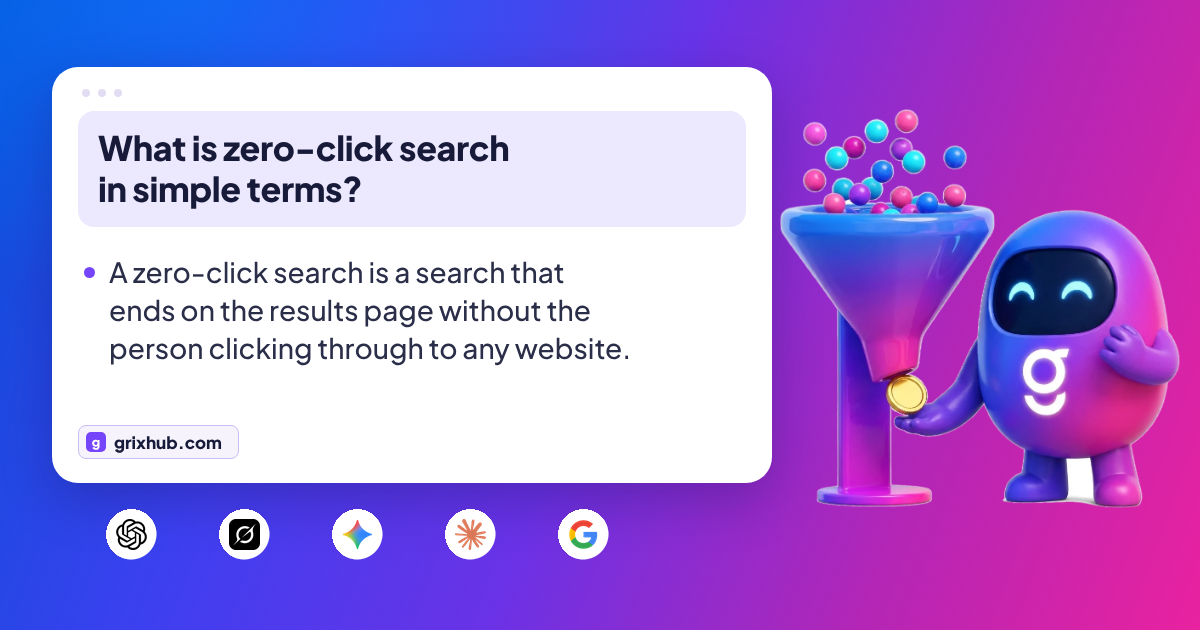
Zero-click search is a search that ends on the results page without the searcher clicking through to any website, because the answer box, map, video or AI summary already gave them what they needed. That is the zero-click search meaning in one line: you can be seen, or even quoted, and still get no visit.
For a long time, search had a simple deal. You helped Google answer questions, and Google sent you the visitor. Rankings turned into clicks, clicks turned into customers, and everyone knew what a good month looked like.
That deal has been changing for more than a decade. First came instant answers and featured snippets. Then knowledge panels, map packs and “People also ask” boxes. Now AI Overviews, AI Mode and chatbots such as ChatGPT write the whole answer and show links as footnotes.
The result is a quiet shift that shows up in almost every Search Console account we open: impressions climb, positions hold, and clicks slide. Owners assume something is broken. Usually nothing is broken. The searcher simply stopped needing the click.
Below, you’ll learn exactly what counts as a zero-click search, how common it is in 2026, why the studies disagree, what Google says, and the practical steps that keep a brand visible and profitable when fewer people click. Every number is linked to the study it came from.
 How we put this guide together
This guide is written by Jade Teekhasaenee, who leads SEO and AEO at Grixhub in Bangkok. Our team technically audits websites for brands in Thailand and around the world, and we regularly check how those brands appear in Google AI Overviews, Google AI Mode, ChatGPT and Gemini. It draws on Google’s own Search Central documentation, named studies from SparkToro, Pew Research Center, Ahrefs, Seer Interactive, Semrush, Similarweb and Bain, and a 2026 field experiment from the Indian School of Business and Carnegie Mellon University. Every statistic was checked against its original source on 9 November 2026, and we note where a study is a draft, uses a small panel, or is disputed by Google.
What is zero-click search?
Zero-click search is any search that ends without a click to a website. The searcher gets the answer on the results page itself, or gives up and searches again.
A zero-click search is a search where the person types a query, looks at the results, and leaves without clicking any result that takes them to another website. The search still happened. Google still showed results. But no website received a visitor from it.
The name comes from clickstream research. Analysts watch anonymized browser panels and record what happens after each search. Did the person click an organic result? An ad? A Google property such as Maps or YouTube? Did they change the query? Or did they do nothing at all? The “nothing at all” bucket, and in some studies the “searched again” bucket, is what gets called zero-click.
A search session that ends on the search results page, or in a new search, without a click to any website. Common causes are featured snippets, knowledge panels, map packs, calculators, weather and sports boxes, and AI-written answers such as Google AI Overviews.
It helps to picture a real case. Say you run a small boutique hotel by the river in Bangkok. (This is a hypothetical example we will use throughout the guide.) Someone searches “check-in time riverside hotel bangkok”. Google shows your hotel’s Business Profile with the check-in time, a map pin and a call button. The guest reads 2:00 pm, taps Directions, and arrives that afternoon. You got a guest. Your website got zero clicks.
Now picture a second searcher who types “is it worth staying near the river in bangkok”. An AI Overview writes four short paragraphs about the river area, transport, and price ranges, and lists three sources underneath. The searcher reads it, nods, and closes the tab. Nobody got a click. Whether anybody got anything out of it depends on whose facts and whose brand ended up inside that answer.
A classic click search vs a zero-click search
Classic search
riverside hotel bangkok
- Blue link 1
- Blue link 2 click
- Blue link 3
Zero-click search
is it worth staying near the river in bangkok
AI Overview answers on the page
Short written answer with 3 sources
[1][2] your page[3]
Searcher leaves without a click
Illustration of the two outcomes; the hotel example is hypothetical.
Both searches above are zero-click. One was great for the business and one may have been neutral or useful, depending on whether the brand was named. That is the first thing to understand: zero-click describes what happened to the click, not whether the search had value for you.
If you are new to the idea of optimizing for answers rather than links, our plain-English guide to answer engine optimization explains the bigger shift that zero-click search is part of.
Zero-click search meaning: what counts as a zero click?
It depends on the study. Most count searches with no click at all; some also count searches that end in a new query, and some treat clicks to Google's own properties separately.
The zero-click search meaning sounds simple, yet studies count it in slightly different ways, and that changes the headline number by many percentage points. Before you quote any figure, it helps to know which version you are looking at.
No click at all. The strictest meaning. The person searched and did nothing else: no click on a result, no new search. This is the purest “Google answered it” case, though it also includes people who simply gave up.
No click, or a new search. Many studies, including SparkToro’s, count a search that leads straight into another search as zero-click too. In its 2024 study, SparkToro found that about 37% of US searches led to no action and 21.4% led to another Google search, which is how it reached the larger zero-click figure, according to Search Engine Roundtable’s write-up of the study.
Clicks to Google’s own properties. A click on Google Maps, YouTube, Google Images or Google Flights is a click, but not a click to the open web. SparkToro’s 2024 report found that nearly 30% of all US clicks went to Google-owned properties, as Search Engine Land reported. Some writers lump these into “no click to your website”, which makes the problem sound even bigger.
Session rules. Clickstream studies also need a rule for when a session ends. SparkToro’s 2026 study ended a mobile search session after 10 seconds of inactivity, while Semrush’s 2022 study tracked the next two actions and dropped gaps longer than two minutes. Small rules like these shift the result.
When you share a zero-click number with your boss or a client, say which study, which country, which year and which devices it covers. “68% of US Google searches on desktop and mobile web, January to April 2026, SparkToro with Similarweb data” is a fact. “70% of searches are zero-click” is a guess.
For your own business, a practical meaning works better than a research one. Ask: did this search end without anyone reaching a page I control? If yes, it was zero-click for you, even if the person clicked through to Maps or a review site. That framing helps when you decide where to show up, which we cover later.
Where did zero-click search come from?
Zero-click grew in steps: instant answers and featured snippets, then knowledge panels, map packs and People Also Ask, and since 2024 AI Overviews, AI Mode and chatbots.
Zero-click search was not invented by AI. It grew out of years of Google adding more answers directly to the results page, each one a reasonable product choice on its own, and together a big change in how much traffic leaves Google.
The early steps were small. Calculators, unit converters, weather, sports scores and flight status all appeared in the results. Nobody needed a website to learn that it was 31°C in Bangkok, so nobody clicked.
Then came featured snippets. Google describes them as boxes that flip the normal layout and show the descriptive snippet first, and its featured snippets documentation is blunt that you cannot mark up a page to become one: Google’s systems decide. A good snippet often answered the question so well that the click became optional.
Knowledge panels, local map packs, “People also ask” boxes, image and video carousels followed. By 2019, SparkToro’s Jumpshot-based analysis put US zero-click searches at 49%, according to SparkToro’s 2026 report, which recaps the history.
The biggest step came with generative AI. Google rolled out AI Overviews in the US in May 2024 and, by its own May 2025 announcement, expanded them to more than 200 countries and territories and more than 40 languages. On Alphabet’s Q2 2025 earnings call on 23 July 2025, Sundar Pichai said AI Overviews had over 2 billion monthly users and that AI Mode already had over 100 million monthly active users in the US and India.
Chatbots took the idea to its end point. In ChatGPT, Gemini or Perplexity, there is no list of ten links to click in the first place. There is an answer, and sometimes a few small source links. If you want to understand how those systems pick what to show, our explainer on how AI search engines work walks through it step by step.
So zero-click search is the long trend, and AI is the latest and fastest part of it. That matters because it tells you the fix is not a one-off trick for AI. It is a change in what you are trying to win.
How common are zero-click searches in 2026?
Very common. SparkToro and Similarweb data show 68.01% of US Google searches ended without a click from January to April 2026, up from 60.45% in 2024.
Zero-click searches are now the majority of Google searches in the US. The newest large study, published by SparkToro’s Rand Fishkin in June 2026 using Similarweb panel data, found that 68.01% of US Google searches ended without a click between January and April 2026.
That figure covers desktop and mobile web browsers. It excludes searches made in the Google mobile app, which SparkToro notes likely have an even higher zero-click rate. The study also found that clicks of any kind, including organic, paid and Google-owned properties, fell 9.51 points versus 2024, a 22.9% decline, and that searches leading to another search rose 7.2 points.
US Google searches ending without a click
Source: SparkToro, “In 2026, Less than One Third of Google Searches Still Send a Click”. Each year used a different panel (Jumpshot, Datos, Similarweb desktop and mobile web, Jan to Apr 2026), so read it as a trend, not a like-for-like series.
The 2024 edition of the same research, built on Datos clickstream data, found 58.5% of US searches and 59.7% of EU searches ended without a click. It also estimated that for every 1,000 US Google searches, only 360 clicks went to the open web, meaning a site that is not Google-owned and not an ad. Rand Fishkin shared the study on X when it came out:
— Rand Fishkin (@randfish) July 2, 2024
Similarweb, whose data powered the 2026 study, reported its own trend in July 2025. Its analysis found that zero-click searches grew from 56% to 69% between May 2024, when AI Overviews launched in the US, and May 2025, according to Search Engine Roundtable’s summary of the report. The same report found organic visits to news sites fell from over 2.3 billion in mid-2024 to under 1.7 billion.
— Similarweb (@Similarweb) July 2, 2025
Consumer surveys point the same way. Bain and Company’s February 2025 report, based on a December 2024 survey of 1,117 US consumers, found that about 80% of consumers rely on zero-click results in at least 40% of their searches, and estimated that this reduces organic web traffic by 15% to 25%.
Zero-click search by the numbers
All figures are linked to their original sources in this section.
A note on geography: almost all of this research is about the US, with some EU data. We have not found a public clickstream study of zero-click rates in Thailand, so we will not guess one. What we can say is that the features behind zero-click search, such as map packs, knowledge panels and, in many markets, AI Overviews, are available worldwide, so the same forces apply.
Why do people stop clicking on search results?
Because the results page already answers them, because they refine the search instead, or because the click goes to a Google property such as Maps or YouTube.
People stop clicking for three main reasons: the answer is already on the page, the results were not good enough and they search again, or the next step happens inside Google rather than on a website.
The answer is on the page. If the question has a short, factual answer, a featured snippet, a knowledge panel or an AI Overview can settle it in seconds. Semrush’s 2022 study of 20,000 US users described the worst case plainly: the user found the answer on the results page and never went to a website.
They refine the query. Not every zero-click search is a happy one. In the same Semrush study, 27.6% of desktop searches went through some form of refinement. On mobile, 29.3% of follow-up actions were a new keyword, compared with 17.9% on desktop. A person who rewrites their query twice is not satisfied; they just have not found it yet.
The click stays inside Google. A tap on “Directions”, “Call” or a YouTube video is a real action, but it lands in a Google product. For local businesses this is often the best possible outcome. Google Business Profile reports these actions as calls, direction requests, website clicks, messages and bookings, as listed in Google’s Business Profile performance help page.
Mobile behavior. Phones change the math. Small screens put the answer box, the map and the AI summary above everything else. SparkToro’s 2026 data excludes the Google app entirely and still lands at 68%, which suggests the real mobile figure is higher.
Back to our hypothetical riverside hotel. When someone searches its name plus “parking”, the Business Profile and an AI answer cover it. When someone searches “boutique hotel bangkok with river view pool”, they want photos, prices and reviews, so they are far more likely to click. The type of question, not the platform, decides most of the outcome.
Zero-click also includes people who leave unhappy. Pew Research Center found users ended their browsing session on 26% of visits to a results page with an AI summary, compared with 16% without one. We cannot tell from that whether they were satisfied or gave up, and neither can Pew.
Which search features cause zero-click results?
The main ones are AI Overviews, AI Mode, featured snippets, knowledge panels, People Also Ask, local map packs, and image and video carousels.
Most zero-click results come from a short list of search features that answer the question, or start the next action, on the results page itself. Knowing which one appears for your important searches is the first step in deciding what to do.
The search features behind zero-click results
Feature list based on Google Search Central documentation and Semrush’s zero-click guide, May 2026.
AI Overviews. A written summary at the top of the page, with supporting links. Google’s AI features documentation says a page only needs to be indexed and eligible to show a snippet to be used as a supporting link, and that there are no extra technical requirements. We dig into how they affect clicks in the next section.
AI Mode. A separate, conversational search experience. Google says both AI Overviews and AI Mode may use “query fan-out”, issuing multiple related searches across subtopics to build the answer. That means your page can be pulled in for a sub-question you never targeted.
Featured snippets. One page’s text quoted above the results. You can’t mark a page up to get one, but clear, direct answers under clear headings make it more likely. The same writing habits help with AI answers, which is why we teach them together in our guide to answer-first content.
Knowledge panels. Facts about an entity, often pulled from many sources. If your brand has one, the details in it should match your website exactly.
People also ask. Expanding questions with short answers. Each answer can satisfy a related question without a click, though a good one also earns some clicks from curious readers.
Local map pack and Business Profile. For “near me” and local searches, the map pack often is the result. Calls and direction requests happen right there.
Image and video results. Clicks go to Google Images or YouTube. If you make videos, that can still be your brand, just not your website.
Make a simple sheet of your 30 most valuable searches and note which of these features appears for each one, on mobile and desktop. That one hour of work tells you more about your zero-click exposure than any industry average.
How do AI Overviews change zero-click search?
They reduce clicks. Pew found people clicked a regular result in 8% of visits with an AI summary versus 15% without, and Ahrefs measured about 58% lower clicks for the top result.
AI Overviews make zero-click searches more likely, and every major independent study we reviewed finds fewer clicks when one appears. The size of the drop varies by method, but the direction is consistent.
Pew Research Center (July 2025). Pew tracked 900 US adults who shared their browsing activity in March 2025, covering 68,879 unique Google searches. In its published findings, users clicked a traditional result in 8% of visits when an AI summary appeared and 15% when it did not. They clicked a link inside the AI summary itself in only about 1% of visits.
How often people clicked a result (Pew, March 2025)
Source: Pew Research Center, 900 US adults, 68,879 searches, March 2025 browsing data.
Ahrefs (February 2026). Ahrefs compared 300,000 keywords using aggregated Search Console data. For keywords with an AI Overview, the average desktop click-through rate for position one fell from 7.3% in December 2023 to 1.6% in December 2025. For similar informational keywords without an AI Overview, it fell from 7.6% to 3.9%. After adjusting for the general decline, Ahrefs estimates about 58% lower clicks for the top result when an AI Overview is present, up from the 34.5% it measured in April 2025.
Position 1 click-through rate, with and without an AI Overview
About 58% lower clicks for position 1 when an AI Overview shows
Source: Ahrefs, 300,000 keywords, desktop Search Console data, published Feb 2026.
Seer Interactive (November 2025). Seer studied 3,119 informational queries across 42 organizations and 25.1 million organic impressions from June 2024 to September 2025. In its September 2025 update, organic click-through rate on queries with an AI Overview fell from 1.76% to 0.61%, a 61% drop. Queries without an AI Overview also fell, from 2.72% to 1.62%, which shows that clicks are falling across the board, not only where AI appears.
Organic click-through rate, June 2024 vs September 2025 (Seer)
Down 61% with an AI Overview, down 41% without one
Source: Seer Interactive, 3,119 informational queries, 42 organizations, 25.1M organic impressions.
A randomized field experiment (April 2026). Researchers Saharsh Agarwal and Ananya Sen, from the Indian School of Business and Carnegie Mellon University, ran a two-week experiment with 1,065 US desktop Chrome users in January and February 2026. A browser extension hid AI Overviews for one group. As Search Engine Journal reported, zero-click searches rose from 54% to 72% when AI Overviews were shown, and outbound organic clicks fell 38% on queries that triggered one. The paper is an unreviewed SSRN draft limited to desktop Chrome users, so treat it as strong but early evidence.
What should you take from this? Not panic. Take a plan. Clicks from informational searches are shrinking, and AI Overviews speed it up. For a deeper look at the traffic side and recovery tactics, read our guide on how to optimize for AI Search.
Do AI Mode and chatbots make zero-click search worse?
Yes, per session. Semrush found 92% to 94% of AI Mode sessions ended without a visit to another site, though AI Mode is still a small share of Google searches.
AI Mode and chatbots push zero-click behavior further than AI Overviews, because the whole experience is built around the answer rather than the links. The good news, for now, is that AI Mode is still a small slice of total Google searching.
Semrush analyzed almost 69 million US desktop Google sessions from 1 May to 5 July 2025. In its AI Mode study, only 6% to 8% of AI Mode sessions led to a visit to an external domain, meaning 92% to 94% were zero-click. Semrush compares this with about 34% zero-click for Google searches without an AI Overview and about 43% with one, while noting those figures come from different studies and timeframes.
Zero-click rate by Google search experience (Semrush)
Source: Semrush, 69M US desktop sessions, May to Jul 2025. Semrush notes the three figures come from different studies and methods.
Scale matters, though. In the same study, AI Mode grew from about 0.25% of Google search sessions in early May 2025 to just over 1% in early July. SparkToro’s 2026 data found only 0.34% of US searches moved into AI Mode between January and April 2026. Different panels, different methods, but both say AI Mode is still a minority experience on Google.
Chatbots are a different story. They have no blue links to begin with, so almost every conversation is zero-click by design. Yet they also send some traffic that did not exist before. Similarweb reported that referrals from ChatGPT to news publishers rose 25 times year over year by mid-2025, according to the same Search Engine Roundtable summary we cited above. That is still small next to Google, but it is growing.
Do not read “93% zero-click in AI Mode” as “AI Mode will cost you 93% of your traffic”. The figure describes AI Mode sessions only, on desktop, in mid-2025. What it does tell you is the direction: the more search becomes a conversation, the more the brand inside the answer matters and the less the link under it does.
If you want to compare the platforms in detail, our guide to AEO vs SEO vs GEO explains how optimizing for Google’s results, AI Overviews and chatbots overlap and where they differ.
What does Google say about zero-click searches?
Google says total organic clicks are relatively stable and that clicks from AI features are higher quality, but it has not published data to support either claim.
Google’s position is that the web is not losing clicks overall and that the clicks it sends are better than before. Independent researchers and many site owners dispute that, mainly because Google has not shared the data behind it.
On 6 August 2025, Liz Reid, VP and Head of Google Search, wrote that total organic click volume from Google Search to websites has been “relatively stable year-over-year”, and that Google is “sending slightly more quality clicks to websites than a year ago”. Google defines quality clicks as ones where users don’t quickly click back. The post gives no percentages and argues that third-party studies showing dramatic declines use flawed methods.
Google’s documentation repeats the quality point. Its AI features page, last updated on 10 December 2025, says clicks from pages with AI Overviews are higher quality, meaning users are more likely to spend more time on the site, and suggests site owners track conversions and time on site rather than clicks alone.
Google also argues that AI makes people search more. Hema Budaraju, a Google Search product VP, wrote in May 2025 that in big markets such as the US and India, AI Overviews drive an over 10% increase in usage of Google for the queries that show them. More searches can mean more impressions for you, even if each search sends fewer clicks.
The industry response was skeptical. Search Engine Roundtable’s Barry Schwartz noted that Google shared no charts or Search Console figures, that the comparison baseline already included a year of AI Overviews, and that Search Console counts AI Overview and AI Mode activity inside regular web data with no way to separate it.
Total organic clicks are relatively stable year over year. Clicks are higher quality. AI Overviews increase Google usage by over 10% for queries that show them. No figures published for clicks from AI features on their own.
68.01% zero-click in US Google searches (SparkToro, 2026). 8% vs 15% clicks with vs without an AI summary (Pew, 2025). About 58% lower clicks for the top result with an AI Overview (Ahrefs, 2026). 61% lower organic CTR on AI Overview queries (Seer, 2025).
Both things can be partly true. Google can send a similar total number of clicks because people search more often, while individual sites, especially those that answer simple informational questions, lose a large share of theirs. That is roughly what we see in practice: the total pie may be stable, but the slices have moved.
Google’s Search Central team covered AI Overviews and what they mean for site owners in its July 2024 Search News episode, which is a useful primary source if you want Google’s framing in its own words.
Google Search Central · YouTube
Google Search Central · AI Overviews, e-commerce site updates, and more! (July ’24) · watch on YouTube
Why do zero-click statistics differ so much between studies?
Because studies use different data panels, countries, devices, time periods and definitions of a click. Compare like with like, and read each number with its method.
Zero-click numbers range from about 25% to over 90% because each study measures something slightly different. None of them is wrong. They answer different questions, and you need to know which question before you use the number.
| Study | Data and sample | Period | Headline finding |
|---|---|---|---|
| Semrush zero-clicks study | Clickstream, 20,000 US users | May 2022 | 25.6% zero-click on desktop |
| SparkToro 2024 | Datos clickstream, US and EU | Through May 2024 | 58.5% US, 59.7% EU |
| Similarweb | Similarweb panel | May 2024 to May 2025 | 56% rising to 69% |
| Pew Research Center | 900 US adults, 68,879 searches | March 2025 | 8% vs 15% clicks with vs without AI summary |
| Semrush AI Mode | 69M US desktop sessions | May to July 2025 | 92% to 94% of AI Mode sessions zero-click |
| SparkToro 2026 | Similarweb desktop and mobile web, US | Jan to Apr 2026 | 68.01% zero-click |
| Agarwal and Sen (draft) | 1,065 US desktop Chrome users, randomized | Jan to Feb 2026 | 54% vs 72% without vs with AI Overview |
Different panels. SparkToro’s own history uses Jumpshot for 2019, Datos for 2024 and Similarweb for 2026. Each panel recruits different people with different devices. SparkToro says so clearly and calls its long-run chart a trend rather than a like-for-like series.
Different devices. Desktop and mobile behave differently, and the Google app is often excluded. Semrush’s 2022 study shows how messy this can get: the article gives a 57% mobile zero-click figure in one place and 17.3% in another, which is a good reminder to read methods, not just headlines.
Different definitions. As we covered earlier, some studies count a new search as zero-click and some don’t. Some count clicks to Google Maps or YouTube as clicks, some don’t.
Different query sets. Ahrefs and Seer measure click-through rate on specific keyword sets, mostly informational. Those will always show bigger drops than all searches, because informational queries are where AI Overviews show most.
For planning, ignore the industry average and measure your own exposure. Your Search Console data, filtered to your most valuable pages, is a better guide to your future than any study of all US searches.
Is zero-click search bad for your business?
Not always. It hurts most when you earn money from page views on simple questions. For local, brand and buying searches, a zero-click result can still bring a call, a visit or a later branded search.
Zero-click search is bad for some business models and close to harmless, or even helpful, for others. The deciding factor is what a click from that search was worth to you in the first place.
Who it hurts most. Publishers and content sites that earn from ads on page views lose the most, because the simple informational questions that brought them volume are exactly the ones AI Overviews answer best. Similarweb’s numbers for news sites, falling from over 2.3 billion organic visits to under 1.7 billion, show how hard that can hit.
Who it hurts less. Local businesses often win the action without the click. Our hypothetical riverside hotel does not care whether the guest booked from its website or called from the map pack, as long as the guest arrives. Business Profile calls and direction requests are zero-click in research terms, and very much not zero value.
Where it can help. Being named inside an answer is a form of exposure, like a mention in a news article. Seer Interactive found that, on queries with an AI Overview, brands that were cited earned 35% more organic clicks and 91% more paid clicks than brands that were not cited, in Q3 2025. Seer is careful to say it cannot prove the citation causes the extra clicks, since stronger brands are probably cited more often. Still, it suggests the brand inside the answer keeps more of the remaining clicks. If you still need the paid-click side, our Google Ads management service can run those campaigns.
Where it is neutral. Some searches were never going to make you money. Someone checking the time difference between Bangkok and London was never a customer for anyone. Losing that click costs you nothing but a line in a traffic chart.
The useful question is not “how many clicks did I lose?” but “how many of the clicks I lost were from people who would have become customers?” When we run audits, that question usually shrinks a scary-looking traffic drop into a smaller, more manageable list of pages that truly matter. If you are wondering whether this means search is finished, our answer to is SEO dead explains why it isn’t, and what has really changed.
Which searches are most likely to end without a click?
Short factual questions, definitions, quick facts, local details and long question-style searches that trigger AI summaries. Searches for prices, comparisons and bookings still earn more clicks.
Searches with a short, settled answer are the most likely to end without a click, along with longer question-style searches that trigger an AI summary. Searches where people need to compare, see details or take action still lead to more clicks.
Pew’s data shows how much query wording matters. Only 8% of one- or two-word searches produced an AI summary, compared with 53% of searches with ten or more words. Among searches starting with a question word such as who, what, when or why, 60% produced a summary.
Share of Google searches that showed an AI summary, by query type (Pew)
Source: Pew Research Center, 68,879 US Google searches, March 2025 browsing data.
That lines up with what we see when we check searches for brands. Here is a rough guide, built from the studies above and our own checks, to which kinds of searches tend to keep or lose clicks.
High zero-click risk. Definitions (“what is a deposit policy”), quick facts (“bangkok airport to old town distance”), simple how-to steps, opening hours, and broad “is it worth” questions. These are where AI Overviews and featured snippets do their best work.
Medium risk. “Best” lists and general comparisons. AI answers often summarize them, but people who are close to buying still want to see the options, photos and reviews for themselves.
Lower risk. Searches with clear buying or booking intent, searches for your brand by name, searches that need a tool or calculator, and anything where the person needs to see visual detail, such as room photos or a product page. Semrush’s own guide on zero-click searches makes a similar point: original research, interactive tools and detailed guides hold up better than short “what is” answers.
This is also why long, question-shaped searches matter for AEO. They are more likely to trigger AI summaries, so they are where being cited inside the answer counts most. Finding them is a skill of its own, covered in our guide to prompt research.
How do you know if zero-click search is hurting your traffic?
Check Google Search Console for pages where impressions and average position hold steady but clicks and CTR fall. Then confirm by looking at the live results page for those queries.
The clearest sign of zero-click impact is a page whose impressions and average position stay steady while its clicks and click-through rate fall. That pattern means you are still being shown, in the same spot, but people stopped needing to click.
Here is the process we use when a brand asks why its traffic is down even though rankings look fine.
- In Google Search Console, open the Performance report and compare the last three months with the same three months a year earlier.
- Switch to the Pages view and sort by the biggest drop in clicks.
- For each of the top 20 pages, check whether impressions and average position held steady. If they did and CTR fell, flag the page as likely zero-click impact.
- Open the main queries for each flagged page and search them yourself, on mobile and desktop, logged out. Note whether an AI Overview, featured snippet, map pack or video block appears above you.
- Note whether your brand or page is named or linked inside that feature.
Two cautions. First, Google’s documentation says AI feature traffic is reported inside the “Web” search type in Search Console, so you cannot simply filter AI Overview clicks out. Second, a falling CTR can also be caused by new competitors, new ads or a weaker title. That is why step four, looking at the real page, matters.
A traffic drop with falling average position is usually not a zero-click problem. It is a ranking problem, and it needs the normal SEO fixes first. Don’t blame AI for a technical issue such as a broken canonical or a page that dropped out of the index.
For local businesses, add one more check. Open your Business Profile performance and compare calls, direction requests and website clicks over the same periods. If website clicks fell but calls and directions rose, people are still choosing you; they’re just doing it on the results page.
A quick way to see how your listing appears before anyone clicks is our free SERP snippet preview tool. A clear title and description still decide many of the clicks that remain.
What should you do about zero-click search?
Stop chasing every lost click. Be the answer that gets cited, keep building pages that deserve a click, show up where decisions happen, and measure visibility and conversions, not sessions alone.
The best response to zero-click search is to change what you are trying to win: be named and cited inside the answer, make the pages that remain worth clicking, and measure the business results rather than the raw clicks. Trying to force clicks back usually fails.
What to do about zero-click search
- 1Measure exposurewhich key searches end on the page
What you controlyour query list and checks
- 2Be the answerclear, quotable passages
What you controlanswer-first writing
- 3Be the brand namedmentions on trusted sites
What you controlPR, reviews, profiles
- 4Earn the click that’s lefttools, data, detail
What you controlpages worth visiting
- 5Track new metricscitations, branded search, leads
What you controlyour reporting
Grixhub’s working process, based on the studies cited in this guide.
1. Measure your exposure. Use the Search Console process in the previous section to find which of your valuable searches now end on the results page. This gives you a short list instead of a vague worry.
2. Be the answer. If an AI Overview or a featured snippet is going to answer the question anyway, you want it to be built from your page. That means opening each section with a direct, specific answer and backing it with facts a machine can quote. This is the heart of answer engine optimization.
3. Be the brand that gets named. AI answers lean on what other sites say about you. Reviews, directory listings, press mentions and forum discussions all feed the picture. A brand that appears consistently across trusted sources is more likely to be named in the answer.
4. Earn the clicks that are left. Some searches will always need a visit. Build the pages that deserve it: tools, original data, detailed comparisons, real prices, real photos.
5. Track what matters now. Replace “sessions from organic” as your only number with a set of measures that include visibility inside AI answers, branded search, and conversions. We cover that set in detail further down.
This is the work our AEO service is built around, but none of it needs special software to start. The next sections go through the most important steps in more detail.
How do you get cited in AI Overviews and AI answers?
Make sure Google and AI crawlers can reach and index your pages, answer each question directly at the top of a section with specific facts, and earn mentions on sites AI tools trust.
To get cited in AI Overviews and other AI answers, your page has to be reachable and indexed, it has to contain a clear, specific passage that answers the question, and your brand has to be trusted enough, on your site and elsewhere, to be chosen over others.
Be eligible first. Google says a page must be indexed and eligible to show a snippet to appear as a supporting link in AI Overviews or AI Mode, and that no special schema, AI text file or markup is required. So the first checks are basic SEO ones: can Googlebot crawl the page, is it indexed, and are you accidentally blocking snippets with nosnippet or a very low max-snippet setting? For ChatGPT and Perplexity, also check that their crawlers are not blocked, which our free AI crawler checker does in a minute.
Answer first, then explain. AI systems pull passages, not whole pages. A section that opens with a one or two sentence answer, then adds detail, is much easier to quote than one that builds slowly to a point. Our riverside hotel’s “Is it worth staying near the river in Bangkok?” page should open with a direct verdict and the facts behind it: distance to the nearest pier, typical travel time to the main sights, and the price range for river-view rooms.
“Our hotel offers a unique experience in a vibrant part of the city, blending tradition and modern comfort for every kind of traveler.”
“Yes, if you plan to use the river boats. Our hotel is a 4-minute walk from the nearest pier, and the boat reaches the Grand Palace area in about 15 minutes. River-view rooms start from the rate shown on our booking page.”
Use specific facts. Numbers, times, prices, names and dates give an AI system something concrete to quote and give readers a reason to trust you. Vague claims give it nothing.
Keep facts consistent. If your website, Business Profile, booking sites and social profiles disagree on check-in times or prices, AI answers may pick the wrong one or skip you. Consistency is boring and it works.
Earn outside mentions. Reviews, local guides, travel blogs, forums such as Pantip and Reddit, and press coverage all help AI systems understand who you are and whether to recommend you.
Each of these steps has a full guide. Start with how to rank in Google AI Overviews, then check your pages with our free AEO content checker. If you want structured data that matches your visible content, our guide to schema markup for AEO explains what helps and what doesn’t.
Which pages still earn clicks when search goes zero-click?
Pages that offer something an answer box can't: tools and calculators, original data, detailed comparisons, real prices and photos, bookings and personal experience.
Pages still earn clicks when they offer something a summary cannot replace: a tool to use, data to explore, detail to compare, or an action to complete. If your page only repeats a fact, expect the results page to take that job.
Tools and calculators. A cost estimator, a size chart, an availability checker. People need to interact with them, so they click.
Original data and research. If you publish numbers nobody else has, AI answers may quote them, but curious readers and journalists still click to see the source. Original research also earns the links and mentions that help with citations.
Detailed comparisons. A summary can say “Room A has a balcony and Room B does not”. It can’t show the photos side by side, the floor plans and the real rates for next weekend.
Transactional pages. Booking, buying, signing up and contacting all require a visit. Make sure these pages load fast, show prices clearly and work on a phone, because the people who reach them are the ones who still click.
First-hand experience. Google’s Liz Reid wrote that users increasingly look for forums, videos and first-hand perspectives. A guide written by someone who has actually done the thing, with real photos and specific details, is more likely to be worth the click than a generic overview.
None of this means you should stop answering simple questions. Those answers are what get you cited. The idea is to pair them: a clear, quotable answer at the top of the page, and a reason to keep reading or take action underneath it.
How should you measure success when clicks fall?
Track visibility inside AI answers (mentions and citations), impressions, branded search, conversions and Business Profile actions alongside clicks, and compare month over month.
When clicks fall because of zero-click search, success has to be measured by visibility and outcomes rather than sessions alone. Keep tracking clicks, but add measures that show whether you are still being seen and chosen.
Old SEO metrics vs zero-click era metrics
Keep clicks in the report. Just stop letting them be the only number.
Impressions. If impressions grow while clicks fall, you are still being shown. That is a visibility win, even if it doesn’t look like one.
Mentions and citations in AI answers. Track a fixed list of the questions your customers ask, and record whether your brand is named and whether your page is linked in Google AI Overviews, AI Mode, ChatGPT and Gemini. Because AI answers vary from run to run, run each question more than once. Our own tool, GrixTrack, runs each prompt three times for that reason, and its free plan covers 10 keywords, 5 prompts, 1 project and 2 competitors. Our guide on how to measure AI visibility explains the method if you prefer to do it by hand.
Branded search. Some people who see your name in an AI answer will search for you directly later instead of clicking the source link. We have not seen a public study that measures how many, so treat rising branded impressions in Search Console as a useful sign, not proof, that zero-click exposure is working.
Conversions and actions. Google itself recommends tracking conversions and time on site rather than clicks alone. For local businesses, add Business Profile calls, direction requests and bookings.
AI referral traffic. Visits from chatgpt.com, perplexity.ai and gemini.google.com are small for most sites but growing, as Similarweb’s 25x rise in ChatGPT referrals to news publishers shows. Set up a separate channel group for them in your analytics so you can see how they convert on your own site.
For a wider view of where AI search usage is heading, our roundup of AI search statistics collects the latest numbers in one place.
Where should you start with zero-click search?
In the first 30 days: list your 30 most valuable searches, check which ones end on the results page, fix eligibility issues, rewrite your 5 most exposed pages answer-first, and set a new baseline.
Start small: find the searches that matter most to your business, see which of them now end without a click, and fix the pages behind those first. A focused 30-day plan beats a vague promise to “do AEO”.
Your first 30 days in a zero-click world
- Week 1
- 1List your 30 most valuable searchesbuying, local and top questions
- 2Check each on mobile and desktopAI Overview, snippet, map pack, video?
- Week 2
- 3Fix eligibilityindexing, crawler access, snippet controls
- Weeks 3 to 4
- 4Rewrite your 5 most exposed pages answer-firstdirect answer, specific facts, clear headings
- 5Set a new baselineimpressions, AI mentions, branded search, leads
Grixhub’s starting plan. Timelines are a guide, not a promise of results.
Week 1: map your exposure. Write down the 30 searches that bring you customers or would if you ranked for them. Include a few long, question-style ones. Search each on a phone and a laptop, logged out, and note what appears above the links.
Week 2: fix eligibility. Make sure your key pages are indexed, not blocked from snippets, and reachable by the crawlers you care about. These fixes are quick and they’re the foundation everything else stands on.
Weeks 3 and 4: rewrite and baseline. Pick the five pages with the most exposure and rewrite each section to open with a direct answer and specific facts. Then record your starting numbers: impressions, clicks, AI mentions and citations, branded search and leads. Check again every month.
Expect a lag. Google has to recrawl a page before changes can show, and Google’s documentation says recrawling can take several days to several months. Mentions on other websites take longer still. Zero-click search is a long trend, so the response is a steady habit, not a sprint.
If you’d rather have a second pair of eyes, we can run this check for you and show which of your important searches already end in an AI answer, and whether your brand is in it.
Frequently asked questions

What is zero-click search in simple terms?
A zero-click search is a search that ends on the results page without the person clicking through to any website. They read the answer in a featured snippet, a knowledge panel, a map listing or an AI Overview, or they search again, and never visit a site.
What is the zero click search meaning in SEO?
In SEO, zero-click search means your page can be seen, and even quoted, without earning a visit. Impressions can rise while clicks fall, so rankings and traffic stop moving together. That is why SEO teams now track visibility, citations and conversions alongside clicks.
What percentage of Google searches are zero-click?
SparkToro and Similarweb data show 68% of US Google searches ended without a click in early 2026. The exact figure was 68.01% for January to April 2026, up from 60.45% in 2024 and 49% in 2019, though each year used a different data panel.
Do AI Overviews cause more zero-click searches?
Yes, most independent studies find fewer clicks when an AI Overview appears. Pew Research found people clicked a regular result in 8% of visits with an AI summary versus 15% without, and a 2026 field experiment found zero-click searches rose from 54% to 72% when AI Overviews were shown. Google disputes how large the effect is.
Is zero-click search bad for my business?
Not always, it depends on what the search was worth to you. Simple fact lookups were never likely to become customers, while local and buying searches often end in a call, a direction request or a later branded search. The risk is highest for sites that earn money from page views on simple informational questions.
How do I know if zero-click search is hurting my traffic?
Look in Google Search Console for pages where impressions are steady or rising, average position is steady, but clicks and click-through rate are falling. That pattern usually means the results page or an AI Overview is answering the question before people reach your link.
Can I stop Google from using my content in AI Overviews?
You can limit it with the nosnippet, data-nosnippet and max-snippet controls, but there is a cost. Google says these controls also apply to AI Overviews and AI Mode, so blocking snippets usually makes your regular listing less useful too. Most brands are better off aiming to be the cited source.
Sources and further reading
- SparkToro (Rand Fishkin): In 2026, less than one third of Google searches still send a click (June 2026, Similarweb data)
- Search Engine Land: Google zero-click searches reach 68% in early 2026
- Search Engine Land: Nearly 60% of Google searches end without a click (SparkToro and Datos, 2024)
- Search Engine Roundtable: Google zero click study now at 58.5% in 2024 (3 Jul 2024)
- Pew Research Center: Google users are less likely to click on links when an AI summary appears (22 Jul 2025)
- Ahrefs: Update: AI Overviews reduce clicks by 58% (Feb 2026)
- Seer Interactive: AIO impact on Google CTR, September 2025 update (4 Nov 2025)
- Search Engine Journal: AI Overviews cut organic clicks 38%, field study finds (Agarwal and Sen, SSRN draft, Apr 2026)
- Semrush: Google AI Mode study, 69M sessions (30 Jul 2025)
- Semrush: Zero-clicks study, 20,000 users (25 Oct 2022)
- Semrush: What is a zero-click search? (May 2026)
- Search Engine Roundtable: Similarweb: no clicks from Google grew from 56% to 69% since AI Overviews (3 Jul 2025)
- Google (Liz Reid): AI in Search is driving more queries and higher quality clicks (6 Aug 2025)
- Search Engine Roundtable: Google says clicks are stable with AI Overviews (7 Aug 2025)
- Google Search Central: AI features and your website (updated 10 Dec 2025)
- Google Search Central: Featured snippets and your website (updated 10 Dec 2025)
- Google: AI Overviews expand to 200+ countries and 40+ languages (20 May 2025)
- Alphabet: Q2 2025 earnings call (23 Jul 2025)
- Bain and Company: Goodbye clicks, hello AI: zero-click search redefines marketing (19 Feb 2025)
- Google Business Profile Help: Understand your Business Profile performance and insights
Keep reading

Written by Jade Teekhasaenee
Founder & Managing Director, Grixhub
Jade leads SEO and AEO strategy at Grixhub in Bangkok. He has technically audited websites for brands in Thailand and around the world, and he built GrixTrack to measure how often brands are mentioned and cited by ChatGPT, Gemini and Google AI Mode.
Losing clicks but not sure where to?
We will check which of your key searches now end in an AI Overview or a zero-click results page, show you whether your brand is named or cited there, and map what it takes to win those spots back.

Grixhub is a digital growth and technology company in Bangkok, Thailand: SEO, AEO, digital marketing, paid media management, websites, apps and AI automation.
Services
Digital marketing
SEO
AEO
Website development
App development
AI & automation
Paid Media Management
Google Ads
ChatGPT Ads
Facebook Ads
Instagram Ads
TikTok Ads
Contact
Email: jade@grixhub.com
Phone: +66 62 480 9604
LINE: Grixhub
Bangkok, Thailand
Company
About · Blog
Free AEO Audit call
Terms · GrixTrack Terms · Refund Policy · Privacy Policy · Cookie Policy · Image Licence
Follow us